Global problem of burying dead nuclear reactors
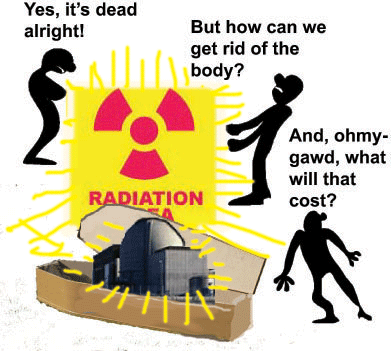
 Abandon nuclear energy programme, Unep boss urges Kenya , Standard, BY PETER ORENGO, 13 Feb 12 “……..According to the United Nations Environment Programme’s (UNEP) Year Book 2012, one of United Nations Environment Program (UNEP) ‘s emerging global concerns is the challenge of decommissioning the growing number of end-of-life nuclear power reactors….
The UNEP Year Book says the cost of decommissioning varies greatly, depending on the reactor type and size, its location, the proximity and availability of waste disposal facilities and the condition of both the reactor and the site at the time of decommissioning….. Continue reading
Russian government lied over danger of nuclear submarine fire

 Report: Russian sub carrying nuclear missiles during fire; govt had said none aboard , Washington Post, By Associated Press, February 13 MOSCOW — A fire at a drydocked Russian nuclear submarine in December could have sparked a radiation disaster because it was carrying nuclear-tipped ballistic missiles and other weapons, despite official
statements to the contrary, a Russian news magazine reported Monday.
The respected Kommersant Vlast said the fire aboard the Yekaterinburg could have triggered powerful explosions that would have destroyed the submarine and scattered radioactive material around a large area. When the fire erupted on Dec. 29, Russia’s Defense Ministry said all weapons had been unloaded before the submarine was moved to a drydock
for repairs at the Roslyakovo shipyard in the Murmansk region. Continue reading
Where to put Japan’s 22 metric tons of perhaps radioactive debris?
Radiation concerns keep municipalities from helping with disaster-area debris, Mainichi Daily News, 14 Feb 12, Concerns about radiation are preventing the massive amount of debris left in areas hit by the March 2011 tsunami from being sent to other areas for processing…..
According to the Ministry of the Environment, 22.52 metric tons of debris remained in the three prefectures of Iwate, Miyagi and Fukushima as of Jan. 31. The national government hopes to have debris from Iwate and Miyagi processed in other municipalities, as the amount
is 11 to 19 times the regular amount of waste generated in each of the prefectures in one year…. http://mdn.mainichi.jp/mdnnews/news/20120213p2a00m0na017000c.html
Unseemly haste for tax-payer to supply $8.3 billion nuclear loan
 the loan guarantee is nearing final approval, less than a week after the Nuclear Regulatory Commission (NRC) greenlighted the license for the project.
Energy Dept. nears approval of $8.3B nuke loan, setting up clash in Congress, The Hill, By Andrew Restuccia – 02/13/12 Energy Secretary Steven Chu said Monday he expects to finalize an $8.3 billion taxpayer-backed loan for two new nuclear reactors in Georgia, setting up another battle on Capitol Hill over the government’s investments in energy projects. Continue reading
The mental scars for Fukushima radiation evacuees
Japan Earthquake Anniversary: Nuclear Evacuees Scarred By Disaster One Year Later Huffington Post: 2/13/12 “….Nearly a year has passed since a massive 9.0 magnitude earthquake hit Japan, Okuma town, but the site of the reactors at the centre of the Fukushima nuclear crisis remains off limits for residents, save for short trips to hastily abandoned homes.
For the about 11,000 residents of Okuma, and the nearly 80,000 people across the prefecture who have been unable to return to their homes due to high radiation, the mental scars run deep even though many of their homes are physically intact.
Many do not know when, if ever, they can return to land that has been in their families for generations…….
The Japanese government declared the Daiichi nuclear plant to be in a state of “cold shutdown” late last year but the Environment Ministry has said about 2,400 square km (930 square miles) of land around the plant may need to be decontaminated — an area roughly the size of Luxembourg…. http://www.huffingtonpost.com/2012/02/13/japan-earthquake-anniversary_n_1272447.html#254326
Nuclear Regulatory Commission’s poor oversight of safety enforcement
US nuclear watchdog questions oversight of safety enforcement, msnbc.com, By M. Alex Johnson 13 Feb 12, The federal government’s nuclear watchdog has faulted the Nuclear Regulatory Commission for failing to follow through on safety agreements with nuclear facilities, saying its system for tracking corrective action raises questions about its oversight of nuclear safety and security. Continue reading
Class action in Israel, by cancer sufferers who worked for nuclear centre
Israel nuclear reactor sent unprotected workers to search for uranium ore, lawsuit claims Haaretz 13.02.12 Former employees at the Negev Nuclear Research Center in Dimona saywere given only dusk masks, goggles during an official search for the rare mineral.
By Gili Cohen Workers at the Dimona nuclear reactor were sent to search for uranium ore across Israel without the necessary protective gear, a court hearing discussing the class-action suit advanced by the reactor’s former employees indicated on Sunday.
The hearing in the Petah Tikva District Court was held on the complaint by 44 employees and their families that the workers are suffering from cancer and other diseases due to radiation at work . According to claims made by the plaintiffs, some of the reactor’s workers were employed at a “project to search for uranium ore inIsrael,” working week-long stints, equipped with only goggles and dusk masks…… http://www.haaretz.com/news/national/israel-nuclear-reactor-sent-unprotected-workers-to-search-for-uranium-ore-lawsuit-claims-1.412648
Kenya urged to adopt renewable energy, not nuclear
Abandon nuclear energy programme, Unep boss urges Kenya BY PETER ORENGO, 13 Feb 12, Kenya has been advised to shelve its intended development of nuclear power to meet its growing energy needs, but instead concentrate on the vast renewable energy resources.
According to the United Nations Environment Programme’s (UNEP) Year Book 2012, one of United Nations Environment Program (UNEP) ‘s emerging global concerns is the challenge of decommissioning the growing number of end-of-life nuclear power reactors.
Countries have also been reviewing their nuclear programmes following the tsunami that struck Fukushima and its nearby nuclear power plant in Japan, last year…. Considering dangers and cost involved, it will be surprising if Kenya opted for nuclear energy rather than the clean, cheap and available energy potential the country has,” said Achim Steiner, UN Under-Secretary General and UNEP Executive Director at Gigiri.
He said Kenya has the option of getting energy from bioenergy, geothermal, solar, hydropower, ocean and wind energy… …http://www.standardmedia.co.ke/politics/InsidePage.php?id=2000052072&cid=4
USA and North Korea to resume talks
U.S. to Meet North Koreans for New Talks By STEVEN LEE MYERS NYT, February 13, 2012 WASHINGTON — The Obama administration announced on Monday that it would hold its first talks with North Korea over its nuclear weapons program since the death of the
country’s leader, Kim Jong-il, in December.
The talks, to be held in Beijing on Feb. 23, will be the third since last summer to explore the
possibility of resuming negotiations to get North Korea to dismantle its nuclear arsenal. They will offer a chance to gauge whether Mr. Kim’s son and successor as supreme leader, Kim Jong-un, is more open, to diplomacy.
The United States, along with South Korea, Japan, Russia and China, has called on North Korea to suspend activities at its nuclear sites and allow international inspectors to verify a freeze as a condition for resuming talks on a broader agreement that would provide economic
and other assistance in exchange for dismantling the weapons program…. http://www.nytimes.com/2012/02/14/world/asia/united-states-to-hold-talks-with-north-korea-on-nuclear-program.html
Huge expense to extend life of France’s nuclear reactors, but cheaper than new ones
France to extend life of nuclear reactors beyond 40 years, M & C, Feb 12, 2012, Paris – French President Nicolas Sarkozy has decided to extend the life of the country’s 58 nuclear reactors beyond 40 years, Industry Minister Eric Besson said Sunday. France’s nuclear reactors were built with a 40-year life span in mind, but the nuclear safety authority can decide, on a case-by-case basis, to extend the life of a reactor.
‘The decision has been taken,’ Besson said, while acknowledging that the ASN had the final say….
.. EDF says to extend the life of a reactor would cost between 680 million euros (896 million dollars) and 860 million euros, a fraction of the cost of building a new reactor.
France gets three-quarters of its electricity from nuclear plants. A number of European countries, including Germany, pulled the plug on nuclear power in the wake of last year’s nuclear disaster in Japan but Sarkozy remains a staunch champion of atomic energy..
…. The role of nuclear power in the energy mix is a subject of debate in this year’s
presidential campaign. Sarkozy’s main challenger, Socialist candidate Francois Hollande, has
pledged to reduce the share of nuclear in the energy mix to 50 per cent by 2025….
http://news.monstersandcritics.com/business/news/article_1690615.php/France-to-extend-life-of-nuclear-reactors-beyond-40-years
Thorium nuclear reactors – not all they’re cracked up to be
What you then get, as well as heat energy, radiation, and fission products from the Plutonium and Uranium, is U232. U232 (and its decay products) emit very hard gamma radiation.
will anyone really trust the nuclear lobby when it says ‘we have the answer’, as so often before?
Nuclear Problems, Environmental Research Web, 12 Feb 12,”……With uranium fired reactors out of favour after Fukushima, for the longer term, some in the nuclear lobby have been promoting thorium as an allegedly safer fuel- looking at molten flouride salt systems.
The Weinberg Foundation was launched last year to promote the Liquid Flouride Thorium Reactor (LFTR) Continue reading
Anti nuclear campaign against Hinkley nuclear site
Anti-nuclear campaigners set up camp at Hinkley C site, BBC News 12 Feb 12, Protesters have set up camp in an abandoned farm on the site of the proposed Hinkley Point C nuclear power station in Somerset.
They are angry West Somerset Council has given EDF Energy the go-ahead for preparatory work before planning permission has been granted…. The South West Against Nuclear protesters arrived at the site in the early hours of Sunday……
A planning application for a new power station was submitted to the Infrastructure Planning Commission (IPC) in October. Further public consultation is taking place and a final decision will be made by the energy secretary.
Protester Zoe Stone said: “We are concerned EDF’s preliminary works are going to destroy a protected nature reserve, a site of Special Scientific Interest and all before they even have planning permission to build a power station….. http://www.bbc.co.uk/news/uk-england-somerset-17002517
Iowa’s surplus electricity – more evidence it doesn’t need nuclear power
Opponents Question Need For Iowa Nuclear Plant, KCCI.com February 12, 2012 DES MOINES, Iowa –– Lawmakers and advocacy groups are questioning whether a nuclear energy bill is necessary to address electricity needs.
MidAmerican Energy is pursuing legislation allowing the company to recover costs related to a nuclear plant regardless of whether it’s completed. The Iowa Utilities Board would need to sign off before a plant could be built.
But data show Iowa’s electrical supply has grown more than twice as fast as consumption since 2000, and the state has gone from a net importer of electricity to a net exporter over that time…. opponentssay its further evidence that the state doesn’t need a nuclear plant.
http://www.kcci.com/news/30438803/detail.html#ixzz1mIw8TkOz
The war-mongering of Israel and USA.

How the US and Israel are Shredding the NPT, The Real Nuclear Outlaws CounterPunch, by CARL BOGGS, 5 April 12, While United States and Israeli leaders, duly assisted by a warmongering media, ramp up war talk against Iran, two troublesome pieces of information are ritually ignored. First, even American intelligence reports conclude that Iran is not close to building a nuclear-weapons program. Second, it is the U.S. and Israel – not Iran – that stand in flagrant violation of the Nuclear Non-Proliferation Treaty (NPT). The real nuclear outlaws are located in Washington and Tel Aviv rather than in Tehran.
The consensus of 17 U.S. agencies, as reported by National Intelligence Estimates of 2007 and 2011, finds that Iran has not enriched uranium above 20 percent purity, far short of the nearly 90 percent essential to weapons development. Further, no viable nuclear delivery system or command structure has been uncovered. High-powered U.S. surveillance and espionage operations, many inside Iran, have revealed nothing beyond (an entirely legal) civilian energy program. Recent International Atomic Energy Agency (IAEA) investigations, the latest in November 2011 and February 2012, cite “continuing enrichment processes” but nothing beyond the 20 percent level. The IAEA merely states what should be obvious – that some Iranian sites “could be” used for a weapons program at some point in the future…..
The Iranians have every right within existing international rules to carry out their program – a fact conveniently obscured by the Western media and politicians. Their Israeli antagonists, on the other hand, not only possess a nuclear arsenal of up to 400 warheads – possibly fifth largest in the world – but breezily dismiss the NPT as a worthless nuisance…..
Make no mistake: despite the media fiction of a small, weak, relatively defenseless country isolated and surrounded by aggressive foes, Israel currently rivals Britain, France, and China as a world nuclear power, central to its shared goal (with the U.S.) of military supremacy in the Middle East. Credible sources indicate that Israel possesses not only neutron bombs but an array of tactical nukes, ballistic missiles, atomic land mines, cruise missiles, nuclear-armed subs, and high-explosive artillery shells. The subs alone are armed with four cruise missiles each, replete with multiple warheads. The general Israeli military arsenal dwarfs the actual or potential armed forces of all other Middle Eastern nations combined. Several U.N. resolutions calling for Israel to join the NPT, open up its nuclear facilities to inspection, and agree to a regional nuclear-free zone have been stonewalled by the U.S. and Israel. After the CIA reported that Israel had the Bomb in 1968 (fully 18 years before Mordecai Vanunu’s insider revelations), no outside visits to Israeli military sites have been allowed.
Meanwhile, India – still a non-NPT state – has long benefitted from a massive transfer of atomic resources and technology from the U.S., dating to years before the Indian weapons breakthrough of 1974. As an imagined counterweight to Chinese military power, India was empowered to build as many as 65 warheads, manufactured and deployed in the absence of external monitoring and made possible by the work of 1100 U.S.-trained scientists. Like Israel and also Pakistan, India maintains a hostile attitude toward IAEA monitoring. In July 2005 the U.S. signed an historic deal with New Delhi for nuclear cooperation, just when India was busy modernizing its illegal atomic stockpile and delivery systems. (The deal was approved by Congress in October 2008.) Those profiting, of course, included dozens of U.S. technical and military corporations……
n the end, the Iranian “crisis” is symptomatic of a deeper predicament: nothing will be resolved until every state – not just the targeted villains – is held accountable to the same universal norms. This means, above all, the U.S., Israel, and other nuclear outlaws. Blix noted that the NPT “is not a treaty that appoints the nuclear-weapons states individually or jointly to police non-nuclear weapons states and threaten them with punishment. It is a contract in which all parties commit themselves to the goal of a nuclear weapons-free world.” There can be no meaningful “contract” without an internationalization of security arrangements that, in the end, will require a dismantling of the American warfare state that underpins its nuclear outlawry and that of its clients. http://www.counterpunch.org/2012/04/04/the-real-nuclear-outlaws/#.T33s-UO4hjA.facebook
Nuclear radiation and water pollution – theme for February 2012
 What you are not supposed to know:It doesn’t take an accident for a nuclear power plant to release radioactivity into our air, water and soil. All it takes is the plant’s everyday routine operation, and federal regulations permit these radioactive releases…
.Government regulations allow radioactive water to be released to the environment containing “permissible” levels of contamination. Permissible does not mean safe.Detectors at reactors are set to allow contaminated water to be released, unfiltered, if below “permissible” legal levels.
The Nuclear Regulatory Commission relies upon self-reporting and computer modeling from reactor operators to track radioactive releases and their projected dispersion. A significant portion of the environmental monitoring data is extrapolated – virtual, not real.Accurate accounting of all radioactive wastes released to the air, water and soil from the entire reactor fuel production system is simply not available. http://www.nirs.org/factsheets/routineradioactivereleases.htm
Nuclear disaster and fresh water : The risk of radioactive releases into fresh water water through a nuclear accident is an ever present danger. Drinking water for millions of people could be contaminated.
Sea water From Fukushima huge amounts of contaminated water accumulated during efforts to cool the reactors, with much of it reaching the sea, and radiation has been found in fish, seaweed and other seafood.
“At least 462 trillion becquerels of radioactive strontium have leaked to the Pacific Ocean since the March disaster at the Fukushima No. 1 nuclear power plant, making it one of the world’s most severe such cases of marine pollution, according to calculations by The Asahi Shimbun newspaper. http://www.examiner.com/human-rights-in-national/over-462-trillion-becquerels-fukushima-strontium-pacific-ocean-seafood-risk?CID=examiner_alerts_article
1 This Month

Protect Sazan Island from the Trump family! https://secure.avaaz.org/campaign/en/protect_sazan_island_from_the_trump_family_loc/?bqFCVab&v=174511&cl=22707147157&_checksum=5e9dde668860e8231c33699735e16a1fbf22ab2cb01da50c999fe8732b9775ef&utm_source=email&utm_medium=blast_email&utm_campaign=174511

Cuba Is Not a Failed State – It Is a Besieged State
PETITION: “Global Appeal to Endorse Palestinian Right of Return of Refugees”
To see nuclear-related stories in greater depth and intensity – go to https://nuclearinformation.wordpress.com
-
Archives
- June 2026 (129)
- May 2026 (306)
- April 2026 (356)
- March 2026 (251)
- February 2026 (268)
- January 2026 (308)
- December 2025 (358)
- November 2025 (359)
- October 2025 (376)
- September 2025 (257)
- August 2025 (319)
- July 2025 (230)
-
Categories
- 1
- 1 NUCLEAR ISSUES
- business and costs
- climate change
- culture and arts
- ENERGY
- environment
- health
- history
- indigenous issues
- Legal
- marketing of nuclear
- media
- opposition to nuclear
- PERSONAL STORIES
- politics
- politics international
- Religion and ethics
- safety
- secrets,lies and civil liberties
- spinbuster
- technology
- Uranium
- wastes
- weapons and war
- Women
- 2 WORLD
- ACTION
- AFRICA
- Atrocities
- AUSTRALIA
- Christina's notes
- Christina's themes
- culture and arts
- Events
- Fuk 2022
- Fuk 2023
- Fukushima 2017
- Fukushima 2018
- fukushima 2019
- Fukushima 2020
- Fukushima 2021
- general
- global warming
- Humour (God we need it)
- Nuclear
- RARE EARTHS
- Reference
- resources – print
- Resources -audiovicual
- Weekly Newsletter
- World
- World Nuclear
- YouTube
-
RSS
Entries RSS
Comments RSS
 nuclear-news