Nuclear reprocessing not a viable option for Japan
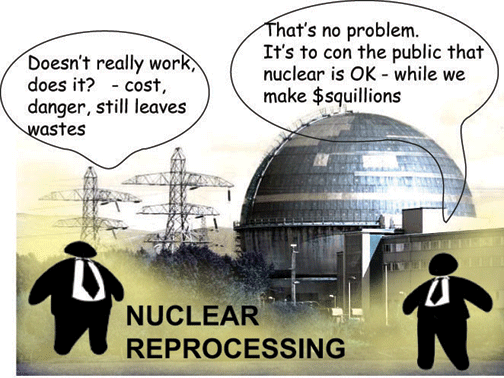 Fast-breeder said realistic no more, Japan Times, 25 Feb 12, Kyodo A panel of experts reviewing the nuclear fuel cycle policy in light of the Fukushima crisis has agreed that while a fast-breeder reactor has advantages, from a technology viewpoint it can’t be considered a realistic option for the next 20 to 30 years. The nuclear fuel policy involves reprocessing spent fuel to produce plutonium that can be reused to produce electricity.
The subcommittee of the Japan Atomic Energy Commission said in a draft document summarizing its discussions that two viable options during the next few decades would be to not reprocess spent nuclear fuel, and to recycle plutonium-uranium mixed oxide fuel, or MOX fuel.
The former option is called the “once-through” cycle, in which uranium fuel is used in nuclear reactors just one time and disposed of by burying it in the ground. In the latter option, MOX fuel is manufactured from plutonium recovered from spent nuclear fuel and used
in ordinary reactors.
Japan has used MOX fuel in reactors, and the government has said the
commercialization of a fast-breeder reactor would be expected to
drastically improve the efficiency of nuclear fuel resource
utilization. At present, the only such reactor, the accident- and
scandal-prone Monju prototype in Fukui Prefecture, remains shut down
and facing a bleak future amid mounting safety fears and budgetary
concerns.
Tatsujiro Suzuki, chairman of the subcommittee, told a news conference
Thursday that he thinks a fast-breeder reactor has “extremely
advantageous characteristics from a long-term viewpoint.”
But he added there are uncertainties about the reactor’s development,
and the draft document said other technologies could serve as
alternatives.
The document also said the “once-through” cycle has high economic
efficiency, while MOX recycling has high efficiency of uranium use.
The subcommittee plans to come up with policy options on nuclear fuel
cycles that are expected to be reflected in discussions to decide the
country’s overall energy policy.
http://www.japantimes.co.jp/text/nn20120224x1.html
No comments yet.
1 This Month

of the week – Shut Down Drone Warfare!


Tell the Ukrainian Government to Drop Prosecution of Peace Activist Yurii Sheliazhenko

Petition to revoke the licensing of the Near Surface Nuclear Disposal Facility (NSDF) at Chalk River. https://www.ourcommons.ca/petitions/en/Petition/Details?Petition=e-7247
To see nuclear-related stories in greater depth and intensity – go to https://nuclearinformation.wordpress.com
-
Archives
- March 2026 (230)
- February 2026 (268)
- January 2026 (308)
- December 2025 (358)
- November 2025 (359)
- October 2025 (376)
- September 2025 (257)
- August 2025 (319)
- July 2025 (230)
- June 2025 (348)
- May 2025 (261)
- April 2025 (305)
-
Categories
- 1
- 1 NUCLEAR ISSUES
- business and costs
- climate change
- culture and arts
- ENERGY
- environment
- health
- history
- indigenous issues
- Legal
- marketing of nuclear
- media
- opposition to nuclear
- PERSONAL STORIES
- politics
- politics international
- Religion and ethics
- safety
- secrets,lies and civil liberties
- spinbuster
- technology
- Uranium
- wastes
- weapons and war
- Women
- 2 WORLD
- ACTION
- AFRICA
- Atrocities
- AUSTRALIA
- Christina's notes
- Christina's themes
- culture and arts
- Events
- Fuk 2022
- Fuk 2023
- Fukushima 2017
- Fukushima 2018
- fukushima 2019
- Fukushima 2020
- Fukushima 2021
- general
- global warming
- Humour (God we need it)
- Nuclear
- RARE EARTHS
- Reference
- resources – print
- Resources -audiovicual
- Weekly Newsletter
- World
- World Nuclear
- YouTube
-
RSS
Entries RSS
Comments RSS
 nuclear-news
Leave a comment