Uranium mining’s radiation dangers continue near Grand Canyon
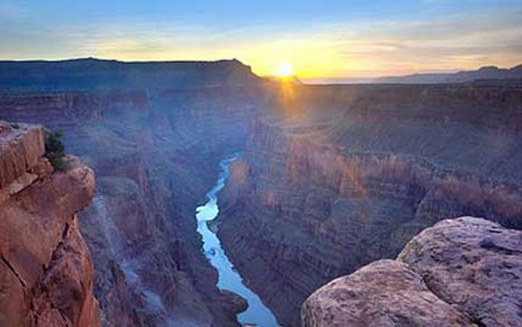
 Risks remain from uranium mining near the Grand Canyon Feb 22, 2012 High Country News By Heather Hansen, Red Lodge Clearing House. “….. There are over 5,000 active uranium claims within those one million acres. The withdrawal goes a long way toward protecting the watersheds, seeps and springs, sacred sites and critical wildlife habitat in the area because the only claims that can now be mined would have had to establish “valid existing rights,” before the 2009 moratorium. Yet even with these protections, the mines with existing rights — the ones allowed to operate despite the moratorium — may still have a significant negative impact on the Grand Canyon environment
Claims with valid existing rights within the withdrawal can be mined, or re-mined, which is the case here. There are four uranium mines in the withdrawal area, all built in the 1980s and all owned by Denison Mines, a Canadian/Korean mining firm. The Canyon Mine is south of the Grand Canyon in the Kaibab National Forest and the Pinenut, Kanab North and Arizona 1 mines are north of the canyon on the Arizona Strip.
Of those, only the Arizona 1 is currently operating; Denison reactivated the mine in December 2009. Denison also plans to re-open the Pinenut mine this May, according to a press release the company issued just days after the ink dried on Secretary of the Interior Ken Salazar’s record of decision for the withdrawal. The other three mines — Pinenut, Canyon and Kanab North have been left essentially in limbo –they were closed in the late 1980s or early 1990s but have never been remediated, supposedly, because they were to be reopened at any time.
The uranium in this area is concentrated in columns, called Breccia Pipes, and the ore is generally one-third of a mile or more beneath the ponderosa and pinyon pine forests. It’s accessed by excavating vertical and horizontal shafts, and the ore and waste rock is then piled up outside the mine until it can be hauled 300 miles to a mill near Blanding, Utah. Once on the surface, the uranium is vulnerable to wind and water, giving it the potential to affect the aquifers in the area.
Conservationists have been told by the Arizona Department of Environmental Quality that the agency has no record of contaminant dispersion at any of the un-remediated mine sites in the area. If that’s true, they seemed to have missed a few major studies the United States Geological Survey (USGS) has released recently, in which they compared radioactivity at sites with similar geology, some that had been mined and others that had not been. In mined watersheds they found concentrations of uranium, and other undesirable substances, in soil and water far above the EPA standards. (This is important because industry hides behind the fact that uranium and other elements do occur naturally at some level in groundwater in the area.) The quantities and extent of contamination are far above normal.
An investigative report done recently by the Arizona Republic found that the Arizona 1 mine, which lies about 20 miles north of the Grand Canyon’s rim, has been “largely left to regulate itself.” The ADEQ did their first inspection of the site in September 2010, roughly nine months after it had already re-opened. At that time, while they took a look at the ground level operations only, never inspecting the 1,252-foot-deep mine, they noted four “major violations.” These violations included a pipe sticking through a “lined” holding pond intended to prevent groundwater contamination, and the fact that no test to measure the permeability of the rock in the mine had been done at the site.
In addition to the ADEQ violations, the U.S. Environmental Protection Agency (EPA) issued violations to Denison for failing to notify the agency that it planned to resume mining at Arizona 1, and for not securing federal approval before testing emissions or ventilating the mine.
And the environmental assessments and plans of operation for these mines — the reports that warn of possible mining impacts and dictate how the mine will run — were written in the 1980s and have never been updated. Given what we’ve learned about the environmental impact of the mines since they were last in operation, these are clearly inadequate. ….. http://www.hcn.org/hcn/blogs/range/risks-remain-from-uranium-mining-near-the-grand-canyon
No comments yet.
1 This Month

of the week – Shut Down Drone Warfare!


Tell the Ukrainian Government to Drop Prosecution of Peace Activist Yurii Sheliazhenko

Petition to revoke the licensing of the Near Surface Nuclear Disposal Facility (NSDF) at Chalk River. https://www.ourcommons.ca/petitions/en/Petition/Details?Petition=e-7247
To see nuclear-related stories in greater depth and intensity – go to https://nuclearinformation.wordpress.com
-
Archives
- March 2026 (230)
- February 2026 (268)
- January 2026 (308)
- December 2025 (358)
- November 2025 (359)
- October 2025 (376)
- September 2025 (257)
- August 2025 (319)
- July 2025 (230)
- June 2025 (348)
- May 2025 (261)
- April 2025 (305)
-
Categories
- 1
- 1 NUCLEAR ISSUES
- business and costs
- climate change
- culture and arts
- ENERGY
- environment
- health
- history
- indigenous issues
- Legal
- marketing of nuclear
- media
- opposition to nuclear
- PERSONAL STORIES
- politics
- politics international
- Religion and ethics
- safety
- secrets,lies and civil liberties
- spinbuster
- technology
- Uranium
- wastes
- weapons and war
- Women
- 2 WORLD
- ACTION
- AFRICA
- Atrocities
- AUSTRALIA
- Christina's notes
- Christina's themes
- culture and arts
- Events
- Fuk 2022
- Fuk 2023
- Fukushima 2017
- Fukushima 2018
- fukushima 2019
- Fukushima 2020
- Fukushima 2021
- general
- global warming
- Humour (God we need it)
- Nuclear
- RARE EARTHS
- Reference
- resources – print
- Resources -audiovicual
- Weekly Newsletter
- World
- World Nuclear
- YouTube
-
RSS
Entries RSS
Comments RSS
 nuclear-news
Leave a comment