How the nuclear lobby’s devious marketing distorts “incentives”
 the NRC’s decision on Vogtle was “a non-event” because, he said, “The morning after the license was issued, nobody on Wall Street woke up and said, ‘Hey! Now I’m going to buy in!'” The licensing decision had, he said, “no effect on the economics.”
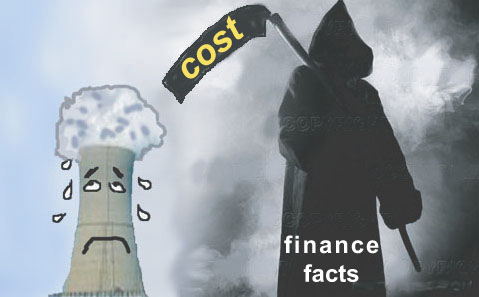
The Nuclear Industry’s Answer to Its Marketplace Woes, Greentech media Construction Work in Progress (CWIP) financing shifts the risks of nuclear energy to utility ratepayers. HERMAN K. TRABISH: FEBRUARY 22, 2012 “……..An example of incentive distortion is “the sunk-costs argument” now being used by Southern Company for the Vogtle reactors under development in Georgia with CWIP financing. Construction there is reportedly both behind schedule and over budget. Southern Company, Cooper said, is arguing that, with as much as $4 billion in sunk costs, “It’s cheaper to finish this project than to start something else.”
Some nuclear developers, he added, will simply tell regulators that have authorized the spending of billions in ratepayer funds, “If you don’t give me the next $50 million, I’m going to abandon this project.”
Vogtle has just been licensed by the Nuclear Regulatory Commission (NRC), causing a stir among environmental activists. To Cooper, the NRC’s decision on Vogtle was “a non-event” because, he said, “The morning after the license was issued, nobody on Wall Street woke up and said, ‘Hey! Now I’m going to buy in!'” The licensing decision had, he said, “no effect on the economics.”
More significantly, he added, the Obama administration has not advanced the Vogtle $8.33 billion federal loan guarantee that has been on hold since last year because of the budget and schedule problems.
“The Obama administration talks about nuclear power,” Cooper said, “but it has stopped putting the people’s money where their mouth is.”
Georgia is one of four Southeastern states that were convinced in the 2006 to 2007 period by nuclear industry lobbying to allow CWIP financing for nuclear plants. Of five projects, Cooper said, the only one that is “seriously moving forward” is Vogtle.
It demonstrates, Cooper said, what it takes to build a nuclear project today. “A massive amount of subsidy, the federal loan guarantee, construction work in progress and muni partners who also don’t raise funds in normal capital markets but are backed by the full faith and credit of municipalities,” he summarized. In addition, Cooper said he believes Westinghouse, the reactor manufacturer, is subsidizing the project in its own self-interest.
Cooper pointed out that renewables are an economically viable alternative to nuclear power. “They always say it’s hard to do renewables and it’s hard to convince people to do efficiency,” he explained. “But then they always assume it’s easy to build nuclear. And it’s not.”
“Base load,” Cooper said, “is so 20th century.” Given “the sum total of the tools we have for integrating resources and managing the grid,” he explained, “it is time for utilities that are not transitioning to grow up and adopt some new technology.”
Cooper disagrees that small modular reactors, the next generation of nuclear technology, are an answer to future power requirements. “It is not clear to me that the safety concerns are solved because you are smaller,” he said. “Certainly the cost concerns are not.” And, with smaller reactors that promise to efficiently recycle nuclear waste, he said, “you shrink the output much faster than you shrink the cost of safety.”
Any utility could come forward “with a proposal to build a reactor,” he said. And if the numbers are right, “the public utility commission will approve. But they can’t do that. It doesn’t exist.”
He suggested to Iowa legislators, he noted, that they “pass a nuclear development fund” to advance small modular reactors but “they wouldn’t do it.” What they wanted to do, he said, is use “the ratepayer to make risky venture capitalist investments in technologies that are completely unknown. That’s not what you should be doing with ratepayer money.” http://www.greentechmedia.com/articles/read/the-nuclear-industrys-answer-to-its-marketplace-woes/
No comments yet.
1 This Month

of the week – Shut Down Drone Warfare!


Tell the Ukrainian Government to Drop Prosecution of Peace Activist Yurii Sheliazhenko

Petition to revoke the licensing of the Near Surface Nuclear Disposal Facility (NSDF) at Chalk River. https://www.ourcommons.ca/petitions/en/Petition/Details?Petition=e-7247
To see nuclear-related stories in greater depth and intensity – go to https://nuclearinformation.wordpress.com
-
Archives
- March 2026 (230)
- February 2026 (268)
- January 2026 (308)
- December 2025 (358)
- November 2025 (359)
- October 2025 (376)
- September 2025 (257)
- August 2025 (319)
- July 2025 (230)
- June 2025 (348)
- May 2025 (261)
- April 2025 (305)
-
Categories
- 1
- 1 NUCLEAR ISSUES
- business and costs
- climate change
- culture and arts
- ENERGY
- environment
- health
- history
- indigenous issues
- Legal
- marketing of nuclear
- media
- opposition to nuclear
- PERSONAL STORIES
- politics
- politics international
- Religion and ethics
- safety
- secrets,lies and civil liberties
- spinbuster
- technology
- Uranium
- wastes
- weapons and war
- Women
- 2 WORLD
- ACTION
- AFRICA
- Atrocities
- AUSTRALIA
- Christina's notes
- Christina's themes
- culture and arts
- Events
- Fuk 2022
- Fuk 2023
- Fukushima 2017
- Fukushima 2018
- fukushima 2019
- Fukushima 2020
- Fukushima 2021
- general
- global warming
- Humour (God we need it)
- Nuclear
- RARE EARTHS
- Reference
- resources – print
- Resources -audiovicual
- Weekly Newsletter
- World
- World Nuclear
- YouTube
-
RSS
Entries RSS
Comments RSS
 nuclear-news
Leave a comment