Australian government’s special laws for the benefit of uranium mining company
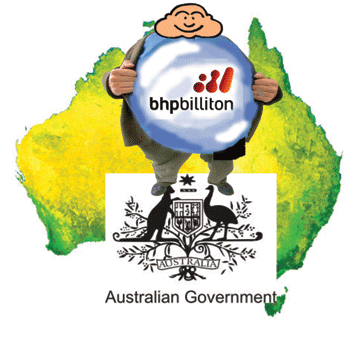 Olympic Dam mine is a dam designed to leak an average of three million litres of liquid radioactive waste a day from the tailings storage facility through decades of mining up to 2050.
The federal and SA governments agreed to surface dumping of the tailings rather than to require best practice disposal into the pit.
Our uranium fuelled Fukushima, David Noonan, The Guardian, 22 Feb 12, Australian uranium fuelled the Fukushima nuclear disaster yet our governments have just approved the world’s largest uranium project in BHP Billiton’s proposed new pen pit mine at Roxby Downs. “We can confirm that Australian obligated nuclear material was at the Fukushima Daiichi site and in each of the reactors – maybe five out of six, or it could have been all of them; almost all of them”.
This frank smoking gun admission by Dr Floyd, the Director-General of the Australian Safeguards and Non-Proliferation Office (ASNO) in the Department of Foreign Affairs and Trade came some seven months after the Fukushima crisis had started to unfold. It is quite likely this Australian uranium came from Roxby Downs in SA.
Denial runs deep in the nuclear industry The nuclear utility TEPCO
and the Japanese government lacked capacity and preparedness to
respond to the inherent nuclear risks that reactors imposed on their
society. Fire fighters from Tokyo had to risk their lives and health
to try to control the failing Fukushima nuclear reactors as they
exploded and burnt and the reactor cores melted down spewing radiation
over nearly 10 percent of Japan.
Uranium mining companies in Australia are in denial. They cited “commercial in confidence” so as not to disclose their contracts and not to reveal which reactors were fuelled with their uranium.
The radioactive tailings produced by uranium miners need to be
isolated from the environment for far longer than recorded human
history – in effect forever.
However, Olympic Dam mine is a dam designed to leak an average of three million litres of liquid radioactive waste a day from the tailings storage facility through decades of mining up to 2050.
The federal and SA governments agreed to surface dumping of the tailings rather than to require best practice disposal into the pit.
They agreed that the company does not have to rehabilitate the proposed one kilometre deep pit that will be left to form a
hyper-saline contaminated lake of some 350 metres in depth as a permanent scar on the landscape. Some 3.5 million litres a day of saline groundwater will be lost to the pit in perpetuity as it cuts through the local aquifers.
The world’s largest and richest mining company has been allowed to
avoid paying for environment protection measures and mine
rehabilitation costs of some many hundreds of millions of dollars.
The federal government gave election policy commitments that they have
failed to deliver:
“Labor will accordingly only allow the mining of uranium under the
most stringent conditions”.
And: “Ensure that Australian uranium mining, milling and
rehabilitation is based on world’s best practice standards”……..
Aboriginal heritage obligations that apply to every other miner or developer do not apply to the Big Australian for the 70-year extended period of the Roxby Indenture, and the state further agreed that this can only be changed in future with the agreement of the company….
Commercial vested interests of uranium mining companies are writing the script for Australia’s uranium sales deals under both Liberal and now ALP federal governments…….
A nuclear deal with India would suit BHP Billiton’s interests in
potentially providing a second market country for the uranium-infused
bulk copper concentrate from their proposed new open pit mine, and to
allow them to lay off some of the increased uranium yellowcake
production from the pit onto one of very few remaining potential
nuclear markets in the shadow of Fukushima.
The illusion of protection in uranium sales will further unravel as
the book-keeping exercise in ASNO’s so-called “nuclear safeguards” may
fail to track uranium in concentrates in non-transparent China, as the
developing world struggles with nuclear risks that Japan was unable to
contain, and as Australian uranium continues to fuel nuclear
insecurity across the world.
http://www.cpa.org.au/guardian/2012/1536/08-our-uranium.html
No comments yet.
1 This Month

of the week – Shut Down Drone Warfare!


Tell the Ukrainian Government to Drop Prosecution of Peace Activist Yurii Sheliazhenko

Petition to revoke the licensing of the Near Surface Nuclear Disposal Facility (NSDF) at Chalk River. https://www.ourcommons.ca/petitions/en/Petition/Details?Petition=e-7247
To see nuclear-related stories in greater depth and intensity – go to https://nuclearinformation.wordpress.com
-
Archives
- March 2026 (230)
- February 2026 (268)
- January 2026 (308)
- December 2025 (358)
- November 2025 (359)
- October 2025 (376)
- September 2025 (257)
- August 2025 (319)
- July 2025 (230)
- June 2025 (348)
- May 2025 (261)
- April 2025 (305)
-
Categories
- 1
- 1 NUCLEAR ISSUES
- business and costs
- climate change
- culture and arts
- ENERGY
- environment
- health
- history
- indigenous issues
- Legal
- marketing of nuclear
- media
- opposition to nuclear
- PERSONAL STORIES
- politics
- politics international
- Religion and ethics
- safety
- secrets,lies and civil liberties
- spinbuster
- technology
- Uranium
- wastes
- weapons and war
- Women
- 2 WORLD
- ACTION
- AFRICA
- Atrocities
- AUSTRALIA
- Christina's notes
- Christina's themes
- culture and arts
- Events
- Fuk 2022
- Fuk 2023
- Fukushima 2017
- Fukushima 2018
- fukushima 2019
- Fukushima 2020
- Fukushima 2021
- general
- global warming
- Humour (God we need it)
- Nuclear
- RARE EARTHS
- Reference
- resources – print
- Resources -audiovicual
- Weekly Newsletter
- World
- World Nuclear
- YouTube
-
RSS
Entries RSS
Comments RSS
 nuclear-news
Leave a comment