New nukes for UK – a desperate effort to save France’s nuclear industry?
the world is experiencing a ‘glut’ of gas according to the IEA
it is now looking increasingly likely that there will be no new nuclear power stations in Britain
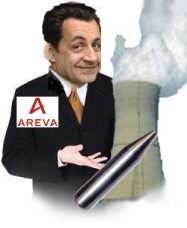 The decision on whether or not new nuclear is actually built in Britain will be taken in Paris, not London. And very possibly by a new French President less in thrall to the nuclear industry.
 No More Nukes?, (UK) February 17, 2012 by tomburke It is just David Cameron’s bad luck to have chosen to back a nuclear future for Britain at a moment when it is becoming increasingly unlikely that it will happen. And it is entirely appropriate that he should find himself doing so in Paris since that is where the fate of DECC’s nuclear policy will be determined.
The idea of replacing Britain’s aging AGRs with Areva’s EPR was always inspired by a French government seeking to close an emerging decades long gap in domestic nuclear orders. The justification for British homeowners and businesses being forced to pay for a French industrial policy was a supposed electricity generation gap.
Without French nuclear power stations, Britons would be freezing in the dark by 2015 according to energy ministers. This was always nonsense but has been made totally ridiculous by several recent developments. Continue reading
Vogtle’s nuclear waste pools close to full – where to put new wastes?
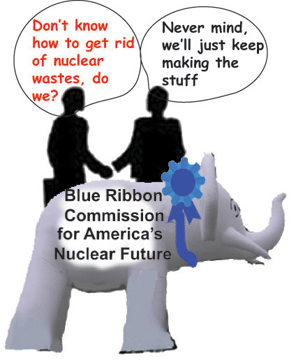 New Plant Vogtle reactors praised despite unresolved nuclear waste plan Augusta Chronicle By Rob Pavey Staff Writer Feb. 17, 2012 Nuclear expansion was touted this week as the answer to America’s energy needs, but there is still a question of what to do with the spent fuel the process creates.
Just a few hundred yards past a Burke County podium where Energy Secretary Steven Chu
cheered the $14 billion expansion of Plant Vogtle, a lesser known construction project is under way to add storage for spent fuel that could be stranded indefinitely here in Georgia.
The waste, part of 2,490 metric tons of the material statewide, has been accumulating in concrete-lined pools since Vogtle’s first two reactors went online in 1987 and 1989. Those pools will be full in 2014, Continue reading
UK government disregards the danger of nuclear reactors
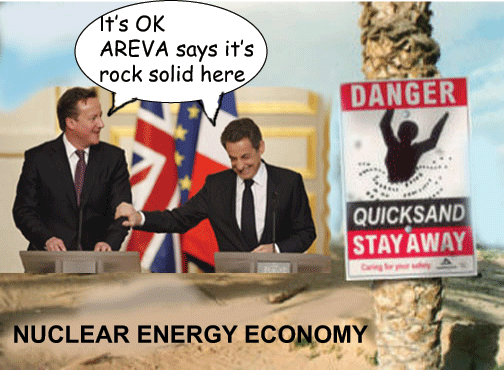 In the UK, the government is determined to push ahead with the development of a new fleet of nuclear reactors, as the partnership announced by David Cameron and Nicholas Sarkozy shows.
The orchestrated effort between coalition officials and the nuclear industry to create a pro-nuclear public information campaign in the days after Fukushima showed that not even a large-scale nuclear incident could halt ministers’ obsession with new nuclear. Officials did not even wait for the results of the government’s own safety review before rushing to assure the British people that a similar disaster is not possible in the UK.
Why we must phase out nuclear power The inherent risk in the use of nuclear energy can and does have disastrous consequences, Guardian UK, Caroline Lucas, Rebecca Harms, Dany Cohn-Bendt, 18 Feb While global attention has long since shifted elsewhere, the nuclear catastrophe in Fukushima is far from over. This is the nature of nuclear accidents: they leave a long-lasting radioactive legacy.
One year on, the situation is not under control. The announcement by the Japanese government that the damaged reactors were in a state of “cold shutdown” was met with scepticism and anger from a concerned public – and with disbelief among nuclear experts. Continue reading
Protestors occupy Hinkley nuclear site, accuse EDF of pre-empting permission
 Activists occupying new nuclear site accuse EDF of ‘ignoring democracy’ John Vidal, environment editor guardian.co.uk, Friday 17 February 2012 The energy company has started work on the £10bn Hinkley Point C power station without permission to build Environmental activists have occupied the site of what is planned to be Britain’s first new nuclear power station since 1995, and on Friday accused EDF of “ignoring democracy” and starting work on the £10bn project without permission to build the station….. Continue reading
Court action over radioactive waste faces Australian company Lynas
 Lynas itself had admitted it had no prepared any such permanent waste storage facility
I cannot understand why Malaysia is prepared to tolerate the potential hazards to occur here from a plant which will give no substantial benefit of Malaysia because of the pioneer status granted to Lynas for 10 years
Lynas Corp failed to meet any of the conditions in its first proposals, according to the regulator.
Anti-Lynas groups are planning a mammoth rally in Kuantan on February 26 to pressure Putrajaya to terminate the project.
A year on, anti-Lynas campaign goes to court http://www.themalaysianinsider.com/malaysia/article/a-year-on-anti-lynas-campaign-goes-to-court The Malaysian Insider By Debra Chong , February 17, 2012 KUALA LUMPUR, — A nationwide campaign to stop Lynas heads into the courtroom with damaging allegations against the Australian rare earths producer and Malaysia’s regulators.
The court filing also accuses Lynas of economic imperialism and points out that until today it does not have a plan to permanently dispose of its waste, some which contain potentially harmful levels of radiation. Continue reading
Japan’s former Prime Minister an apostle for renewable energy, not nuclear
Nuclear crisis turns Japan ex-PM Kan into energy apostle By Linda Sieg and Yoko Kubota TOKYO | Fri Feb 17, 2012 (Reuters) – Nearly a year after Japan’s Fukushima nuclear disaster, then-premier Naoto Kan is haunted by the specter of an even bigger crisis forcing tens of millions of people to flee Tokyo and threatening the nation’s existence.
“Having experienced the 3/11 nuclear disaster, I changed my way of thinking. The biggest factor was how at one point, we faced a situation where there was a chance that people might not be able to live in the capital zone including Tokyo and would have to evacuate,” Kan told Reuters in an interview on Friday.
“If things had reached that level, not only would the public have had to face hardships but Japan’s very existence would have been in peril.”
That convinced Kan, in office for less than a year when the March 11 triple disaster struck, to declare the need for Japan to end its reliance on atomic power and promote renewable sources of energy such solar that have long taken a back seat in the resource-poor country’s
energy mix….. http://www.reuters.com/article/2012/02/17/us-japan-kan-idUSTRE81G08P20120217
UK firm Centrica’s investors might not be happy about nuclear plans
Centrica faces big questions on nuclear despite Franco-British summit, Telegraph UK 18 Feb 12, David Cameron and Nicolas Sarkozy invoked the spirit of entente cordiale on Friday in Paris, reaffirming their countries’ commitment to building Britain’s new fleet of nuclear power plants. By Damian Reece, Head of Business 17 Feb 2012
There were supporting statements from blue-chip corporate names such as Rolls-Royce on this side of the English Channel and EDF and Areva on their side of la Manche. All was fusion.
But behind the political smiles lies an increasingly tense reality which throws into question everything the Coalition is trying to achieve in its National Policy Statement on energy, approved by Parliament in July.
The are several risks, none of which Friday’s Franco-British summit addressed. Continue reading
A non hysterical approach to the Iran nuclear issue
 Old fears cloud Western views on Iran’s nuclear posturing, Sydney Morning Herald, John Mueller, February 18, 2012 Alarmism about nuclear proliferation is fairly common coin in the foreign policy establishment. And of late it has been boosted by the seeming efforts of Iran or its friends to answer covert
assassinations, apparently by Israel, with attacks and attempted attacks of their own in India, Georgia and Thailand.
A non-hysterical approach to the Iran nuclear issue is entirely possible. It should take several considerations into account. Continue reading
USA’s worries about its nuclear reactors similar to Fukushima’s
U.S. nuclear plants similar to Fukushima spark concerns By Matt Smith, CNN
February 17, 2012 — As the United States prepares to build its first new nuclear power reactors in three decades, concerns about an early generation of plants have resurfaced since last year’s disaster in Japan.
The Vermont Yankee nuclear power plant — the subject of a battle between state authorities and the Nuclear Regulatory Commission over its continued operation — uses one of 23 U.S. reactors built with a General Electric-designed containment housing known as the Mark I.
It’s the same design that was used at Japan’s Fukushima Daiichi nuclear power plant, where three reactors melted down after the station was struck by the tsunami that followed Japan’s historic earthquake in March 2011. The disaster resulted in the widespread release of radioactive contamination that forced more than 100,000 people from their homes…..
Arnie Gundersen, a former nuclear engineer and a leading critic of the Vermont Yankee plant, says the Japanese accident shows the Mark I containment system can’t prevent a release of radioactivity in a meltdown.
Watch an excerpt from this weekend’s CNN Special Investigations Unit report on Vermont Yankee
In an October hearing before the NRC’s Petition Review Board, he said the vents were a “Band-Aid fix” for the design that failed “not once, not twice, but three times” at Fukushima Daiichi.
“True wisdom means knowing when to modify something and knowing when to stop,” said Gundersen, who leads a state commission set up to monitor the Vermont Yankee plant.
Half of U.S. reactors are more than 30 years old….. http://edition.cnn.com/2012/02/17/us/us-nuclear-reactor-concerns/?hpt=us_c1
The lives of Fukushima nuclear refugees on film
Read The Wall Street Journal’s profile of all three Fukushima documentaries.
 ‘Nuclear Nation’ Examines Lives of Fukushima Refugees WSJ, FEBRUARY 17, 2012, “Nuclear Nation” is one of three documentaries showing at the Berlin Film Festival tracing the fate of those affected by the Fukushima tsunami and subsequent nuclear meltdown on March 11, 2011. The lengthy, 145-minute documentary (soon available in a truncated version) follows several of the 1400 refugees from Futaba living in defunct Kisai High School, with interviews as recent as December. Speakeasy sat down with director Atushi Funahashi to discuss his film…..
There’s a scene in the documentary where Futaba citizens protest their situation, and politicians merely stand there, some even awkwardly clapping. You show a lot of politicians preoccupied with keeping up an appearance of calm, often remaining totally silent…..
I hope this shows the miserable situation these people have to go through. I thought Japan was a civilized country, but it’s not…The central capital is exploiting the rural area. The power generated in Fukushima has been almost all sent to Tokyo. The people in Fukushima were the ones working [so hard]. There are many people saying the people [in Fukushima] took these subsidies to build new [academic and athletic] centers and they got rich, that they’re now in this refugee camp, but it was their own risk and it’s their fault. But I want to question that. Read The Wall Street Journal’s profile of all three Fukushima documentaries. http://blogs.wsj.com/speakeasy/2012/02/17/nuclear-nation-examines-lives-of-fukushima-refugees/
11 USA nuclear reactors may have unsafe cooling systems
Nuclear Regulatory Commission says accident models could be amiss, By Mike M. Ahlers, CNN February 18, 2012 — The models may underestimate how much nuclear fuel would heat up during system failures
The commission is asking 11 U.S. nuclear power plants for more information
There is no immediate threat to public safety
Washington — The Nuclear Regulatory Commission has asked 11 nuclear power plants for information about the computer models they use to test different accident scenarios, saying those models may underestimate how much nuclear fuel will heat up during cooling system
failures….
At issue is a phenomenon known as “thermal conductivity degradation,” or TCD, the NRC said. TCD refers to the fact that nuclear fuel loses its capacity to transfer heat as it ages.
The NRC said it is concerned that some computer models may not account for TCD. If the plants are not considering TCD, the possibility exists that fuel rods could heat up 100 degrees more than anticipated in an accident scenario, exceeding the 2,200-degree limit considered safe,the NRC said. That could damage the fuel rods’ outer layer, leading to
reactor damage, the NRC said……
The plants have until March 19 to provide the information to the NRC
staff. http://edition.cnn.com/2012/02/17/us/nuclear-accident-models/index.html
1 This Month

of the week – Shut Down Drone Warfare!


Tell the Ukrainian Government to Drop Prosecution of Peace Activist Yurii Sheliazhenko

Petition to revoke the licensing of the Near Surface Nuclear Disposal Facility (NSDF) at Chalk River. https://www.ourcommons.ca/petitions/en/Petition/Details?Petition=e-7247
To see nuclear-related stories in greater depth and intensity – go to https://nuclearinformation.wordpress.com
-
Archives
- March 2026 (230)
- February 2026 (268)
- January 2026 (308)
- December 2025 (358)
- November 2025 (359)
- October 2025 (376)
- September 2025 (257)
- August 2025 (319)
- July 2025 (230)
- June 2025 (348)
- May 2025 (261)
- April 2025 (305)
-
Categories
- 1
- 1 NUCLEAR ISSUES
- business and costs
- climate change
- culture and arts
- ENERGY
- environment
- health
- history
- indigenous issues
- Legal
- marketing of nuclear
- media
- opposition to nuclear
- PERSONAL STORIES
- politics
- politics international
- Religion and ethics
- safety
- secrets,lies and civil liberties
- spinbuster
- technology
- Uranium
- wastes
- weapons and war
- Women
- 2 WORLD
- ACTION
- AFRICA
- Atrocities
- AUSTRALIA
- Christina's notes
- Christina's themes
- culture and arts
- Events
- Fuk 2022
- Fuk 2023
- Fukushima 2017
- Fukushima 2018
- fukushima 2019
- Fukushima 2020
- Fukushima 2021
- general
- global warming
- Humour (God we need it)
- Nuclear
- RARE EARTHS
- Reference
- resources – print
- Resources -audiovicual
- Weekly Newsletter
- World
- World Nuclear
- YouTube
-
RSS
Entries RSS
Comments RSS
 nuclear-news