New ways to store surplus renewable energy
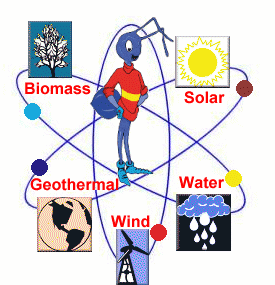 As the use of renewable energy spreads, some companies are storing energy as heat rather than cold. And some are harnessing batteries at the point of generation.
 Surplus Renewable Energy: An Update, NYT, By MATTHEW L. WALD, 9 Feb 2012 Last year I wrote about sudden surges in renewable energy that set up a conflict between wind producers in the Pacific Northwest and the Bonneville Power Administration, a federal agency that runs hydroelectric dams and the regional grid. ….
…at a two-day National Electricity Forum sponsored by the Energy Department and others, the federal energy secretary, Steven Chu, on Wednesday proposed a different set of solutions to the problem, which is likely to emerge elsewhere as installations of renewable energy expand and systems have to cope with surges or deficits of power they cannot predict.
One solution would be to break down the barriers between utilities so that the variability of generation can be leveled out over a larger area, Dr. Chu suggested. Routing more power to California would be a good first move, he said…..
Another would be using batteries, the secretary of energy said. The problem is that at the moment, the batteries needed to store just one kilowatt-hour (the amount needed to run an window air conditioner for an hour) cost about $350.
That is steep, given that the average price of that amount of energy is about 11 cents. But at $100, Dr. Chu said, batteries would “go viral’’ and change the energy equation.
But there are simpler solutions, the secretary said. He said he recently visited a medical center in Houston that ran a power plant that produced both electricity and steam and could run at very high efficiency when both were needed. The problem, Dr. Chu said, is that at some hours, especially at night, there was not much need for the steam. So the medical center was using it to run a cooling device that was usually a component of an air-conditioning system….
As the use of renewable energy spreads, some companies are storing energy as heat rather than cold. And some are harnessing batteries at the point of generation.
Dr. Chu described a synergy between batteries for plug-in hybrid or electric cars and batteries for the grid. “If I look at the world 10 years ago versus today, we were kind of a sleepy outpost’’ for batteries, he said, with no demand beyond “laptops, some power tools, and toothbrushes.”
“And now they’re saying it’s a $150 billion market,’’ he said.
Dr. Chu predicted that some of that would spill over into the grid. Until then, Bonneville proposes that its customers share the costs of unplugging the wind machines during times of high river flows with the wind producers. http://green.blogs.nytimes.com/2012/02/08/surplus-renewable-energy-an-update/
No comments yet.
1 This Month

of the week – Shut Down Drone Warfare!


Tell the Ukrainian Government to Drop Prosecution of Peace Activist Yurii Sheliazhenko

Petition to revoke the licensing of the Near Surface Nuclear Disposal Facility (NSDF) at Chalk River. https://www.ourcommons.ca/petitions/en/Petition/Details?Petition=e-7247
To see nuclear-related stories in greater depth and intensity – go to https://nuclearinformation.wordpress.com
-
Archives
- April 2026 (68)
- March 2026 (251)
- February 2026 (268)
- January 2026 (308)
- December 2025 (358)
- November 2025 (359)
- October 2025 (376)
- September 2025 (257)
- August 2025 (319)
- July 2025 (230)
- June 2025 (348)
- May 2025 (261)
-
Categories
- 1
- 1 NUCLEAR ISSUES
- business and costs
- climate change
- culture and arts
- ENERGY
- environment
- health
- history
- indigenous issues
- Legal
- marketing of nuclear
- media
- opposition to nuclear
- PERSONAL STORIES
- politics
- politics international
- Religion and ethics
- safety
- secrets,lies and civil liberties
- spinbuster
- technology
- Uranium
- wastes
- weapons and war
- Women
- 2 WORLD
- ACTION
- AFRICA
- Atrocities
- AUSTRALIA
- Christina's notes
- Christina's themes
- culture and arts
- Events
- Fuk 2022
- Fuk 2023
- Fukushima 2017
- Fukushima 2018
- fukushima 2019
- Fukushima 2020
- Fukushima 2021
- general
- global warming
- Humour (God we need it)
- Nuclear
- RARE EARTHS
- Reference
- resources – print
- Resources -audiovicual
- Weekly Newsletter
- World
- World Nuclear
- YouTube
-
RSS
Entries RSS
Comments RSS
 nuclear-news
Leave a comment