Multi $billion radioactive cleanup at Hanford not going well
 Problems plague cleanup at Hanford nuclear waste site, By Peter Eisler, USA TODAY HANFORD SITE, Wash. – Seven decades after scientists came here during World War IIto create plutonium for the first atomic bomb, a new generation is struggling with an even more daunting task: cleaning up the radioactive mess. The U.S. government is building a treatment plant to stabilize and contain 56 million gallons of waste left from a half-century of nuclear weapons production. The radioactive sludge is so dangerous that a few hours of exposure could be fatal. A major leak could contaminate water supplies serving millions across the Northwest. The cleanup is the most complex and costly environmental restoration ever attempted.
And the project is not going well. Continue reading
Effort to clean up Hanford radioactive spill
Plan developed to clean up highly radioactive Hanford spill BY ANNETTE CARY, TRI-CITY HERALD 02/06/12 Hanford officials have settled on a plan to clean up what may be the most highly radioactive spill at the nuclear reservation.
It depends on calling back into service the 47-year-old, oversized hot cell where the spill occurred to protect workers from the radioactive cesium and strontium that leaked through the hot cell to the soil below.
Radioactivity in the contaminated soil, which is about 1,000 feet from the Columbia River, has been measured at 8,900 rad per hour. Direct exposure for a few minutes would be fatal, according to Washington Closure. Continue reading
Chinese County rejects nuclear plant as a “time bomb”

 Chinese County Protests Nuclear Plant Construction, VOA, February 9th, 2012 Chinese state media say authorities in eastern China are demanding construction of a local nuclear-power plant be stopped permanently because residents in the earthquake-prone region are at risk.
The state-run Global Times newspaper says a campaign against the plant was launched in the Anhui provincial county of Wangjiang. The paper says the controversy had drawn nationwide attention after a report in November questioning the plant’s safety was posted last week on the Internet.
 The newspaper quotes critic and activist Sun Bin as saying “we all believe the plant is a time bomb.” The paper said the November critique pointed out that the facility – located in an adjacent county – sits on a seismic fault zone “with frequent occurrences of earthquakes.” The November report also said fault-zone data was not mentioned in earlier environmental impact reports. Plant construction was suspended for further impact studies last year, after Japan’s Fukushima nuclear disaster…….. http://blogs.voanews.com/breaking-news/2012/02/09/chinese-county-protests-nuclear-plant-construction/
How global warming brings freezing winter to Europe
In particular, the loss of Arctic sea ice could be influencing the development of high-pressure weather systems over northern Russia, which bring very cold winds from the Arctic and Siberia to Western Europe and the British Isles, the scientists believe.

 Is Climate Change Bringing the Arctic to Europe? The Energy Collective, Joseph Romm, February 7, 2012 Less Summer Arctic Sea Ice Cover May Mean Some Colder, Snowier Winters in Central Europe [For Now]
[T]he probability of cold winters with much snow in Central Europe rises when the Arctic is covered by less sea ice in summer. Scientists of the Research Unit Potsdam of the Alfred Wegener Institute for Polar and Marine Research in the Helmholtz Association have decrypted a mechanism in which a shrinking summertime sea ice cover changes the air pressure zones in the Arctic atmosphere and impacts our European winter weather. These results of a global climate analysis were recently published in a study in the scientific journal Tellus A.
That’s the news release for yet another new study examining what will inevitably be the huge implications for extreme weather from the massive amount of heat released by the declining Arctic sea ice cover. Arctic sea ice in September 2007 reached its lowest extent on record, approximately 40% lower than when satellite records began in 1979. Sea ice loss in 2011 was virtually tied with the ice loss in 2007, despite weather conditions that were not as unusual in the Arctic. ”Such a large area of open water is bound to cause significant impacts on weather patterns, due to the huge amount of heat and moisture that escapes from the exposed ocean into the atmosphere over a multi-month period following the summer melt.” Continue reading
All of Tepco’s nuclear reactors to be out of service in March
 Japan’s Tepco to suspend all nuclear operations By MarketWatch, Feb. 9, 2012, Tokyo Electric Power Co. said Thursday it will suspend operations of the No. 6 reactor at the Kashiwazaki-Kariwa nuclear power plant in Niigata Prefecture on March 26 for a periodic check, a plan that will take all of its 17 reactors out of service, Kyodo News reported. Continue reading
What is the price of the West getting it wrong on Iran?
‘spy vs spy’ approach is not sustainable. Eventually there will be a loser. The least worst option is for a dual approach of diplomacy and sanctions.
Middle East WMD 2.0 – Someone Will Be Proven Wrong on Iran, Huffington Post, Paul Herouxm, 9 Feb 12, The current stand-off with Iran should be called “Middle East WMD 2.0.” No one knows Iran’s true intentions.
There is little concern with the outcome that Iran is not pursuing a weapons program and the West does nothing — this is the right course of action. Nor is there too much concern with the outcome that Iran was pursuing a weapons program and the US stops the program through
force — if it is truly justified and can be proven, then so be it.
But what if we get it wrong? Continue reading
Taipei insists that its many thousands of spent nuclear fuel rods are safe
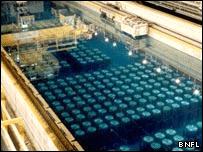
 Atomic body dismisses report on nuclear safety Taipei Times Staff Writer, with CNA , 9 Feb 12, The Atomic Energy Council yesterday dismissed a French newspaper’s report that raised doubts about the security of facilities storing spent reactor fuel, saying that spent fuel has always been kept under safe storage and strict management.
The French newspaper Le Monde reported on Tuesday that spent fuel pools at the Jinshan (金山) Nuclear Power Plant in Shimen District (石門), New Taipei City (新北市) and Guosheng Nuclear Power Plant in Wanli District (萬里), New Taipei City, have become saturated and could therefore be severely hazardous in the event of an accident. Continue reading
France’s President insists that aging nuclear plant is safe
 Sarkozy refuses to close aging nuclear plant despite growing resistance Washington Post, By Associated Press, February 9 FESSENHEIM, France — French President Nicolas Sarkozy is refusing to shut down an aging nuclear plant that has become a symbol of growing resistance to nuclear energy in France…. He insisted there was no doubt about the plant’s safety…. http://www.washingtonpost.com/world/europe/sarkozy-refuses-to-close-aging-nuclear-plant-despite-growing-resistance/2012/02/09/gIQAYDH60Q_story.html
New ways to store surplus renewable energy
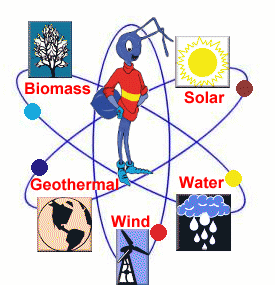 As the use of renewable energy spreads, some companies are storing energy as heat rather than cold. And some are harnessing batteries at the point of generation.
 Surplus Renewable Energy: An Update, NYT, By MATTHEW L. WALD, 9 Feb 2012 Last year I wrote about sudden surges in renewable energy that set up a conflict between wind producers in the Pacific Northwest and the Bonneville Power Administration, a federal agency that runs hydroelectric dams and the regional grid. ….
…at a two-day National Electricity Forum sponsored by the Energy Department and others, the federal energy secretary, Steven Chu, on Wednesday proposed a different set of solutions to the problem, which is likely to emerge elsewhere as installations of renewable energy expand and systems have to cope with surges or deficits of power they cannot predict. Continue reading
Vermont’s renewable energy kickstarts energy independence for the State
Local renewable industry poised to make ‘Vermont energy strong’ , VT Digger, Gabrielle Stebbins, 9 Feb 2012 Montpelier, Vermont – Vermont’s local renewable energy industry— made up of diverse manufacturers, construction contractors, installers, developers, and suppliers— announced today the industry is equipped to help make “Vermont energy strong” in the 21st Century.
The industry, which ranges from local fabricators assembling electrical boards and contractors that specialize in hot water, solar, wind, hydro, geothermal and biomass heating installations to regional and international manufacturers of innovative renewable energy technologies, held a press conference on pending policy issues today in Montpelier.
“The benefits of a strong renewable industry flow throughout the state by creating local jobs, producing energy locally, and providing energy security,” said Gabrielle Stebbins, Executive Director of Renewable Energy Vermont (REV), the state trade association representing more than 300 renewables and efficiency businesses in the state. “Growing our own renewable energy in-state is in keeping with Vermonters’ desire for self reliance, a clean energy future that leaves a better legacy for our children, and keeping our dollars local.” Continue reading
Bonnir Raitt to sing against nuclear power on May 31
Bonnie Raitt helps the fight to end nuclear power in New England Mass.Market, 2012 February 9 by Jon Chesto The nuclear industry in New England has another high-profile foe, with guitarist Bonnie Raitt stepping up to support the cause this spring.
The Guacamole Fund, a nonprofit that helps put together benefit concerts for grass-roots organizations, is selling tickets for a Bonnie Raitt concert in Portland, Maine, and a dessert reception after the show with the musician. Tickets for the May 31 concert and reception are selling for $300 apiece, and proceeds go to the New England Coalition, a group main goal is to oppose nuclear power in the region…. Continue reading
Canadian govt to sell nuclear laboratories, to reduce taxpayers’ financial risks
Government of Canada to Unload AECL Laboratories, TechFinance, February 9, 2012 Government of Canada is seeking “Expression of Interest” as a process of selling Atomic Energy of Canada Limited (AECL)’s Nuclear Laboratories.
Government of Canada said this process will help inform the restructuring process, a critical step to further strengthen Canada’s nuclear industry while reducing taxpayers’ exposure to financial risks in this sector.
AECL’s Nuclear Laboratories include two main sites: Chalk River Laboratories (CRL), located in Ontario, and Whiteshell Laboratories, located at Pinawa, Manitoba…….
http://news.techfinance.ca/government-of-canada-to-unload-aecl-laboratories/
Climate change can still be reversed
Don’t despair – still time to reverse climate change, Canberra Times, JOHN QUIGGIN 09 Feb, 2012 The numbers are daunting. Global atmospheric concentrations of greenhouse gases already amount to the equivalent of 390ppm, and current emissions are contributing around 2ppm each year. Emissions are still increasing, and were barely dented by the global financial crisis. The time remaining to turn this around is short. Patterns of energy use are largely determined by long-lived capital investments in electricity generation, transport networks and motor vehicle production systems. If current patterns of investment persist until 2025 or beyond, the chances of reaching the 2025 target are bleak.
The good news is that, at least for electricity generation, a decarbonised energy system appears to be feasible. The prices of the main renewable technologies, wind and solar photovoltaics have been dropping rapidly, to the point where they are feasible alternatives to fossil fuels. The same has not been true, so far, for nuclear power,……
Time is running short, but there are a few hopeful signs. China and India have dipped a toe or two in the water, introducing both carbon taxes and feed-in tariffs for renewable energy. The taxes are at very low levels initially, but may be increased over time. There is even an outside chance that the political situation in the US, which came agonizingly close to introducing an emissions trading scheme in 2009 and 2010, might change for the better. Looking at the huge amount that needs to be done to stabilise the global climate, and the limited time left to do it, it is easy to give way to despair. But there is still (just) enough time to turn things around, if world leaders can be made to put our long-term future ahead of short-run expediency. http://www.canberratimes.com.au/news/opinion/editorial/general/dont-despair-still-time-to-reverse-climate-change/2449321.aspx?storypage=2
Radiation induced mutations in insects
 Mousseau et al confirms Cornelia Hesse-Honegge, Paul Langley’s Nuclear History Blog, 10 Feb 12, http://www.wissenskunst.ch/en/biographie.htm have a look at the illustrations. quote: Biography Cornelia Hesse-Honegger, scientific illustrator and science artist, was born in 1944 in Zurich, Switzerland. For 25 years she worked as a scientific illustrator for the scientific department of the Natural History Museum at the University of Zurich. Since 1969 she has collected and painted leaf bugs, Heteroptera. Her watercolors are exhibited internationally at museums and galleries. Her work is an interface between art and science; it plays witness to a beautiful but endangered nature.
Since the catastrophe of Chernobyl in 1986, she has collected, studied and painted morphologically disturbed insects, which she finds in the fallout areas of Chernobyl as well as near nuclear installations. http://nuclearhistory.wordpress.com/2012/02/09/mousseau-et-al-confirms-cornelia-hesse-honegger/
Energy efficiency program by Australian government
 New Australian government energy efficiency programs opened Eco Business, February 9th, 2012 By : Energy Matters The Gillard Government has just announced the opening of series of energy efficiency initiatives and assistance targeted towards business, local government, households and communities.
A joint statement from Minister for Climate Change and Energy Efficiency Greg Combet, Minister for Regional Australia, Regional Development and Local Government Simon Crean; and Parliamentary Secretary for Climate Change and Energy Efficiency Mark Dreyfus states these programs will make it easier for regional communities and smaller councils to access assistance and support in the transition to a low carbon future.
The programs include:
Community Energy Efficiency Program – $200 million
To assist local government, not-for-profit and community organisations to undertake energy efficiency upgrades to community infrastructure, including council buildings, stadiums, education facilities, town halls and nursing homes. Continue reading
1 This Month

of the week – Shut Down Drone Warfare!


Tell the Ukrainian Government to Drop Prosecution of Peace Activist Yurii Sheliazhenko

Petition to revoke the licensing of the Near Surface Nuclear Disposal Facility (NSDF) at Chalk River. https://www.ourcommons.ca/petitions/en/Petition/Details?Petition=e-7247
To see nuclear-related stories in greater depth and intensity – go to https://nuclearinformation.wordpress.com
-
Archives
- April 2026 (91)
- March 2026 (251)
- February 2026 (268)
- January 2026 (308)
- December 2025 (358)
- November 2025 (359)
- October 2025 (376)
- September 2025 (257)
- August 2025 (319)
- July 2025 (230)
- June 2025 (348)
- May 2025 (261)
-
Categories
- 1
- 1 NUCLEAR ISSUES
- business and costs
- climate change
- culture and arts
- ENERGY
- environment
- health
- history
- indigenous issues
- Legal
- marketing of nuclear
- media
- opposition to nuclear
- PERSONAL STORIES
- politics
- politics international
- Religion and ethics
- safety
- secrets,lies and civil liberties
- spinbuster
- technology
- Uranium
- wastes
- weapons and war
- Women
- 2 WORLD
- ACTION
- AFRICA
- Atrocities
- AUSTRALIA
- Christina's notes
- Christina's themes
- culture and arts
- Events
- Fuk 2022
- Fuk 2023
- Fukushima 2017
- Fukushima 2018
- fukushima 2019
- Fukushima 2020
- Fukushima 2021
- general
- global warming
- Humour (God we need it)
- Nuclear
- RARE EARTHS
- Reference
- resources – print
- Resources -audiovicual
- Weekly Newsletter
- World
- World Nuclear
- YouTube
-
RSS
Entries RSS
Comments RSS
 nuclear-news