France, no new nuclear reactors, and can’t afford to shut down existing ones
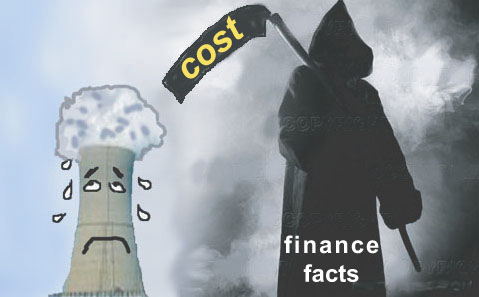
 France must extend nuclear reactor lifespans-audit Jan 31, 2012 Some 22 nuclear reactors will reach 40 years old by 2022
* EDF wants to extend reactors lifespan to 60 years
* Heavy investments needed in short, medium term
PARIS, Jan 31 (Reuters) – France has no option but to extend the lifespan of existing nuclear plants, because any investments in new nuclear capacity or an increase in its reliance on other forms of energy would be too costly and come too late, the French Court of Audit said.
The French independent government body, which is charged with conducting financial and legislative audits, said in a report that a lack of investment decisions to build new reactors meant there were few choices left.
“In the absence of investment decisions, an implicit decision has
already been made that commits France either to prolong the reactors’
lifespan beyond 40 years or to quickly change the energy mix, which
implies more investment,” said the report on the costs of the French
nuclear power sector…..
“IRREVERSIBLE”
Greenpeace said the failure to make any investment decisions in the
past is resulting at higher financial costs and putting the population
at risk.
The failure to invest is “in total contempt of the nuclear safety
authority (ASN), which is the only authority entitled to decide
whether to extend the lifespan of reactors,” said Sophia Majnoni, who
is in charge of nuclear at Greenpeace France.
State-owned utility EDF, which operates all of France’s reactors, has
said it aims to extend their lifespan to 60 years, but there is no
official limit to their functioning. The bulk of French reactors were
built in the 1980s and 1990s.
The Court of Audit also said that to maintain the current level of
electricity production, heavy investments would be needed in the short
and medium term, including a doubling of maintenance investments,
which would in turn push production costs up by 10 percent.
The Court recommended that the choice of the future of the energy mix
should not be made in an implicit manner but that a strategy should be
explicitly elaborated, debated and adopted….
UNCERTAINTY ON FUTURE COSTS
The Court of Audit said French nuclear companies, including Areva and
EDF, had taken into account all costs related to nuclear energy but
that there was still a great deal of uncertainty regarding future
costs.
“This uncertainty cannot be lifted for the moment, because we have not
gone through the concrete experience of dismantling reactors or
putting in place the deep burial of radioactive waste,” Didier Migaud,
the head of the Court of Audit, told a news briefing.
France’s nuclear energy waste management agency (ANDRA) pegged future
costs for storage at 35 billion euros in 2010, up from 15 billion
euros in 2005, with a new cost level to be announced at the end of
2012.
EDF’s investments costs to upgrade the reactions could reach 3.7
billion euros per year, including work imposed by ASN earlier this
month to prevent a nuclear disaster such as Japan’s Fukushima
accident, the report added.
The report’s conclusions echo a leaked draft government study on
Monday, which said that extending the life of France’s reactors would
be a cheaper investment option to 2035-2040 than building any type of
new power plant.
The leaked government study on energy scenarios for France until 2050,
due to be published in its final form on Feb. 13, shows that such
extensions would cost 680 million to 860 million euros per reactor.
PRESIDENTIAL CAMPAIGN
That would compare to the roughly 5-6 billion euros ($6.56-$7.87
billion) it would cost to build a new-generation reactor such as the
1,600 megawatt EPR reactor constructed by state-controlled Areva.
The Court of Audit report, commissioned by Prime Minister Francois
Fillon in May 2011, comes as France’s reliance on nuclear power has
become part of the country’s presidential campaign in the aftermath of
Japan’s nuclear disaster in March.
While the ruling UMP party plans to maintain the country’s nuclear
share of 75 percent in the electricity mix, the highest in the world,
socialist candidate Francois Hollande said he would bring down that
share to 50 percent by 2025.
Hollande, campaigning against President Nicolas Sarkozy, has said that
if elected he would close France’s oldest plant, Fessenheim, toning
down earlier plans as part of a pact with the Green party to shut 24
reactors by 2025.
The Fessenheim plant, one of 19 across the country, houses two
900-megawatt reactors.
France first opted for a full-blown nuclear energy programme with
minimal public debate after the first oil crisis in 1974 and continued
to support nuclear power after the 1986 Chernobyl disaster. ($1 =
0.7625 euros) (Reporting by Benjamin Mallet; Writing by Caroline J
http://af.reuters.com/article/metalsNews/idAFL5E8CV46820120131
No comments yet.
1 This Month

of the week – Shut Down Drone Warfare!


Tell the Ukrainian Government to Drop Prosecution of Peace Activist Yurii Sheliazhenko

Petition to revoke the licensing of the Near Surface Nuclear Disposal Facility (NSDF) at Chalk River. https://www.ourcommons.ca/petitions/en/Petition/Details?Petition=e-7247
To see nuclear-related stories in greater depth and intensity – go to https://nuclearinformation.wordpress.com
-
Archives
- March 2026 (230)
- February 2026 (268)
- January 2026 (308)
- December 2025 (358)
- November 2025 (359)
- October 2025 (376)
- September 2025 (257)
- August 2025 (319)
- July 2025 (230)
- June 2025 (348)
- May 2025 (261)
- April 2025 (305)
-
Categories
- 1
- 1 NUCLEAR ISSUES
- business and costs
- climate change
- culture and arts
- ENERGY
- environment
- health
- history
- indigenous issues
- Legal
- marketing of nuclear
- media
- opposition to nuclear
- PERSONAL STORIES
- politics
- politics international
- Religion and ethics
- safety
- secrets,lies and civil liberties
- spinbuster
- technology
- Uranium
- wastes
- weapons and war
- Women
- 2 WORLD
- ACTION
- AFRICA
- Atrocities
- AUSTRALIA
- Christina's notes
- Christina's themes
- culture and arts
- Events
- Fuk 2022
- Fuk 2023
- Fukushima 2017
- Fukushima 2018
- fukushima 2019
- Fukushima 2020
- Fukushima 2021
- general
- global warming
- Humour (God we need it)
- Nuclear
- RARE EARTHS
- Reference
- resources – print
- Resources -audiovicual
- Weekly Newsletter
- World
- World Nuclear
- YouTube
-
RSS
Entries RSS
Comments RSS
 nuclear-news
Leave a comment