Dim prospects for global nuclear industry
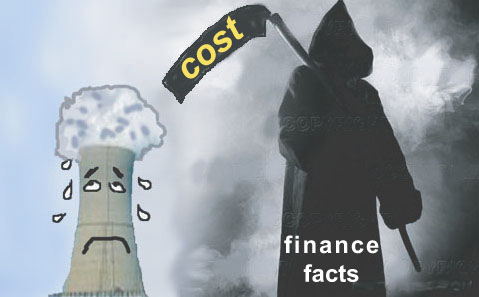
 Prospects for Nuclear Power in 2012, Platts a leading global provider of energy, metals and petrochemicals information., London, 30 January 2012 Even before the Fukushima disaster, the long-awaited nuclear renaissance in the West seemed to be running out of steam. There were two main factors behind this failure; the new Generation III+ reactors produced to take account of the lessons of Chernobyl that would spearhead the revival were not living up to their promises, and, more importantly, banks were proving unwilling to provide finance
Energy Economist – Report.
The key markets for the renaissance were the US and the UK. As pioneers of nuclear power, potentially large markets and countries that seemed to have abandoned plans for new nuclear plants, a successful revival in these countries would have been a powerful endorsement for these new technologies. Following on, the expected reversal of nuclear phase-outs in Germany and Italy would have provided two more large, high-prestige markets.
These follow-on markets are now clearly off the agenda. However, the US and UK governments seem oblivious to the idea that Fukushima might have any implications for new build plants. The incentives in terms of loan guarantees in the US and long-term Power Purchase Agreements at non-market prices in the UK are still in place. Government commitment appears undiminished.
Yet turning a blind eye to Fukushima is clearly not sustainable. The hope that the disaster can be written off as having relevance only to earthquake and tsunami prone countries with Mark 1 Boiling Water Reactors is no more credible than the hope that Chernobyl would have relevance only to a particular Soviet design operated in an inexplicable way.
Gen III+ Claims
The nuclear industry would probably like to forget the claims it made for Generation III+ designs. In short, Gen III+ reactors would achieve the dream combination of being both safer and simpler, making them cheaper and easier to build. The expected overnight (excluding finance charges) construction cost was forecast to be no more than $1,000/kW so that a typical 1,500 MW nuclear power plant would cost $1.5 billion. This was much less than the few plants completed in the 1990s and, not by coincidence, a figure that meant power from new nuclear reactors would be competitive with power from gas-fired plants.
However, the $1,000/kW promise quickly began to unravel when the first order for a Gen III+ design, Olkiluoto in Finland, was priced in 2004 at more than double that level. Construction of the European Pressurized Reactor supplied by French company Areva and its only successor so far in the West, Flamanville in France, has descended into farce. Both plants are now five years over their expected construction time and the latest cost estimates are about double the level forecast at construction start. Most recent serious cost estimates and bids in the past few years for Gen III+ designs have been of the order of $6,000/kW.
However, finance is only partly about build cost. The main issue is risk and comes from the poor record of nuclear plants being built to time and cost, a reputation only worsened by Olkiluoto and Flamanville. The banks have signalled that they are unwilling to bear this risk, leaving three sets of interests that might be able to take it on: the utilities, the vendor or the consumer in some form via the state.
In the past, nuclear power plants have been built with the assumption that consumers would bear the risk because electricity tariffs would recover whatever costs were incurred. When US regulators became unwilling to pass on all these costs in the late 1970s, under pressure from the financial community, ordering there came to an abrupt halt and many plants already ordered and under construction were abandoned. A decade later, as competitive electricity markets began to replace monopolies in Western Europe, nuclear mainly ceased to be a financeable option there too. Although Finland is part of a competitive electricity market, Olkiluoto was fully insulated from it by PPAs lasting the life-time of the plant priced at whatever costs were incurred. Similarly, while France is theoretically an open electricity market, EDF, the builder of Flamanville, remains a de facto monopoly supplier.
The attempted US revival dating back to 2002 was based on shifting the risk from the banks to taxpayers by granting loan guarantees for nuclear projects. Even in today’s economic situation, sovereign debt is good enough to convince most banks to lend, allowing borrowing at not much more than base rate. However, there are other problems with loan guarantees in addition to the likely reluctance of vendor countries to add to their debts.
First, according to international agreements, there should be a premium on the loan cost, either a fee or a higher interest rate that reflects this risk. If the size of this premium accurately reflects the risk, logically, the cost of this premium should be the same as if the private sector was taking the risk. So if loan guarantees are economically priced, they may offer no financial advantage. Second, if the project does go wrong and costs escalate, the utility will have to go to the market to borrow more money to support a failing project, a situation unlikely to impress shareholders.
The possibility that the plant vendor will shoulder the risk no longer exists following Olkiluoto.
When the project started to go badly wrong, Areva quickly refused to honor its ‘turnkey’ contract and the issue of who will pay the extra billions of euro costs will be settled in a court of arbitration. No vendor is now likely to offer a turnkey contract and, even if they did, banks are unlikely to place any value on such a contract.
This brings the issue of shifting the risk from the banks back to convincing consumers that they must bear the risk. The most likely project in the US to go ahead, the Vogtle project for two AP1000 reactors supplied by Toshiba/Westinghouse is in a state (Georgia) where the regulator is already allowing cost recovery even before the start of serious construction. The other project with a reasonable chance of success, the Summer project, also for two AP1000s, is also in a state (South Carolina) with a compliant regulator. It is unlikely there will be many more states with regulators willing and able to commit consumers to repay all the costs, especially if things go wrong at these sites. The two US projects that were in states with competitive electricity markets were quickly abandoned.
In the UK, despite the political rhetoric that a new nuclear program would receive no public subsidies, what is now likely to be on offer are Feed-in-Tariffs and longterm Contracts for Differences. These effectively ensure that all power from nuclear plants is guaranteed to be sold at a predictable price set outside the market.
EDF is the most likely developer in the UK. Whether it will go ahead with an EPR in the UK is likely to depend on whether the design can survive the problems at Olkiluoto and Flamanville and on how fully the CfDs are guaranteed to cover costs. Since the terms of these contracts will be regarded as commercially sensitive, the public will never know what it has signed up to. But, if construction goes ahead, it can be assumed strong cost-recovery guarantees are in place. How the European Commission will view such contracts, which are blatantly unfair state aid and therefore presumably illegal, remains to be seen…..
Lifetime Extensions
Before Fukushima, there was a strong trend to obtain lifetime extensions for existing plants. Particularly in the US and France, there was an expectation that plant life would be extended from 40 to 60 years (and perhaps 80 years). In France, this has worsened Areva’s problems because France already has more than enough nuclear capacity. Extending existing plants’ life to 60 years would mean that the first replacements would not be needed till nearly 2040, leaving Areva dependent on exports in the meantime.
Nevertheless, if the renaissance is indeed still-born, life extensions would mean vendors would continue to have a strong, safe business for a further 20-30 years, providing services, replacement equipment and fuel. That is how the world nuclear industry has survived the past two decades.
However, while life extensions in the US do not seem to have been affected by Fukushima, very surprisingly, in France, they have. EU-mandated ‘stress tests’ at nuclear plants were widely seen as not being likely to uncover much. Essentially it seemed that safety authorities were being asked to assess whether the reactors they had licensed were indeed safe.
Yet it was the French authorities, not known for their aggressive handling of EDF, that have provided the most significant criticisms of existing plants. In its initial review in September 2011, France’s nuclear regulator seemed to be following up on the issues of subcontracting it had identified as causing problems at Flamanville. In January 2012, the regulator signalled that life-extension was not going to be the license to print money it is often seen as. In short, life-extension would cost about €1 billion per plant, about the cost projected originally for a brand new plant….
Nuclear Prospects
Despite attempts by some governments and the nuclear industry to pretend that the Fukushima disaster is not relevant to future investments, it will be decades before the full impact of Fukushima is understood. Chernobyl was a nuclear power plant of dubious design, operated in an inexplicable way in a decaying Soviet Republic, yet 25 years later, no design that was produced to take account of Chernobyl’s lessons has entered service.
Fukushima’s technology is much closer to the designs that dominate existing capacity and Gen III+ designs. It was also installed in probably the most technologically sophisticated country in the world and the country that taught the world quality control.
The reality the nuclear industry may have to face is the one that has been around since Three Mile Island, that designing a PWR or BWR that can survive a loss of coolant and loss of site power and still be economic is simply not feasible. Fukushima may therefore mark the effective end of the nuclear renaissance in the West.
Nevertheless, the UK and the US will probably build some new units proving only that if enough public money is thrown at nuclear power, new reactors can be built, but the scale of support needed will limit the number to no more than a handful and, as the lessons from Fukushima emerge, the designs available now may need significant and expensive modification. The prospects are somewhat better in the rest of the world, led by the BRICs, but even there, the question marks over costs and technology may mean that nuclear optimism in those countries proves short-lived.
No comments yet.
1 This Month

of the week – Shut Down Drone Warfare!


Tell the Ukrainian Government to Drop Prosecution of Peace Activist Yurii Sheliazhenko

Petition to revoke the licensing of the Near Surface Nuclear Disposal Facility (NSDF) at Chalk River. https://www.ourcommons.ca/petitions/en/Petition/Details?Petition=e-7247
To see nuclear-related stories in greater depth and intensity – go to https://nuclearinformation.wordpress.com
-
Archives
- March 2026 (230)
- February 2026 (268)
- January 2026 (308)
- December 2025 (358)
- November 2025 (359)
- October 2025 (376)
- September 2025 (257)
- August 2025 (319)
- July 2025 (230)
- June 2025 (348)
- May 2025 (261)
- April 2025 (305)
-
Categories
- 1
- 1 NUCLEAR ISSUES
- business and costs
- climate change
- culture and arts
- ENERGY
- environment
- health
- history
- indigenous issues
- Legal
- marketing of nuclear
- media
- opposition to nuclear
- PERSONAL STORIES
- politics
- politics international
- Religion and ethics
- safety
- secrets,lies and civil liberties
- spinbuster
- technology
- Uranium
- wastes
- weapons and war
- Women
- 2 WORLD
- ACTION
- AFRICA
- Atrocities
- AUSTRALIA
- Christina's notes
- Christina's themes
- culture and arts
- Events
- Fuk 2022
- Fuk 2023
- Fukushima 2017
- Fukushima 2018
- fukushima 2019
- Fukushima 2020
- Fukushima 2021
- general
- global warming
- Humour (God we need it)
- Nuclear
- RARE EARTHS
- Reference
- resources – print
- Resources -audiovicual
- Weekly Newsletter
- World
- World Nuclear
- YouTube
-
RSS
Entries RSS
Comments RSS
 nuclear-news
Leave a comment