French Polynesia to regain islands, France to provide radiation protection
 most of the radioactive material was transported into the upper atmosphere and dispersed.”….
in August 2006, an official report by the French government confirmed the link between an increase in cases of thyroid cancer on the atolls and France’s atmospheric nuclear tests.
French Senate OKs Return of Nuclear Test Atolls to French Polynesia PARIS, France, January 19, 2012 (ENS) http://www.ens-newswire.com/ens/jan2012/2012-01-19-01.html – The Senate of France has passed legislation that transfers two Pacific atolls used for atmospheric and underground nuclear testing back into the public
domain of French Polynesia….
…If the proposed legislation becomes law, the atolls would be returned to French Polynesia, but France would continue environmental remediation and monitoring of radiation
and geomechanics there “in a sustainable manner.” Continue reading
Small modular nuclear reactors” – is this REALLY “a way for USA to regain leadership in nuclear”
 from a strictly commercial perspective, there is no reason to use nuclear power at all. The capital costs are enormous and the operations and maintenance costs are very high, to say nothing liability insurance.
daviddelosangeles comments on Feds To Finance Small Nuclear Reactor Designs, Ucilia Wang, Forbes, 21 Jan 12, “The key question is would that there need to be a certain minimum number of these [small nuclear] reactors in service for a civilian nuclear power system based on these smaller reactors to operate successfully. This is true for mining, processing, research, and waste disposal. It is not clear that that “critical mass” of reactors could be developed in the current environment.
The decision of the Federal government in the 1950′s to subsidize the creation of the civilian nuclear power industry (e.g. The Price-Anderson Act) was made because nuclear power was not commercially viable but the military needed a nuclear power industry (naval powered submarines – and later aircraft carriers- and nuclear warheads for the air force).
The military alone could achieve the necessary critical mass. A federally subsidized commercial nuclear power industry was the answer. Continue reading
Ratifying the Comprehensive Nuclear Test Ban Treaty – the start of a peace race
 This article on website http://blogcritics.org/culture/article/starting-a-peace-race-with-the/page-3/#ixzz1k84rR2Am contains archival viewing of Presidents Eisenhower and Kennedy

 Starting a Peace Race with the Comprehensive Nuclear Test Ban Treaty, William Lambers — BC Culture, 20 Jan 12, We need to challenge all these countries. But not to an arms race; rather to what President Kennedy called a “peace race.” This is our best hope for unifying the world in eliminating the threat of nuclear weapons and lifting this burden off all peoples.
This unity must first begin at home between Democrats and Republicans. A starting point should be ratifying a pact eliminating all nuclear weapons testing, finally finishing a job started long ago by Presidents Eisenhower and Kennedy….. But decades later, what Ike and Kennedy started is not yet finished. The Comprehensive Nuclear Test Ban Treaty (CTBT) still needs to be ratified.
This treaty goes a step further than the limited one of 1963 and bans all nuclear test explosions, including underground. The United States and seven other nations have yet to approve this treaty for it to take effect. Russia has already ratified it. Continue reading
Economic growth for India through renewable energy
Renewable energy holds key to growth, says Sheila, Times of India, TNN | Jan 21, 2012, NEW DELHI: Chief minister Sheila Dikshit on Friday unveiled the first Renewal Energy Assisted Pump (REAP) system at a function in Mayur Vihar. Developed by discom BSES Yamuna in collaboration with IIT Delhi, the REAP system is an easy-to-install submersible pump connected to a water tank, with a specially designed motor powered by a solar panel.
Officials said REAP would meet water storage and pumping needs in both rural and urban India by harnessing renewable energy sources. “It will help in combating global warming and other environmental issues. In addition to reducing dependence on fossil fuels, it will help BYPL manage the electricity demand better,” said an official.
The first REAP system was installed at a plot owned by the All India Panchayat Parishad (AIPS) in Mayur Vihar. Dikshit said the REAP technology would reduce consumption of power during morning peak hours, when most people switch on their pumps to get water as well as store it. “The technology will also prove useful in agriculture, hospitals, schools, hotels, restaurants, malls and group housing societies,” said a government official. The solar panel will be connected to a pump, which will draw ground water and store it in an overhead tank. The REAP has a capacity to draw 30,000l of water per hour. The CM said generation of power with coal and gas is not a viable solution as these resources are getting depleted. http://timesofindia.indiatimes.com/city/delhi/Renewable-energy-holds-key-to-growth-says-Sheila/articleshow/11573708.cms
Films show effects of uranium mining on indigenous peoples
 Two films show effects of uranium mining Friday Film Pick: Don’t Mine Me & Uranium Art Threat, by EZRA WINTON JANUARY 20, 2012 a doc looking at the history of uranium mining on a Navajo Indian Reservation in the US. Since you can only watch the trailer for this film and read about it as it continues production (with generous donations from supporters), I’m including a second film from 1990 that looks at uranium mining in Canada, called Uranium (trailers after jump).
Don’t Mine Me is a documentary about the history of uranium mining on the Navajo Indian Reservation in the Southwest United States. At the end of WWII, the United States encouraged uranium mining production. Several large uranium deposits were found on the Navajo Reservation and many Navajo men were employed to work these mines. Disregarding the known health risks resulting from exposure to uranium, the United States failed to inform the Navajo workers about the dangers and to regulate the mining to minimize contamination. Several mine workers and families on the reservation have suffered with numerous amounts of health problems, some even fatal, from environmental contamination. For decades the government failed to improve conditions and to inform workers of the dangers. Continue reading
Fiji, Pacific Islands adopt International Renewable Energy Agency program
 Fiji, PICs go for renewable energy Fiji Times, Tevita Vuibau, January 21, 2012 FIJI has joined other Pacific Island countries (PICs) in adopting the Abu Dhabi Communique on Accelerating Renewable Energy Uptake for the Pacific.
According to a statement, Fiji adopted the communique at the conclusion of the Pacific leaders meeting, which preceded the second session of the International Renewable Energy Agency (IRENA) assembly.
Prime Minister Commodore Voreqe Bainimarama headed the country’s delegation to the meeting in Abu Dhabi in the United Arab Emirates.
As part of the communique, the Pacific Island countries resolved to use the large and under-utilised potential for renewable energy in the Pacific region….. He said it… was imperative that Fiji develop a meaningful relationship with IRENA. http://www.fijitimes.com/story.aspx?id=191377
Public ignorance on what really IS ionising radiation
Fukushima Update: Why We Should (Still) Be Worried Business Insider, Russ Baker, WhoWhatWhy | Jan. 20, 2012, “……..What Radiation Is A great help to nuclear proponents is the fact that nuclear physics is complicated, and most people don’t understand even its most basic concepts. The blanket term “radiation” is used to describe all manner of radioactive contamination—as if it’s just one thing—when, in fact, there are different kinds, some much more damaging than others. It also matters exactly what is being exposed to radiation—i.e., exposure outside the body or inside it—and how long the exposure goes on.
In a nutshell, radioactive elements, also known as radioisotopes or radionuclides, are unstable atoms. They seek stability by giving off particles and energy—ionizing radiation—until the radioisotope becomes stable. This process occurs within the nucleus of the radioisotope, and the shedding of these particles and energy is commonly referred to as ‘‘nuclear disintegration.’’ Nuclear radiation expert Rosalie Bertell describes the release of energy in each disintegration as ‘‘an explosion on the microscopic level.”
This process is known as the “decay chain,” and during their decay, most radioactive elements morph into yet other radioactive elements on their journey to becoming lighter, stable atoms at the end of the chain. Some of the morphed-into elements are much more dangerous than the original radioisotope, and the decay chain can take a very long time. This is the reason that radioactive contamination can last so long.
To further complicate the issue, different radioisotopes give off different kinds of radiation—alpha, beta, gamma, X ray, or neutron emissions—all of which behave differently. Alpha emitters, such as plutonium and radon, are intensely ionizing but don’t penetrate very far and generally can’t get through the dead layers of cells covering skin. But when they are inhaled from the air or ingested from radiation-contaminated food or water, they emit high-energy particles that can do serious damage to the cells of sensitive internal soft tissues and organs. The lighter, faster-moving beta particles can penetrate far more deeply than alpha particles, though sheets of metal and heavy clothing can block them. Beta particles are also very dangerous when inhaled or ingested. Strontium-90 and tritium, a radioactive form of hydrogen, are both beta emitters. Gamma radiation is a form of electromagnetic energy like X rays, and it passes through clothing and skin straight into the body. A one-inch shield of either lead or iron, or eight inches of concrete are needed to stop gamma rays, examples of which include cobalt-60 and cesium-137—one of the radionuclides of most concern in the Fukushima fallout. Aside from use in medical diagnostics, X rays are also produced in nuclear fission, and their effects are similar to gamma radiation. Neutron emissions are the most penetrating of all types of radiation and require a shield of several feet of water or concrete to contain them.
The behavior of radioisotopes out in the environment also varies depending on what they encounter. They can combine with one another or with stable chemicals to form molecules that may or may not dissolve in water. They can combine with solids, liquids, or gases at ordinary temperature and pressure. They may be able to enter into biochemical reactions, or they may be biologically inert.
In her book No Immediate Danger: Prognosis for a Radioactive Earth, Bertell notes that if they enter the body either through air, food, water, or an open wound, “They may remain near the place of entry into the body or travel in the bloodstream or lymph fluid. They can be incorporated into the tissue or bone. They may remain in the body for minutes or hours or a lifetime.” To illustrate how different radioisotopes behave, she points out that: “Plutonium is biologically and chemically attracted to bone as is the naturally occurring radioactive chemical radium. However, plutonium clumps on the surface of bone, delivering a concentrated dose of alpha radiation to surrounding cells, whereas radium diffuses homogeneously in bone and thus has a lesser localized cell damage effect. This makes plutonium, because of the concentration, much more biologically toxic than a comparable amount of radium.”
Specific health effects from internal radiation exposure correlate with where radioisotopes land in the body. Bertell explains: “For example, radionuclides lodged in the bones can damage bone marrow and cause bone cancers or leukemia, while radionuclides lodged in the lungs can cause respiratory diseases. Generalized whole body exposure to radiation can be expressed as a stress related to a person’s hereditary medical weakness. Individual breakdown usually occurs at our weakest point.” In other words, the impact of radiation exposure also depends very much on each individual’s level of health and genetic make-up…..
http://www.businessinsider.com/fukushima-update-why-we-should-still-be-worried-2012-1
AREVA’s environmental plan for uranium mining rejected by Nunavut
 “Barry McCallum [Areva’s manager of Nunavut affairs] from Areva has been boasting about how many thousands of pages long their draft environmental impact statement is. It appears that size isn’t everything,” said Jack Hicks, a member of Nunavummiut Makitagunarningit, in an email.
Nunavummiut Makitagunarningit has lobbied against the Kiggavik project for years and is opposed to uranium mining in Nunavut….
 NIRB gives Areva failing grade on Kiggavik’s draft EIS Environmental review on uranium scheme stalled NUNATSIAQ NEWS, Nunavut January 20, 2012 The Kiggavik uranium project, about 80 km from Baker Lake, would cost
$2.1 billion to build … The Nunavut Impact Review Board has rejected Areva Canada’s
draft environmental statement and said an environmental review cannot begin until the company fixes its work.
An environmental review of Nunavut’s first uranium mine is stalled for the time being, following a decision by the Nunavut Impact Review Board to reject an 11-volume draft environmental impact statement from Areva Canada on its proposed Kiggavik uranium extraction project near Baker Lake. Continue reading
Huge potential for wave and tidal power – U.S. East Coast
 STUDY: CA Coast Could Harness Big Energy, KMJNow, by Margaret Carrero, 20 Jan 12 A two year study indicates that California’s coastal waters embody enough power to generate nearly one third of the nation’s energy supply.
USA’s National Center for Science Education defends Climate Change
 NCSE’s climate change initiative launched, National Center for Science Education, January 16th, 2012 NCSE is proud to announce the launch of its new initiative aimed at defending the teaching of climate change. Like evolution, climate change is accepted by the scientific community but controversial among the public.
As a result, educators trying to teach climate change, like their counterparts trying to teach evolution, are often likewise pressured to compromise the scientific and pedagogical integrity of their instruction. But there was no NCSE for climate — no organization, that is, specializing in providing advice and support to those facing challenges to climate change education.
With the launching of the initiative, NCSE itself becomes that organization. As NCSE’s executive director Eugenie C. Scott explained in a January 16, 2012, press release, “We consider climate change a critical issue in our own mission to protect the integrity of science education.” She added, “Climate affects everyone, and the decisions we make today will affect generations to come. We need to teach kids now about the realities of global warming and climate change, so that they’re prepared to make informed, intelligent decisions in the future.”
The response from the scientific and education communities has been enthusiastic…. Included in the climate change initiative is a new area of NCSE’s websitedevoted to climate change education….. http://ncse.com/news/2012/01/ncses-climate-change-initiative-launched-007149
US education’s battles: first evolution, now climate change
“Climate change education is kind of where evolution education was 30 years ago,”
US education advocates tackle climate change sceptics New Scientist, 19 January 2012 Read more: “Education campaigner wants to expel climate denial“A NEW front has opened in the battle over US school science curricula. After decades of fighting to  keep creationism out of the classroom, US science education advocates are steeling themselves to face a new foe: climate change sceptics.
Over the past few years, several US states and local school boards have introduced measures that would mean teachers must include the views of those who are sceptical of a human influence on climate change in science lessons. Continue reading
Violence, gunshots, and radioactive material stolen from Egyptian nuclear facility site

 Radioactive material stolen from Egyptian
  power station: report Reuters Jan 19, 2012 CAIRO – Radioactive material has been stolen from a nuclear power station on Egypt’s Mediterranean coast that was the scene of violent protests last week, the state-run al-Ahram newspaper reported on Thursday.
A safe containing radioactive material at the Dabaa nuclear power plant, which is still under construction, was seized while another also containing radioactive material was broken open and part of its contents taken, the newspaper said.
In Vienna, an official of the U.N. nuclear agency described the items missing as “low-level radioactive sources” which had been taken from a laboratory at the construction site. He could not give any details on the nature of the stolen items…
.. More than a dozen people were wounded last week when military police tried to disperse hundreds of Egyptian protesters demanding the relocation of the Dabaa plant.
Plant staff have refused to go to the site because of the deterioration in the security situation there, al-Ahram said. About 500 Egyptians rallied in front of the plant last week to demand that the project be terminated, with some saying they had lost their land on the site.
Soldiers and the demonstrators threw stones at each other and exchanged gunfire after the protesters demolished a wall surrounding the site, a security source and witnesses said…
http://news.nationalpost.com/2012/01/19/radioactive-material-stolen-from-egyptian-power-station-report/
A nuclear free Scotland would make England pay up for Trident submarine base
The nuclear issue is the one that concerns ministers most; where would the new Trident submarines be based, if not at Faslane on the Clyde?
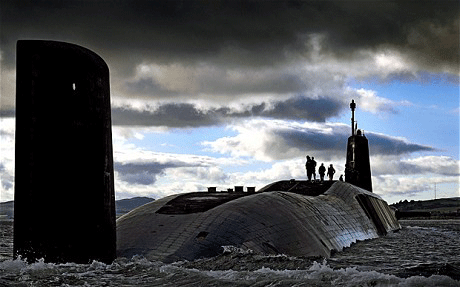

 SNP’s defence policies are ‘laughable’, says Philip Hammond, Nick Hopkins, guardian.co.uk, 19 January 2012 Defence secretary wades into the debate over devolution as the likely effects – and costs – of Scottish independence rattle the MoD.… The new defence secretary, Philip Hammond, is pretty choosy about the media he does, and on what subjects. Today, he went on the record over devolution, and the effects it might have on defence.
No wonder he was prepared to speak, and in such unusually fruity language for a man not known for rhetorical flourish.
He knows the ramifications for the military, and the Treasury, are enormous. The key themes for the SNP are easy enough to spell out – Scotlandwould not be a member of Nato and would be nuclear free. Continue reading
Taxpayers to fund massive nuclear waste dump, damaging to Cumbria
A public inquiry and appeal agreed with Cumbria County Council 15 years ago that the risk of radioactive waste migrating to the surface was too great for geological disposal of intermediate level waste.
Today, that same authority is a partner in the plan which now includes high-level waste.
A nuclear dump would blight Cumbria’s major industries of agriculture and tourism…. MRWS is now sinking taxpayers’ millions into a timetabled process too big to fail.
 NUCLEAR DEBATE: RADIATION FREE LAKELAND: JUST SAY NO: Times and Star By Marianne Birkby, 19 January 2012 The last government set up a quango called Managing Radioactive Waste Safely. MRWS aims to give lucrative contracts, courtesy of the taxpayer, to private companies for a mine 3,280ft deep by 269 sq ft.

Put in perspective, Scafell Pike is 3,208ft. Imagine that size mine filled with high-level radioactive waste by 2026, setting a world first. Continue reading
Violence as protestors oppose Egypt’s new nuclear power plant
Protests at nuclear power station construction site escalate, Egypt Independent, Al-Masry Al-Youm Staff, 19/01/2012 Protesters at the nuclear power station site in Dabaa, located in the Matrouh Governorate on the North Coast, said on Thursday they would continue their sit-in and asserted that the government would not be able to force them out.
Egypt’s first nuclear power station is planned to be built in Dabaa, but the residents stormed the site last week, destroying many buildings and staging a sit-in.
They have already built 50 houses on the site, changed its name to New Dabaa and decided to move the cattle market there.
They also said they would give 1,000 square meters for free to young people who cannot afford a place to live. Dabaa residents say the government did not compensate them for the land it allocated to the project.
The protesters rejected Prime Minister Kamal al-Ganzouri’s assurances that the government will go ahead with plans to build the plant on this site…. The plant’s construction site was looted and vandalized earlier this
week, resulting in LE500 million in losses.
There have been conflicting reports regarding the Nuclear Stations Authority committee that went to inspect the site on Thursday in order to assess the damages. It was rumored that committee members refused to enter the site upon hearing that safes containing radioactive elements were missing…… http://www.almasryalyoum.com/en/node/609946
1 This Month

Protect Sazan Island from the Trump family! https://secure.avaaz.org/campaign/en/protect_sazan_island_from_the_trump_family_loc/?bqFCVab&v=174511&cl=22707147157&_checksum=5e9dde668860e8231c33699735e16a1fbf22ab2cb01da50c999fe8732b9775ef&utm_source=email&utm_medium=blast_email&utm_campaign=174511


Cuba Is Not a Failed State – It Is a Besieged State
PETITION: “Global Appeal to Endorse Palestinian Right of Return of Refugees”
To see nuclear-related stories in greater depth and intensity – go to https://nuclearinformation.wordpress.com
-
Archives
- June 2026 (129)
- May 2026 (306)
- April 2026 (356)
- March 2026 (251)
- February 2026 (268)
- January 2026 (308)
- December 2025 (358)
- November 2025 (359)
- October 2025 (376)
- September 2025 (257)
- August 2025 (319)
- July 2025 (230)
-
Categories
- 1
- 1 NUCLEAR ISSUES
- business and costs
- climate change
- culture and arts
- ENERGY
- environment
- health
- history
- indigenous issues
- Legal
- marketing of nuclear
- media
- opposition to nuclear
- PERSONAL STORIES
- politics
- politics international
- Religion and ethics
- safety
- secrets,lies and civil liberties
- spinbuster
- technology
- Uranium
- wastes
- weapons and war
- Women
- 2 WORLD
- ACTION
- AFRICA
- Atrocities
- AUSTRALIA
- Christina's notes
- Christina's themes
- culture and arts
- Events
- Fuk 2022
- Fuk 2023
- Fukushima 2017
- Fukushima 2018
- fukushima 2019
- Fukushima 2020
- Fukushima 2021
- general
- global warming
- Humour (God we need it)
- Nuclear
- RARE EARTHS
- Reference
- resources – print
- Resources -audiovicual
- Weekly Newsletter
- World
- World Nuclear
- YouTube
-
RSS
Entries RSS
Comments RSS
 nuclear-news