Climate change policy manipulated by the nuclear lobby
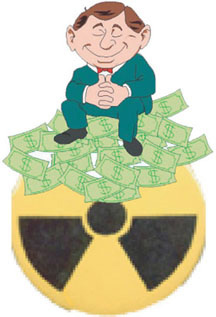 The threat of climate change gained traction in the global imagination after the end of the Cold War. And as warming worries grew, nuclear power became an anti-emissions trump card in the eyes of many, fueling a reactor building spree.
“Government policy came to incorporate promotion of nuclear power. It was taboo for us to even make an issue of it.”
 Nuclear power boosters used climate change to ride to energy supremacy, Mainichi DailyNews, 30 Jan 12 In 1997, in the midst of the international negotiations that would eventually result in the Kyoto Protocol, the Japanese delegation was pondering whether it could realistically accept the protocol’s main point: a commitment to a 6 percent decrease in greenhouse gas emissions from 1990 levels. They were also grappling with what such a commitment would mean for Japan’s energy supplies.
Strangely enough, though the Japanese delegation was grappling with issues of carbon emissions and energy needs, there was not a single representative of the then Environment Agency on hand. Osamu Watanabe, vice minister at the former Ministry of International Trade and Industry at the time of the talks and now president of Japan Petroleum Exploration Co., sums up Japan’s thinking like this:
“Taking nuclear power into account was a prerequisite for accepting the 6 percent reduction. Speaking for the industry ministry, we thought that the more nuclear power we had, the more we could reduce greenhouse gas emissions.”
Meanwhile, at the Environment Agency — which became the Environment Ministry in 2001 — there were many staff who took a more cautious attitude to the promotion of nuclear power. Their skepticism did not, however, often find effective expression.
“The industry ministry put up a lot of resistance to the Environment Agency getting involved in energy policy,” a senior agency official from the time says. “We just couldn’t get a word in.”
The threat of climate change gained traction in the global imagination after the end of the Cold War. And as warming worries grew, nuclear power became an anti-emissions trump card in the eyes of many, fueling a reactor building spree. Another former Environment Ministry official with long experience in climate change policy told the Mainichi,
“Government policy came to incorporate promotion of nuclear power. It was taboo for us to even make an issue of it.”
Even after the Kyoto Protocol was agreed on, the Environment Agency
and its successor ministry had a very rough road trying to defend
climate change policies….
“We thought getting the protocol ratified was the greatest
environmental policy measure we could take, but drawing on nuclear
power never entered our minds,” the former senior Environment Ministry
official says. It was, however, on the minds of some people in
government. When the government finalized its basic principles for
climate change policy in March 2002, the document included a provision
for “promotion of nuclear power,” and set a goal of increasing nuclear
power output by 30 percent by 2010.
The Environment Agency also came under direct pressure to fall in line
behind nuclear power even before the rumblings around the Kyoto
Protocol….
, the environment minister stated that “to reduce greenhouse gas
emissions and to guarantee safety, steady promotion of nuclear power
is necessary.” This was the first time official pronouncements in
favor of nuclear power were made over an environmental assessment….
“I think the government, which seemed to be blocked and drifting on
how to get reactor construction moving and the problems of radioactive
waste disposal, just latched onto the global warming issue when
climate change countermeasures reached a critical juncture. We thought
that the risks of global warming were far greater than those of
nuclear power, but in this earthquake-prone nation of Japan, the
opposite is true.” . University of Tokyo professor emeritus Ryoichi
Yamamoto — a climate change policy advisor to both the Abe and Fukuda
administrations –
http://mdn.mainichi.jp/features/news/20120125p2a00m0na020000c.html
No comments yet.
1 This Month

of the week – Shut Down Drone Warfare!


Tell the Ukrainian Government to Drop Prosecution of Peace Activist Yurii Sheliazhenko

Petition to revoke the licensing of the Near Surface Nuclear Disposal Facility (NSDF) at Chalk River. https://www.ourcommons.ca/petitions/en/Petition/Details?Petition=e-7247
To see nuclear-related stories in greater depth and intensity – go to https://nuclearinformation.wordpress.com
-
Archives
- March 2026 (230)
- February 2026 (268)
- January 2026 (308)
- December 2025 (358)
- November 2025 (359)
- October 2025 (376)
- September 2025 (257)
- August 2025 (319)
- July 2025 (230)
- June 2025 (348)
- May 2025 (261)
- April 2025 (305)
-
Categories
- 1
- 1 NUCLEAR ISSUES
- business and costs
- climate change
- culture and arts
- ENERGY
- environment
- health
- history
- indigenous issues
- Legal
- marketing of nuclear
- media
- opposition to nuclear
- PERSONAL STORIES
- politics
- politics international
- Religion and ethics
- safety
- secrets,lies and civil liberties
- spinbuster
- technology
- Uranium
- wastes
- weapons and war
- Women
- 2 WORLD
- ACTION
- AFRICA
- Atrocities
- AUSTRALIA
- Christina's notes
- Christina's themes
- culture and arts
- Events
- Fuk 2022
- Fuk 2023
- Fukushima 2017
- Fukushima 2018
- fukushima 2019
- Fukushima 2020
- Fukushima 2021
- general
- global warming
- Humour (God we need it)
- Nuclear
- RARE EARTHS
- Reference
- resources – print
- Resources -audiovicual
- Weekly Newsletter
- World
- World Nuclear
- YouTube
-
RSS
Entries RSS
Comments RSS
 nuclear-news
Leave a comment