Climate change policy manipulated by the nuclear lobby
 The threat of climate change gained traction in the global imagination after the end of the Cold War. And as warming worries grew, nuclear power became an anti-emissions trump card in the eyes of many, fueling a reactor building spree.
“Government policy came to incorporate promotion of nuclear power. It was taboo for us to even make an issue of it.”
 Nuclear power boosters used climate change to ride to energy supremacy, Mainichi DailyNews, 30 Jan 12 In 1997, in the midst of the international negotiations that would eventually result in the Kyoto Protocol, the Japanese delegation was pondering whether it could realistically accept the protocol’s main point: a commitment to a 6 percent decrease in greenhouse gas emissions from 1990 levels. They were also grappling with what such a commitment would mean for Japan’s energy supplies.
Strangely enough, though the Japanese delegation was grappling with issues of carbon emissions and energy needs, there was not a single representative of the then Environment Agency on hand. Osamu Watanabe, vice minister at the former Ministry of International Trade and Industry at the time of the talks and now president of Japan Petroleum Exploration Co., sums up Japan’s thinking like this:
“Taking nuclear power into account was a prerequisite for accepting the 6 percent reduction. Speaking for the industry ministry, we thought that the more nuclear power we had, the more we could reduce greenhouse gas emissions.”
Meanwhile, at the Environment Agency — which became the Environment Ministry in 2001 — there were many staff who took a more cautious attitude to the promotion of nuclear power. Their skepticism did not, however, often find effective expression.
“The industry ministry put up a lot of resistance to the Environment Agency getting involved in energy policy,” a senior agency official from the time says. “We just couldn’t get a word in.” Continue reading
Records not kept by 5 Japanese nuclear disaster committees
 Five Japan committees keep no disaster records Terra Daily Tokyo (AFP) Jan 27, 2012 Five government teams dealing with Japan’s tsunami and nuclear catastrophes kept no detailed records, an official said Friday, adding to a growing picture of chaos in Tokyo’s disaster response…
Now the government has admitted having no minutes from a further four emergency committees, Continue reading
USA’s Pentagon secret aim for an even bigger bomb
Pentagon developing more powerful bunker buster bomb to target Iran’s ‘hidden nuclear weapons’ DAILY MAIL 29th January 2012 The Pentagon has made a secret request to develop its largest bomb because officials believe it is not capable of destroying Iran’s fortified underground facilities.

The 13.6 ton Massive Ordnance Penetrator (MOP) is the deepest penetrating ‘bunker buster’ currently in the U.S. arsenal, designed to take out fortifications built by Iran to hide their alleged nuclear weapons.
But a request has now been secretly submitted to Congress for funding
to make a more powerful weapon…. http://www.dailymail.co.uk/news/article-2093371/Pentagon-developing-powerful-bunker-buster-bomb.html#ixzz1kyOvyFCx
Japan’s anti nuclear movement moves to the mainstream
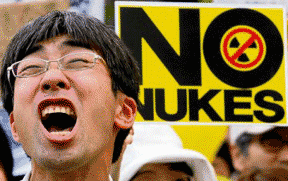 Anti-nuclear movement unites rightists, leftists, The Asahi Shimbun, January 27, 2012 In the early stages of the Fukushima nuclear disaster, Cocoro Fujinami posted a message on her blog that brought the little-known singer instant fame.
“How much are we going to coddle the nuclear power industry?” wrote Fujinami, a so-called B-class idol who has also posed as a gravure model and appeared in film.
However, that message also led to scorn. The 15-year-old is one of the new faces of the anti-nuclear movement in Japan, an issue that has blurred the lines between leftists and
rightists.
After Fujinami posted that message on March 23, her blog received more than 3 million hits over three days. She won support from Softbank Corp. President Masayoshi Son and other well-known figures and became a regular invitee to anti-nuclear demonstrations. Continue reading
Iowa citizens to pay up even if nuclear company walks away!
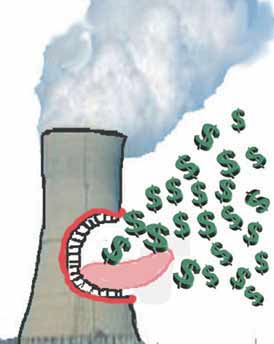 MidAmerican’s nuclear plant proposal puts risk on consumers, Des Monies Register, 29 Jan 12, Sonia Ashe, Iowa Public Interest Research Group, Des Moines Beyond the lack of public protection against the financial risks and uncertainties associated with the development of new nuclear power, some provisions in Iowa’s nuclear construction work in progress bill, H.F. 561, actually incentivize behavior contrary to the public interest.
The Iowa Utility Board staff recently released a memo that makes clear that H.F. 561, as written, “would shift nearly all of the construction, licensing and permitting risk associated with one or more nuclear plants from the company to its customers.” That certainly
doesn’t provide proper motivation for a utility company like MidAmerican Energy to keep costs low or even follow through with completion of the project.
The memo also warns that H.F. 561 would prevent the Iowa Utility Board from offering traditional protection to consumers in the case of cost overruns, project cancellation or mismanagement.
MidAmerican Energy CEO Bill Fehrman keeps emphasizing that this bill lays all the responsibility and power at the feet of the IUB, but it certainly doesn’t sound like the IUB staff agrees.
If bringing new nuclear power to Iowa means forcing already strapped Iowans to bear all the cost and risk involved, with few protections, I say it’s not worth it. We have other, more cost-effective options that don’t require a blank check in advance….
http://www.desmoinesregister.com/article/20120129/OPINION04/301290080/-1/becker_trial/MidAmerican-s-nuclear-plant-proposal-puts-risk-consumers
Problems in assessing radiation in Fukushima school lunches
Radiation testing on school lunches differs, The Yomiuri Shimbun, 30 Jan 12, FUKUSHIMA-–Municipalities are carrying out tests for radioactive substances on ingredients used in school lunches, but parents are worried whether their children are adequately protected as the testsare conducted in various ways. Continue reading
UK assesses the nation’s coming dangers from climate change
UK ranks top risks posed by climate change, SMH, David Stringer, January 27, 2012 Coastlines, working patterns and even the country’s most famous meal are under threat from climate change, Britain says in its first-ever national assessment of the likely risks. Continue reading
Worry over nuclear transport through Caribbean Sea
Hazardous waste through the Caribbean Sea a concern The Barbados Advocate, 1/23/2012 There is concern over the transportation of hazardous nuclear waste and other hazardous material through the Caribbean Sea which are potential threats to lives, health, the environment and our economies.
This comes from Ambassador Raymond Wolfe, speaking on behalf of the Caribbean Community (CARICOM) to the General Assembly’s Social, Humanitarian and Cultural Committee….
He said that the focus on shipping and maritime commerce must also include improved measures, regulations and standards governing maritime safety, the training of seafarers and the safety of navigation at sea, including the safety of shipping vessels… while CARICOM acknowledges the rights of Member States to use nuclear energy for peaceful purposes, there still remains a concern,” he stressed…….. http://www.barbadosadvocate.com/newsitem.asp?more=local&NewsID=22326
What became of japan’s radioactive cows?
Japan loses track of radioactive cows, ABC Asia Pacific News, A woman feeds her cattle at a farm in Kawamata, 45 kilometres west of the Fukushima nuclear power plant. [AFP] Mark Willacy, Tokyo, 27 Jan 2012 Japanese authorities have lost track of nearly 3,000 cows suspected of containing high levels of radioactive caesium.
The cows ate rice straw contaminated in the Fukushima nuclear disaster. Last year Japan’s health ministry ordered the testing of more than 4,500 beef cattle suspected of being contaminated with radiation.
But according to Japan’s Yomiuri newspaper, so far only a third has been tested, with the distribution routes of about 3,000 head of slaughtered cattle remaining a mystery.
Of the tested meat, about six per cent was found to contain radioactive caesium above the acceptable safe limit. Food safety experts say that consumers would have to eat a lot of the
meat to suffer any damage to their health. http://abcasiapacificnews.com/stories/201201/3417073.htm
Australia’s ailing uranium industry
 In short, the deal with India is seen by some as little more than a short term means to prop up an industry breathing its last gasp……
[For uranium explorers] the 52 week highs and lows paints the same picture as we saw for the producers – market participants doubt the viability of exploring for a product whose demand may be in jeopardy.
Share market participants have spoken and they clearly doubt the future of nuclear energy.
URANIUM STOCKS HIT HARD BUT BULLS ARE BELLOWING, The Bull, By Bob Kohut | 30.01.2012 As the dismal trading in 2011 global share markets ground down to its agonising year-end finish, some Australian investors were heartened by the news that our government was about to lift the ban on uranium sales to India.. Continue reading
1 This Month

of the week – Shut Down Drone Warfare!


Tell the Ukrainian Government to Drop Prosecution of Peace Activist Yurii Sheliazhenko

Petition to revoke the licensing of the Near Surface Nuclear Disposal Facility (NSDF) at Chalk River. https://www.ourcommons.ca/petitions/en/Petition/Details?Petition=e-7247
To see nuclear-related stories in greater depth and intensity – go to https://nuclearinformation.wordpress.com
-
Archives
- March 2026 (230)
- February 2026 (268)
- January 2026 (308)
- December 2025 (358)
- November 2025 (359)
- October 2025 (376)
- September 2025 (257)
- August 2025 (319)
- July 2025 (230)
- June 2025 (348)
- May 2025 (261)
- April 2025 (305)
-
Categories
- 1
- 1 NUCLEAR ISSUES
- business and costs
- climate change
- culture and arts
- ENERGY
- environment
- health
- history
- indigenous issues
- Legal
- marketing of nuclear
- media
- opposition to nuclear
- PERSONAL STORIES
- politics
- politics international
- Religion and ethics
- safety
- secrets,lies and civil liberties
- spinbuster
- technology
- Uranium
- wastes
- weapons and war
- Women
- 2 WORLD
- ACTION
- AFRICA
- Atrocities
- AUSTRALIA
- Christina's notes
- Christina's themes
- culture and arts
- Events
- Fuk 2022
- Fuk 2023
- Fukushima 2017
- Fukushima 2018
- fukushima 2019
- Fukushima 2020
- Fukushima 2021
- general
- global warming
- Humour (God we need it)
- Nuclear
- RARE EARTHS
- Reference
- resources – print
- Resources -audiovicual
- Weekly Newsletter
- World
- World Nuclear
- YouTube
-
RSS
Entries RSS
Comments RSS
 nuclear-news