A decision with vision – ban on uranium minng near Grand Canyon
the 20-year ban is supported by an unprecedented coalition of tribal leaders; hunting, fishing, ranching and conservation groups; municipal water suppliers; wildlife advocates; and nearly 300,000 individuals who commented favorably on the proposed moratorium. Chambers of commerce, community leaders and elected officials are also among those mainstream voices speaking out against a handful of politicians now defending industrialists’ demand to exploit our treasured landscape.
At risk are the Grand Canyon’s watersheds. These interconnected surface and groundwater systems extend many miles beyond the park’s boundary.
 Uranium-mining ban was a grand decision, The Arizona Republic, by Roger Clark – Jan. 22, 2012 Arizonans and all Americans won a major victory on Jan. 9 when Interior Secretary Ken Salazar signed a “record of decision” for a 20-year ban on new uranium claims on 1.1 million acres of public land surrounding Grand Canyon National Park.
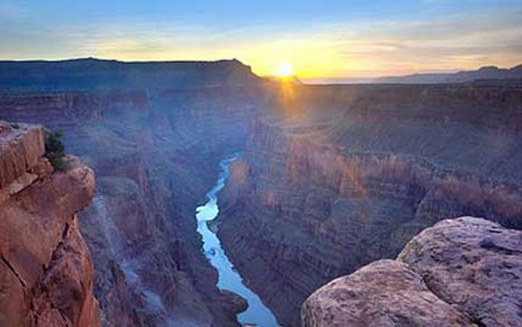
The decision reduces the risk of permanent harm to wildlife, water, our economy and sites sacred to Havasupai and all native people in ourregion. It also best serves our nation’s interests.
As Salazar noted, “Time and again, we as a nation have shown that our
strength comes not just from the power of our industry and technology
but also from the wisdom of restraint.”
It was in this spirit that the Obama administration acted decisively,
as so many leaders have done before, in choosing to protect enduring
values instead of succumbing to the temptation of short-lived economic
interests.
The Grand Canyon has been northern Arizona’s economic engine for
nearly a century. It sustainably provides $700 million a year in jobs
and revenue. We can survive boom-and-bust cycles, but the last uranium
rush left a deadly legacy of poisoned land and water that will keep
employing cleanup crews for generations.
Somehow industry promises to “do it different this time” sound like a
serial embezzler’s cry for one more crack at running the cash
register.
That is why the 20-year ban is supported by an unprecedented coalition
of tribal leaders; hunting, fishing, ranching and conservation groups;
municipal water suppliers; wildlife advocates; and nearly 300,000
individuals who commented favorably on the proposed moratorium.
Chambers of commerce, community leaders and elected officials are also
among those mainstream voices speaking out against a handful of
politicians now defending industrialists’ demand to exploit our
treasured landscape.
At risk are the Grand Canyon’s watersheds. These interconnected
surface and groundwater systems extend many miles beyond the park’s
boundary. Hikers can no longer drink from a permanently polluted
spring located beneath an abandoned uranium mine on the Canyon’s South
Rim.
New mines threaten hundreds of other springs and creeks, which offer
precious water to thousands of species. Moreover, every new mining
operation sacrifices cultural sites and fragments wildlife habitat by
enveloping the park in dirt roads, dust, heavy machinery, noise,
off-road drilling rigs, power lines and relentless truck traffic.
For all of these liabilities, two decades of mining would yield
handsome returns from high-grade uranium ore. But under an antiquated
national mining law, not one penny in royalties would be returned to
taxpayers.
As for jobs, the environmental-impact statement estimates that the
five counties in the area, including Coconino and Mohave, would see
the number of jobs increase by 0.4 percent while the mining lasts.
Mining would not produce any significant change in economic conditions
for residents or local and regional economies.
Virtually all uranium-mining corporations set to mine around the Grand
Canyon are foreign-owned. Mining profits would mostly accrue in
offshore accounts.
One wonders why proponents continue to lie about the amount of jobs
and revenue uranium mining around the Grand Canyon might produce.
Fortunately, well-informed leaders have prevailed.
Americans are cheering this landmark decision. And fellow citizens can
stand proud as we approach our Grand Canyon State’s centennial
celebration.
In closing, Salazar said, “Every generation of Americans faces moments
when we must choose between the pressures of the now and the
protection of the timeless. Today, we know that we can no longer
afford to turn our backs on … iconic landscapes like the Grand
Canyon. … I am therefore at peace with this decision, because it is
the right thing to do.” And so it is.
http://www.azcentral.com/arizonarepublic/opinions/articles/2012/01/22/20120122uranium-mining-ban-grand-decision.html#ixzz1kVSvz0xR
No comments yet.
1 This Month

of the week – Shut Down Drone Warfare!


Tell the Ukrainian Government to Drop Prosecution of Peace Activist Yurii Sheliazhenko

Petition to revoke the licensing of the Near Surface Nuclear Disposal Facility (NSDF) at Chalk River. https://www.ourcommons.ca/petitions/en/Petition/Details?Petition=e-7247
To see nuclear-related stories in greater depth and intensity – go to https://nuclearinformation.wordpress.com
-
Archives
- March 2026 (222)
- February 2026 (268)
- January 2026 (308)
- December 2025 (358)
- November 2025 (359)
- October 2025 (376)
- September 2025 (257)
- August 2025 (319)
- July 2025 (230)
- June 2025 (348)
- May 2025 (261)
- April 2025 (305)
-
Categories
- 1
- 1 NUCLEAR ISSUES
- business and costs
- climate change
- culture and arts
- ENERGY
- environment
- health
- history
- indigenous issues
- Legal
- marketing of nuclear
- media
- opposition to nuclear
- PERSONAL STORIES
- politics
- politics international
- Religion and ethics
- safety
- secrets,lies and civil liberties
- spinbuster
- technology
- Uranium
- wastes
- weapons and war
- Women
- 2 WORLD
- ACTION
- AFRICA
- Atrocities
- AUSTRALIA
- Christina's notes
- Christina's themes
- culture and arts
- Events
- Fuk 2022
- Fuk 2023
- Fukushima 2017
- Fukushima 2018
- fukushima 2019
- Fukushima 2020
- Fukushima 2021
- general
- global warming
- Humour (God we need it)
- Nuclear
- RARE EARTHS
- Reference
- resources – print
- Resources -audiovicual
- Weekly Newsletter
- World
- World Nuclear
- YouTube
-
RSS
Entries RSS
Comments RSS
 nuclear-news
Leave a comment