Double standards of the West in sanctions against Iran
 Like sanctions, war will not work either. A war could not deter Iran from pursuing its nuclear program and seeking nuclear weapons.
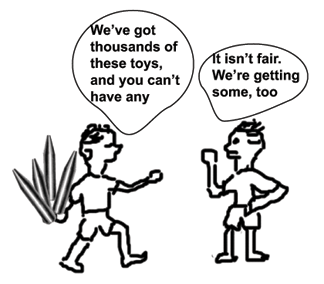
The flaw in the arguments used by the United States, Israel and the European Union against Iran’s nuclear program is the apparent double standard. How can the US expect to persuade Iran to relinquish its nuclear program when America has acquiesced to India, Pakistan, Israel and North Korea acquiring nuclear weapons? The US has even signed a nuclear partnership pact with India…….
 Accepting the inevitable: A nuclear Iran, DAILY NEWS EGYPT, By Mamdouh G. Salameh January 22, 2012, The only sanctions able to hurt Iran are those that ban its crude oil exports, but getting the international community to agree on such sanctions is virtually impossible.
The international political and economic repercussions of these sanctions would be so huge that they are not worth pondering. Even if, by the very unlikely chance, such sanctions were agreed upon by the United Nations Security Council, Iran’s retaliation would be immediate and destructive.
Iran could easily mine the Strait of Hormuz in the face of the 17 million barrels of oil a day (mbd) exported by the Arab Gulf oil producers. This would push the price of oil to more than $150-$200 a barrel (it is currently about $100 a barrel). The biggest loser, of course, would be the biggest oil consumer — namely the United States, which imports 12-14 million barrels of oil every day. This would spell an economic catastrophe for the United States in particular and the world-at-large.
And, in a blatant act of defiance, Iran could even
sabotage Saudi oil installations in Ras Tannura and the eastern region
of Saudi Arabia, thus plunging the world into the largest oil crisis
in its history. That is why sanctions against Iran will not work.
Likewise, a naval blockade to enforce sanctions would prove futile and
could lead to a war between the United States and Iran, with
disastrous implications for the Middle East and US interests in the
Gulf.
Like sanctions, war will not work either. A war could not deter Iran
from pursuing its nuclear program and seeking nuclear weapons. Such a
war could only be waged by the United States or Israel or both
jointly. The flaw in this approach is that Iran unfortunately holds
all the trump cards, meaning that it could inflict so much damage on
the aggressor as to make the war untenable. Moreover, the United
States and Israel can’t win such a war without themselves using
nuclear weapons to destroy Iran, something also unthinkable.
Israel could attack Iran’s nuclear installations in a more limited
strike, but the damage would only delay Iran’s nuclear program, not
stop it outright. The retaliation from Iran would be so devastating as
to make Israel’s war with Hezbollah in 2006 look like child’s play.
You may recall that Israel got a bloody nose at the hands of
Hezbollah, with Iran-supplied rockets raining down on Israel and
forcing 500,000 Israelis from the north of Israel to flee to the
interior. One can only imagine what Iranian missiles targeting Israeli
cities could do.
The United States has neither the appetite nor the forces for another
war in the Middle East, particularly after its debacle in Iraq. US
generals are scared witless of Israel dragging them into war with
Iran, a war they know they cannot win (short of destroying Iran with
nuclear weapons as they did with Japan in World War II).
US military doctrine has always been that the US will only go to war
with overwhelming power and a certainty that it will win the war. Case
in point is the invasion of Iraq and, previously, the invasion of tiny
Granada where the US used the might of a superpower against a country
that did not even have an army.
Being forced into a war with Iran is a completely different matter.
Iran’s retaliation against the United States would be to plunge the
world into the biggest oil crisis it has ever witnessed. Moreover,
Iran would use its Shiite supporters within Iraq to destabilize the
country in the aftermath of the withdrawal of US forces from Iraq.
For these reasons, neither sanctions nor war against Iran will force
it to relinquish its nuclear program and its pursuit of nuclear
weapons. Moreover, the Iranian regime feels it is so well-entrenched
that a regime change is virtually impossible.
The flaw in the arguments used by the United States, Israel and the
European Union against Iran’s nuclear program is the apparent double
standard. How can the US expect to persuade Iran to relinquish its
nuclear program when America has acquiesced to India, Pakistan, Israel
and North Korea acquiring nuclear weapons? The US has even signed a
nuclear partnership pact with India…….
Mamdouh G. Salameh is an international oil economist, a consultant to
the World Bank in Washington DC, and a technical expert for the United
Nations Industrial Development Organization (UNIDO) in Vienna. This
commentary is published by DAILY NEWS EGYPT in collaboration with
bitterlemons-international.org.
hedailynewsegypt.com/global-views/accepting-the-inevitable-a-nuclear-iran.html
No comments yet.
1 This Month

of the week – Shut Down Drone Warfare!


Tell the Ukrainian Government to Drop Prosecution of Peace Activist Yurii Sheliazhenko

Petition to revoke the licensing of the Near Surface Nuclear Disposal Facility (NSDF) at Chalk River. https://www.ourcommons.ca/petitions/en/Petition/Details?Petition=e-7247
To see nuclear-related stories in greater depth and intensity – go to https://nuclearinformation.wordpress.com
-
Archives
- March 2026 (222)
- February 2026 (268)
- January 2026 (308)
- December 2025 (358)
- November 2025 (359)
- October 2025 (376)
- September 2025 (257)
- August 2025 (319)
- July 2025 (230)
- June 2025 (348)
- May 2025 (261)
- April 2025 (305)
-
Categories
- 1
- 1 NUCLEAR ISSUES
- business and costs
- climate change
- culture and arts
- ENERGY
- environment
- health
- history
- indigenous issues
- Legal
- marketing of nuclear
- media
- opposition to nuclear
- PERSONAL STORIES
- politics
- politics international
- Religion and ethics
- safety
- secrets,lies and civil liberties
- spinbuster
- technology
- Uranium
- wastes
- weapons and war
- Women
- 2 WORLD
- ACTION
- AFRICA
- Atrocities
- AUSTRALIA
- Christina's notes
- Christina's themes
- culture and arts
- Events
- Fuk 2022
- Fuk 2023
- Fukushima 2017
- Fukushima 2018
- fukushima 2019
- Fukushima 2020
- Fukushima 2021
- general
- global warming
- Humour (God we need it)
- Nuclear
- RARE EARTHS
- Reference
- resources – print
- Resources -audiovicual
- Weekly Newsletter
- World
- World Nuclear
- YouTube
-
RSS
Entries RSS
Comments RSS
 nuclear-news
Leave a comment