Unethical and unwise killing of Iranian nuclear scientist
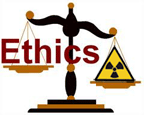 The bomb blast that killed chemist Mostafa Ahmadi-Roshan this week seemed to be designed to limit the scope of the damage, unlike most terrorist attacks. But it did nonetheless kill his driver and wound a third person, which shows how easily an overly flexible definition of “civilian” can stretch to reprehensible lengths.
A utilitarian calculation that suggests killing a few individuals now might save more lives later is not only ethically dubious; it’s also wrong. ..also counter-productive

 Killing civilians, Ottawa Citizen JANUARY 12, 2012 If the definition of “terrorism” is violence targeting civilians to spread fear in furtherance of a political motive, then the assassination of Iranian scientists certainly qualifies as terrorism. It should be condemned as such. It’s also an unwise strategy.
Although no one can say for sure who’s behind the attacks, the main motivation behind this string of assassinations seems clear: to slow down Iran’s efforts to become a nuclear power, not only by eliminating some skilled experts, but also by intimidating their peers.
Reutersquoted an Israeli official recently talking about the “virtual
defection” these attacks are creating within Iran’s scientific
community, a “sense of spreading paranoia” causing scientists to think
hard about their career choices. In other words, terror induced by
violence.
Defenders of the assassinations might question whether the scientists
can be considered civilians, if they’re working to advance the
regime’s nuclear ambitions. That dangerously convenient argument can
be used to justify almost any violence, since so many people in any
country work to advance the state’s goals in some capacity. The bomb
blast that killed chemist Mostafa Ahmadi-Roshan this week seemed to be
designed to limit the scope of the damage, unlike most terrorist
attacks. But it did nonetheless kill his driver and wound a third
person, which shows how easily an overly flexible definition of
“civilian” can stretch to reprehensible lengths.
The Iranian threat to regional security, and in particular to Israel,
is indeed something that should keep every world leader up at night.
The international community has every right to use all legal means to
prevent Iran from arming itself with nuclear weapons. But the dispute
is with the Iranian regime, not its citizens. A utilitarian
calculation that suggests killing a few individuals now might save
more lives later is not only ethically dubious; it’s also wrong.
Killing scientists might slow down Iran’s program but it can’t stop
it. The only thing that can make Iran change its foreign policy is
reform from within Iran itself. Killing scientists is
counter-productive to that effort. Indeed, it bolsters the dangerous
nationalist narrative that Iran is under attack by foreign enemies.
Economic sanctions might also bolster that narrative, but are unlikely
to create the same kind of outrage that terrorism does. Sanctions are,
at least, legal and overt. And they do seem to be getting the regime’s
attention. Sanctions might not be enough to prevent a major conflict
with Iran, but bombing scientists will certainly not prevent that
conflict, and might even play a small part in encouraging it.
http://www.ottawacitizen.com/news/Killing+civilians/5987094/story.html#ixzz1jNcnu5bc
No comments yet.
1 This Month

of the week – Shut Down Drone Warfare!


Tell the Ukrainian Government to Drop Prosecution of Peace Activist Yurii Sheliazhenko

Petition to revoke the licensing of the Near Surface Nuclear Disposal Facility (NSDF) at Chalk River. https://www.ourcommons.ca/petitions/en/Petition/Details?Petition=e-7247
To see nuclear-related stories in greater depth and intensity – go to https://nuclearinformation.wordpress.com
-
Archives
- April 2026 (114)
- March 2026 (251)
- February 2026 (268)
- January 2026 (308)
- December 2025 (358)
- November 2025 (359)
- October 2025 (376)
- September 2025 (257)
- August 2025 (319)
- July 2025 (230)
- June 2025 (348)
- May 2025 (261)
-
Categories
- 1
- 1 NUCLEAR ISSUES
- business and costs
- climate change
- culture and arts
- ENERGY
- environment
- health
- history
- indigenous issues
- Legal
- marketing of nuclear
- media
- opposition to nuclear
- PERSONAL STORIES
- politics
- politics international
- Religion and ethics
- safety
- secrets,lies and civil liberties
- spinbuster
- technology
- Uranium
- wastes
- weapons and war
- Women
- 2 WORLD
- ACTION
- AFRICA
- Atrocities
- AUSTRALIA
- Christina's notes
- Christina's themes
- culture and arts
- Events
- Fuk 2022
- Fuk 2023
- Fukushima 2017
- Fukushima 2018
- fukushima 2019
- Fukushima 2020
- Fukushima 2021
- general
- global warming
- Humour (God we need it)
- Nuclear
- RARE EARTHS
- Reference
- resources – print
- Resources -audiovicual
- Weekly Newsletter
- World
- World Nuclear
- YouTube
-
RSS
Entries RSS
Comments RSS
 nuclear-news
Leave a comment