Dr Mohamed El Baradei on nuclear power and nuclear weapons
27,000 nuclear warheads remain in the arsenals of nine countries. Strategic reliance on 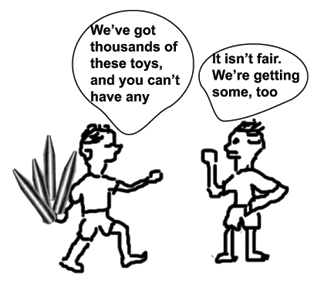 these weapons by these countries and their allies undoubtedly motivates others to emulate them. And of course, plans to replenish and modernize these weapons creates a pervasive sense of cynicism among many non-nuclear-weapon States — who perceive a “do as I say, not as I do” attitude.” (5)
“Why, some ask, should the nuclear-weapon States be trusted, but not others – and who is qualified to make that judgment?
Quotes about safeguards and proliferation, Friends of the Earth, Jim Green 11 Jan 2012,
 1. Quotes from former IAEA Director-General Dr Mohamed El Baradei
“The IAEA’s Illicit Trafficking Database has, in the past decade, recorded more than 650 cases that involve efforts to smuggle such [nuclear and radioactive] materials.” (1)
“Today, out of the 189 countries that are party to the NPT, 118 still do not have additional protocols in force.” (1)
“IAEA verification today operates on an annual budget of about $100 million – a budget comparable to that of a local police department. With these resources, we oversee approximately 900 nuclear facilities in 71 countries. When you consider our growing responsibilities – as well as the need to stay ahead of the game – we are clearly operating on a shoestring budget.” (1)
“… we are only as effective as we are allowed to be.” (1)
“In specific cases of arms control, the Security Council’s efforts have not been very systematic or successful.” (1)
“Under NPT rules, there is nothing illegal about any State having enrichment or reprocessing technology – processes that are basic to the production and recycling of nuclear reactor fuel – even though these operations can also produce the high enriched uranium or separated plutonium that can be used in a nuclear weapon.
An increasing number of countries have sought to master these parts of the “nuclear fuel cycle”, both for economic reasons and, in some cases, as a good insurance policy for a rainy day – a situation that would enable them to develop at least a crude nuclear weapon in a short span of time, should their security outlook change. Whatever the reason, this know-how essentially transforms them into “latent” nuclear-weapon States. That is, regardless of their peaceful intentions, they now have the capability to create weapon-useable nuclear material, which experts consider to be the most difficult step towards manufacture of a nuclear weapon, and can use this capability as a deterrent. In today´s environment, this margin of security is simply not adequate.” (1)
“If a country with a full nuclear fuel cycle decides to break away from its non-proliferation commitments, a nuclear weapon could be only months away.” (2)
“… the Agency’s legal authority to investigate possible parallel weaponisation activity is limited …” (2)
“More countries have sought to master the nuclear fuel cycle, both for economic reasons and, in some cases, as a good insurance policy for a rainy day. Whatever the reason, this know-how essentially transforms them into what might be called a “virtual” or “latent” nuclear-weapon State. Experience has shown that a “choke point” for nuclear weapons development is the acquisition of weapon-useable nuclear material. If a country with a full nuclear fuel cycle decides to break away from its non-proliferation commitments, a nuclear weapon could be only months away. In such cases, we are only as secure as the outbreak of the next major crisis. In today´s environment, this margin of security is simply untenable.” (2)
“If a country with a full nuclear fuel cycle decides to break away from its non-proliferation commitments, a nuclear weapon could be only months away. In such cases, we are only as secure as the outbreak of the next major crisis. In today´s environment, this margin of security is simply untenable.” (3)
“Five years ago, I addressed the 2000 NPT Review Conference – hopeful that the new millennium would bring renewed vigour to these commitments. Many of you were here, and many shared this hope. Are we more or less hopeful now? In five years, the world has changed. Our fears of a deadly nuclear detonation – whatever the cause – have been reawakened. In part, these fears are driven by new realities. The rise in terrorism. The discovery of clandestine nuclear programmes. The emergence of a nuclear black market. But these realities have also heightened our awareness of vulnerabilities in the NPT regime. The acquisition by more and more countries of sensitive nuclear know-how and capabilities. The uneven degree of physical protection of nuclear materials from country to country. The limitations in the IAEA´s verification authority – particularly in countries without additional protocols in force. The continuing reliance on nuclear deterrence. The ongoing perception of imbalance between the nuclear haves and have-nots. And the sense of insecurity that persists, unaddressed, in a number of regions, most worryingly in the Middle East and the Korean Peninsula.” (4)
“Earlier this year, four American éminences grises, Henry Kissinger, William Perry, George Shultz and Sam Nunn – representing a wealth of experience in defense and security strategies – declared that reliance on nuclear weapons as a deterrent is becoming “increasingly hazardous and decreasingly effective”. They called for urgent international cooperation to move towards a world free from nuclear weapons. The following week, the Bulletin of the Atomic Scientists announced that they were moving the hands of their famous Doomsday Clock two minutes closer to midnight. “Not since the first atomic bombs were dropped on Hiroshima and Nagasaki,” they reported, “has the world faced such perilous choices.” In recent years, it is clear that nuclear threats have become more dangerous and more complex. A new phenomenon of illicit trade in nuclear technology has emerged. Countries have managed to develop clandestine nuclear programmes. Sophisticated extremist groups have shown keen interest in acquiring nuclear weapons. In parallel, nuclear material and nuclear material production have become more difficult to control. Energy security and climate change are driving many countries to revisit the nuclear power option. But with that, there is also an increasing interest in mastering the nuclear fuel cycle to ensure a supply of the necessary nuclear fuel. The concern is that by mastering the fuel cycle, countries move dangerously close to nuclear weapons capability. Add to that the threat of the nuclear weapons that already exist. Roughly 27,000 nuclear warheads remain in the arsenals of nine countries. Strategic reliance on these weapons by these countries and their allies undoubtedly motivates others to emulate them. And of course, plans to replenish and modernize these weapons creates a pervasive sense of cynicism among many non-nuclear-weapon States — who perceive a “do as I say, not as I do” attitude.” (5)
“Why, some ask, should the nuclear-weapon States be trusted, but not others – and who is qualified to make that judgment? Why, others ask, is it okay for some to live under a nuclear threat, but not others, who continue to be protected by a ‘nuclear umbrella’?” (5)
(1) Putting teeth in the nuclear non-proliferation and disarmament regime. 2006 Karlsruhe Lecture, Karlsruhe, Germany, 25 March 2006, www.iaea.org/NewsCenter/Statements/2006/ebsp2006n004.html
(2) Reflections on nuclear challenges today. Alistair Buchan Lecture, International Institute for Strategic Studies, London, UK, 6 December 2005
(3) Mohamed El Baradei, December 2005, ‘Reflections on Nuclear Challenges Today’,www.iaea.org/NewsCenter/Statements/2005/ebsp2005n019.html
(4) Mohamed ElBaradei, 2 May 2005, United Nations, New York, USA. Speech to 2005 Review Conference of the Treaty on the Non-Proliferation of Nuclear Weapons,www.iaea.org/NewsCenter/Statements/2005/ebsp2005n006.html
(5) Preventing Nuclear Catastrophe: Where Do We Go From Here? May 24, 2007,www.wagingpeace.org/articles/2007/05/24_ElBaradei_Preventing_Nuclear_Cat… http://foe.org.au/anti-nuclear/issues/oz/u/safeguards/quotes
No comments yet.
1 This Month

of the week – Shut Down Drone Warfare!


Tell the Ukrainian Government to Drop Prosecution of Peace Activist Yurii Sheliazhenko

Petition to revoke the licensing of the Near Surface Nuclear Disposal Facility (NSDF) at Chalk River. https://www.ourcommons.ca/petitions/en/Petition/Details?Petition=e-7247
To see nuclear-related stories in greater depth and intensity – go to https://nuclearinformation.wordpress.com
-
Archives
- March 2026 (222)
- February 2026 (268)
- January 2026 (308)
- December 2025 (358)
- November 2025 (359)
- October 2025 (376)
- September 2025 (257)
- August 2025 (319)
- July 2025 (230)
- June 2025 (348)
- May 2025 (261)
- April 2025 (305)
-
Categories
- 1
- 1 NUCLEAR ISSUES
- business and costs
- climate change
- culture and arts
- ENERGY
- environment
- health
- history
- indigenous issues
- Legal
- marketing of nuclear
- media
- opposition to nuclear
- PERSONAL STORIES
- politics
- politics international
- Religion and ethics
- safety
- secrets,lies and civil liberties
- spinbuster
- technology
- Uranium
- wastes
- weapons and war
- Women
- 2 WORLD
- ACTION
- AFRICA
- Atrocities
- AUSTRALIA
- Christina's notes
- Christina's themes
- culture and arts
- Events
- Fuk 2022
- Fuk 2023
- Fukushima 2017
- Fukushima 2018
- fukushima 2019
- Fukushima 2020
- Fukushima 2021
- general
- global warming
- Humour (God we need it)
- Nuclear
- RARE EARTHS
- Reference
- resources – print
- Resources -audiovicual
- Weekly Newsletter
- World
- World Nuclear
- YouTube
-
RSS
Entries RSS
Comments RSS
 nuclear-news
Leave a comment