Attack on Iran’s nuclear plant likely to radioactively pollute Kuwait
 Kuwait faces more risk than any other country in the region….. This gives Kuwait the right to request that the United States refrain from any military action that would put the Iranian plant at risk, the experts believe.
 Bushehr plant damage risks 90% radiation in Kuwait KUWAIT TIMES, 11 Jan 12, : Kuwait is not prepared for any negative impact from military action against the Bushehr nuclear power plant, experts say. “A radiation leak from the Bushehr Plant puts at least 90 percent of Kuwait’s population at risk of being affected by the worst kinds of cancer that affect the brain and kidney”, according to studies mentioned recently by experts from inside and outside Kuwait who are following the development of Iran’s nuclear projects.
The expert, quoted in an Al-Dar daily report published yesterday, indicated that Kuwait is not prepared to thwart risks of a radiation leak that could happen as a result of a military strike or natural disaster affecting the plant.
The report quotes the experts as saying that an environmental organization assigned to monitor radiation levels is not equipped to give accurate readings regarding hazardous radiation leaks and spread levels. Continue reading
Nuclear Doomsday Clock now at 5 minutes to midnight
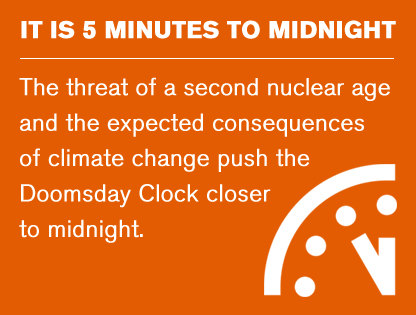 Doomsday clock warning of nuclear power danger closer to midnight L.A. Times, January 10, 2012 | The time on the Doomsday clock has moved, and it’s in the wrong direction. On Tuesday, the Science and Security Board of the Bulletin of the Atomic Scientists announced that the metaphorical doomsday clock is now at five minutes to midnight, putting humanity one figurative minute closer to catastrophic destruction than it was just two years ago.
The Bulletin of the Atomic Scientists was founded in the 1940s by members of the Manhattan Project as a way to educate the public about the dangers of nuclear power. The group debuted the idea of the doomsday clock in 1947, when the time on the clock was set at seven minutes to midnight. They have met every couple of years ever since to discuss the state and fate of the world, and to reset the clock.
This year the board, which includes nuclear and environmental scientists as well as national security experts, cited the failure to act on the Comprehensive Test Ban Treaty by leaders in the United States, China, Iran, India, Pakistan, Egypt, Israel and North Korea as chief among its reasons for moving the minute hand of the clock closer to doomsday.
The board also found the disaster in Fukushima, Japan, particularly alarming. “Safer nuclear reactor designs need to be developed and built, and more stringent oversight, training, and attention are needed to prevent future disasters,” the members wrote.
And finally, the board expressed grave concern about climate change, writing, “In fact, the global community may be near a point of no return in efforts to prevent catastrophe from changes in Earth’s atmosphere.”…. atimesblogs.latimes.com/technology/2012/01/and-the-new-time-on-the-doomsday-clock-is.html
Indigenous peoples fight against nuclear waste dumping on their land

 No nuclear Northwest: Grand Chiefs Kenora Daily Miner and News, By Jon Thompson, 10 Jan 12 Grand chiefs representing every inch of Northwestern Ontario are publicly taking a hard line against burying nuclear waste in their traditional territory, claiming it would violate international law. Continue reading
New continent-wide study shows effects of warming of the planet
 Europe’s mountains show clear and rapid change to a warming climate by ClickGreen 9 Jan 2012 The decade from 2000 to 2009 was the warmest since global climate has been measured, and while localized studies have shown evidence of changes in mountain plant communities that reflect this warming trend, no study has yet taken a continental-scale view of the situation – until now.
With the publication of “Continent-wide response of mountain vegetation to climate change,” scheduled for Advance Online
Publication (AOP) in Nature Climate Change on 8 January, researchers from 13 countries report clear and statistically significant evidence of a continent-wide warming effect on mountain plant communities.
The findings are “clearly significant,” says Ottar Michelsen, a researcher at the Norwegian University of Science and Technology and one of the article’s co-authors. “You can find studies that have shown an effect locally, and where researchers try to say something more globally, but in this case, when you have so many mountains in so many regions and can show an effect, that’s a big thing.”
The article describes the results of a comprehensive effort to measure plant community changes in the mountains over the whole of Europe, with nearly a decade of time between the sampling efforts. Continue reading
Dr Mohamed El Baradei on nuclear power and nuclear weapons
27,000 nuclear warheads remain in the arsenals of nine countries. Strategic reliance on 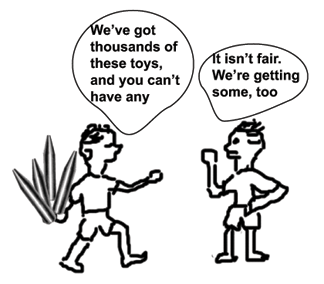 these weapons by these countries and their allies undoubtedly motivates others to emulate them. And of course, plans to replenish and modernize these weapons creates a pervasive sense of cynicism among many non-nuclear-weapon States — who perceive a “do as I say, not as I do” attitude.” (5)
“Why, some ask, should the nuclear-weapon States be trusted, but not others – and who is qualified to make that judgment?
Quotes about safeguards and proliferation, Friends of the Earth, Jim Green 11 Jan 2012,
 1. Quotes from former IAEA Director-General Dr Mohamed El Baradei
“The IAEA’s Illicit Trafficking Database has, in the past decade, recorded more than 650 cases that involve efforts to smuggle such [nuclear and radioactive] materials.” (1)
“Today, out of the 189 countries that are party to the NPT, 118 still do not have additional protocols in force.” (1)
“IAEA verification today operates on an annual budget of about $100 million – a budget comparable to that of a local police department. With these resources, we oversee approximately 900 nuclear facilities in 71 countries. When you consider our growing responsibilities – as well as the need to stay ahead of the game – we are clearly operating on a shoestring budget.” (1)
“… we are only as effective as we are allowed to be.” (1) Continue reading
Community struggle to get a referendum on nuclear power in Japan
Civic group battles to get support for referendums on nuclear power in Tokyo, Osaka. Mainichi Daily News, 11 Jan 12, A civic group has been fighting an uphill battle to collect enough signatures for petitions to hold referendums in Tokyo and Osaka on whether Japan should continue to rely on nuclear power despite the ongoing crisis at the Fukushima No. 1 Nuclear Power Plant. Continue reading
Listing every move of the nuclear war Doomsday Clock
 As Iran ramps up its nuclear program, a look at every movement of the Doomsday Clock National Post, Agence France-Presse Jan 10, 2012 The Doomsday Clock was set up as a symbol of how close the world is to nuclear armageddon. The Bulletin of the Atomic Scientists, a prominent group of international scientists, move the minute hands on the clock toward (and sometimes away from) midnight (which symbolizes nuclear war).
In light of the increased tensions on the Strait of Hormuz, the Bulletin of the Atomic Scientists has moved the clock once again, from 6-minutes-to-midnight to 5-minutes-to-midnight.
Below, a look at every movement of the Doomsday clock since it was introduced in 1947 and the reason the hands moved: 1947: Seven minutes to midnight
The clock first appears as a symbol of nuclear danger.
1949: Three minutes to midnight
The Soviet Union explodes its first atomic bomb.
1953: Two minutes to midnight
The United States and the Soviet Union test thermonuclear devices within nine months of one another……. 2012: Five minutes to midnight.
Global failure to take action against climate change, mounting nuclear tensions and an increasing tendency to reject science are cited as reasons for moving the clock. http://news.nationalpost.com/2012/01/10/as-iran-ramps-up-its-nuclear-program-a-look-at-every-movement-of-the-doomsday-clock/
Renewable energy – wave power for India
 Indian innovator harnesses sea waves for power, The Economic Times, 10 Jan 12, NEW DELHI: An Indian innovator has come up with a technology that tweaks gravity power to harness sea waves for clean and affordable energy, a source more readily available than wind or solar power and, unlike fossil fuels, inexhaustible. Continue reading
An “under-performing investment” – Cameco uranium company
Cameco (CCJ) Downgraded by Zacks Investment Research to “Underperform”, Localised USA, Jan 10th, 2012 Cameco (NYSE: CCJ) was downgraded by equities research analysts at Zacks Investment Research from a “neutral” rating to an “underperform” rating in a research note issued to investors on Tuesday.
Cameco Corporation (Cameco) is a Canada-based company. The Company and its subsidiaries are primarily engaged in the exploration for and the development, mining, refining, conversion and fabrication of uranium for sale as fuel for generating electricity in nuclear power reactors in Canada and other countries. Cameco has three reportable segments: uranium, fuel services and electricity.
The company has a 31.6% interest in Bruce Power L.P. (BPLP). Cameco’s uranium joint venture interests are comprised of McArthur River, Rabbit Lake, Cree Extension Millenium, Moon Lake, Dawn Lake, Read Lake and Virgin River. Cameco’s projects include Kintyre Uranium Exploration Project (Kintyre) and GoviEx Uranium (GoviEx). Kintyre project is located in the East Pilbara region of Western Australia. Cameco holds 12% interest in GoviEx. Its wholly owned subsidiary is Global Laser Enrichment LLC (GLE).
Indian Point nuclear power plant shut due to radioactive water problem
Pump problem shuts nuclear reactor in NYC suburbs, WSJ, JANUARY 10, 2012, WHITE PLAINS, N.Y. — An increase in a leak of slightly radioactive water forced the shutdown Tuesday of a reactor at the Indian Point nuclear power plant in New York City’s suburbs, officials said.
Entergy Nuclear, owner of the plant in Buchanan, said all the water was contained in the pump. It said there was no release of radioactivity from the Indian Point 2 reactor and no danger to workers or the public…
it’s not yet known how long Indian Point 2 will be offline….. Indian Point, 35 miles from midtown Manhattan, is fighting for new 20-year licenses for the two reactors. Current
licenses expire in 2013 and 2015. Gov. Andrew Cuomo has opposed the new licenses, saying it’s unsafe to have a nuclear plant in such a densely populated area.
http://online.wsj.com/article/AP45c33f21230c436195398edcb5f43907.html
Switzerland’s nuclear plants must prove safety features
Swiss nuclear plants need more safety reviews FRANKFURT, Jan 10 (Reuters) by Vera Eckert, – Switzerland’s safety precautions for its nuclear reactors must be further reviewed and more proof that they can withstand major earthquakes must be filed by the end of March, its nuclear safety authority ENSI said on Tuesday.
The assessment was made in the context of stress tests which the country demanded last June in line with the European Union following the Fukushima nuclear disaster in Japan last year.
Switzerland was among seven EU neighbours that agreed to follow the bloc’s lead by imposing new safety checks. “These safety measures will be based on toughter risk assumptions than
assumed in EU stress tests,” the authority said in a statement on its website. “ENSI will assess the plants’ assurances. Results are due by end-June.”
Should they be viewed as insufficient to offer protection against natural disasters, in particular the combination of earthquakes and failure of dams near power stations, ENSI could in theory require plants to stop production, it said…..
http://www.reuters.com/article/2012/01/10/switzerland-nuclear-ensi-idUSL6E8CA3E620120110
1 This Month

of the week – Shut Down Drone Warfare!



Tell the Ukrainian Government to Drop Prosecution of Peace Activist Yurii Sheliazhenko

Petition to revoke the licensing of the Near Surface Nuclear Disposal Facility (NSDF) at Chalk River. https://www.ourcommons.ca/petitions/en/Petition/Details?Petition=e-7247

of the week – STOP SMALL MODULAR REACTORS IN CANADA
To see nuclear-related stories in greater depth and intensity – go to https://nuclearinformation.wordpress.com
-
Archives
- March 2026 (222)
- February 2026 (268)
- January 2026 (308)
- December 2025 (358)
- November 2025 (359)
- October 2025 (376)
- September 2025 (258)
- August 2025 (319)
- July 2025 (230)
- June 2025 (348)
- May 2025 (261)
- April 2025 (305)
-
Categories
- 1
- 1 NUCLEAR ISSUES
- business and costs
- climate change
- culture and arts
- ENERGY
- environment
- health
- history
- indigenous issues
- Legal
- marketing of nuclear
- media
- opposition to nuclear
- PERSONAL STORIES
- politics
- politics international
- Religion and ethics
- safety
- secrets,lies and civil liberties
- spinbuster
- technology
- Uranium
- wastes
- weapons and war
- Women
- 2 WORLD
- ACTION
- AFRICA
- Atrocities
- AUSTRALIA
- Christina's notes
- Christina's themes
- culture and arts
- Events
- Fuk 2022
- Fuk 2023
- Fukushima 2017
- Fukushima 2018
- fukushima 2019
- Fukushima 2020
- Fukushima 2021
- general
- global warming
- Humour (God we need it)
- Nuclear
- RARE EARTHS
- Reference
- resources – print
- Resources -audiovicual
- Weekly Newsletter
- World
- World Nuclear
- YouTube
-
RSS
Entries RSS
Comments RSS
 nuclear-news