Wrap up of the week’s nuclear news
In a week when we are concentrating on the topic of Nuclear Lies, up comes a film that really sets out the history of nuclear lies, with extraordinary archival footage. A IS FOR ATOM -a film not to be missed. http://www.bbc.co.uk/blogs/adamcurtis/2011/03/a_is_for_atom.html

Christina Macpherson's websites & blogs
India’s nuclear power stalemate continues, with the People’s Movement Against Nuclear Energy (PMANE) showing their determination to stop the Koodankulam nuclear project, and the Jaitapur one. As the Russian engineers leave Koodankulam, India’s nuclear corporation turns to Russia to borrow money for that project. And to France, to borrow money to buy France’s nuclear reactors.
A more dangerous stalemate and standoff, as the West threatens more sanctions on Iran, and Iran threatens to stop the flow of oil through the Strait of Hormuz. Israel to close its vulnerable Dimona nuclear reactor, in fear of (?preparation for) war with Iran.
A historic video that exposes the crooked nuclear power industry
“We discovered that our theoretical calculations didn’t have a strong correlation with reality. But we just couldn’t admit to the public that all these safety systems we told you about might not do any good”

 http://www.bbc.co.uk/blogs/adamcurtis/2011/03/a_is_for_atom.html VIDEO A IS FOR ATOM Adam Curtis , 16 March 2011As a background to the ongoing crisis at the Fukushima Daiichi nuclear plant I am putting up a film I made a while ago called A is for Atom. It was part of a series about politics and science called Pandora’s Box.
The film shows that from very early on – as early as 1964 – US government officials knew that there were serious potential dangers with the design of the type of reactor that was used to build the Fukushima Daiichi plant. But that their warnings were repeatedly ignored.
The film tells the story of the rise of nuclear power in America, Britain and the Soviet Union. It shows how the way the technologies were developed was shaped by the political and business forces of the time. And how that led directly to inherent dangers in the design of the containment of many of the early plants. Continue reading
Climate change deniers hold sway, as global warming evidence mounts
 So we start 2012 with an unprecedented understanding of climate science and the consequences of warming, and at the same time seemingly irreconcilable differences on what to do,
 Another Year Goes By and We’re No Closer to Solving Climate Change, Rocky Mountain Institute, Auden Schendler January 5, 2012 One version of the myth of King Midas holds that he was not greedy. Instead, he loved his daughter so much that he longed to leave her a stable future. When given the chance, he asked for the golden touch as a way to create an endowment. But when they embraced, she turned to gold as well. In trying to protect his beloved daughter, Midas destroyed her.
Some climate change deniers have the same admirable motive as Midas. The actions required to solve climate, they fear, will preclude us from capturing the wealth that can benefit or save many children today. Even the left argues that a rising economic tide lifts all boats, despite the fact that continued growth probably dooms the planet to runaway warming. Environmentalists fear that no action on climate condemns us to an even more costly fate that threatens every child, forever.
Finding a fix, then, seems close to impossible. What we learned in 2011–a banner year for human understanding of climate change and its impact on our lives–helps explain why.
In October, climate-change skeptic Dr. Richard Muller released the results of a two-year study at the Berkeley Earth Surface Temperature Project that was funded in part by the Koch brothers, leading climate deniers. Muller’s report, in his own words, found that “global warming is real.” In fact, Muller found warming to be “on the high end” of what others had found. The results were reported in the Wall Street Journal’s editorial page.
2011 also gave a taste of what climatologists have long predicted: that a warmer world will experience more severe weather events, both droughts and storms. PBS reported on “mind-boggling extreme weather” resulting from warming, what Dr. Jeff Masters, Director of Meteorology at the Weather Underground, Inc. calls “steroids for the atmosphere.” This summer, droughts in the Southwest matched those of the dust bowl and a tornado outbreak blew away the record 1974 season. USA Today reported how natural disasters were straining FEMA’s budget. In the last week of 2011, Vermont fixed the last of the roads destroyed by flooding from Hurricane Irene.
At the same time, still more peer-reviewed science came out showing that the anthropogenic warming signal is unmistakable. Continue reading
Infant deaths linked to Fukushima radiation – report ignored by govt and media
[In April 2011] the Environmental Protection Agency (EPA) reported increased levels of radiation in the air, water and milk right across the U.S. that were 100s of times above normal levels.
while deaths were reported across all age categories, infants under the age of one-year old were the demographic hardest hit. The increase in 2010-2011 deaths among infants in the spring was 1.8 percent, compared to a decrease of 8.37 percent in the preceding 14 weeks. Infant deaths were highest “because their tissues are rapidly multiplying, they have undeveloped immune systems, and the doses of radioisotopes are proportionally greater than for adults,”
 this study, which was released publicly on December 19, 2011, was not covered by mainstream media, but mostly watchdog groups and alternative, underground and fringe publications. There has been little reported about the after affects of Fukushima of late.
In an audio news conference, Mangano says the reaction of the nuclear industry and government will likely be a smear campaign to the report’s credibility
 14,000 U.S. Deaths Linked to Fukushima Nuclear Meltdown: Infants Hardest Hit,The Province, Tess Zevenbergen January 9, 2012. The first study linking radioactive fallout to 14,000 U.S. deaths as a result of Fukushima’s nuclear meltdown following the 9.0 magnitude earthquake and tsunami that struck the coast of Japan on Friday, March 11th last year has been published in the International Journal of Health Services (IJHS). According to a news release issued over the PR Newswire, the study is the first peer-reviewed study to appear in a medical scientific journal that documents the health hazards associated with the Fukushima nuclear explosion and meltdown catastrophe.
The study, authored by epidemiologist Joseph Mangano MPH MBA and Executive Director of the Radiation and Public Health Project, and Janette Sherman, a toxicologist and adjunct professor at the University of Michigan, states the number of radiation-related deaths linked to the Fukushima disaster is comparable to the number of deaths following the Chernobyl meltdown of 1986. The results of the study were gleaned from looking at U.S. death rates during the period Fukushima occurred, as well as in previous months and years.
“This study of Fukushima health hazards is the first to be published in a scientific journal. It raises concerns, and strongly suggests that health studies continue, to understand the true impact of Fukushima in Japan and around the world. Findings are important to the current debate of whether to build new reactors, and how long to keep aging ones in operation,” stated Mangano. Continue reading
Fukushima radiation cleanup might cause environmental damage
Ten months after the nuclear disaster, trust in the authorities is nearly non-existent. Without it, Japan’s government risks the biggest cleanup fiasco of all: a decontamination effort that carries huge financial and environmental costs but still fails to convince Fukushima residents that their homes, farms, and forests are safe once again.
Fukushima nuclear cleanup could create its own environmental disaster
Decontaminating the Fukushima region to remove radioactive particles will not be possible without removing large amounts of soil, leaves and plants Winifred Bird for Yale Environment 360, part of the Guardian Environment Network guardian.co.uk, 9 January 2012 Following the nuclear disaster at Chernobyl 25 years ago, the Soviet government chose long-term evacuation over extensive decontamination; as a result, the plants and animals near Chernobyl inhabit an environment that is both largely devoid of humans and severely contaminated by radioactive fallout.
The meltdown last March of three nuclear reactors at the Fukushima Daiichi nuclear power plant in Japan also contaminated large areas of farmland and forests, albeit not as severely or extensively as at Chernobyl. But lacking land for resettlement and facing public outrage over the accident, the Japanese government has chosen a very different path, embarking on a decontamination effort of unprecedented scale.
Beginning this month, at least 1,000 sq km of land — much of it forest and farms — will be cleaned up as workers power-spray buildings, scrape soil off fields, and remove fallen leaves and undergrowth from woods near houses. The goal is to make all of Fukushima livable again. But as scientists, engineers, and ordinary residents begin this massive task, they face the possibility that their efforts will create new environmental problems in direct proportion to their success in remediating the radioactive contamination. Continue reading
India borrowing from France, to buy France’s nuclear reactors
 Interesting to watch the developments in India, as the people’s Koodankulam anti nuclear protest continues. The Russian engineers have now left the site, as work cannot proceed, due to the public opposition.
The Indian nuclear corporation cannot afford its planned new nuclear plants at Jaitapur and Koodankulam, which they are buying from France and Russia respectively. But hey! – that’s no problem, because they are going to borrow the money from France and Russia. Seems like the Indian government is working on behalf of foreign companies, not the Indian people. Nuclear Power Corp Looks Overseas for Loans .http://online.wsj.com/article/SB10001424052970204257504577149981322117366.html
The Indian government is also learning from France’s nuclear company, AREVA, on how to manipulate public opinion. With jolly jingles and other cheery messages, they hope to convince the community that nuclear power is just fine. At left above, a sample of AREVA’s message to children, in its Australian brochure. – Christina Macpherson
 NPCIL launches campaign to clear KNPP concerns,Zee News, January 09, 2012, Chennai: Amid the standoff over the controversial Koodankulam Nuclear Power Plant, the Nuclear Power Corporation of India Limited has launched an intense media campaign to allay safety fears of the people in and around the project site.
“NPCIL has produced 60-second long advertisements to be telecast on TV channels. These will carry messages on cancer and on some issues raised by fishermen,” an official said here today.
In the advertisements, renowned oncologist Dr V Shanta of Cancer Institute, Chennai, marine life experts Murugesan and Sugumaran will clear doubts that locals and fishermen might have (about nuclear
power), they said. The campaign would be telecast on Tamil TV channels, apparently targeting the local population who have been up in arms against the Indo-Russian collaborative project since September last.
NPCIL officials had already aired 60-second long jingles on private radio channels in Tirunelveli district. The commissioning of the plant, earlier slated in December 2011, has been delayed after protests by locals on grounds of safety.
http://zeenews.india.com/news/tamil-nadu/npcil-launches-campaign-to-clear-knpp-concerns_751574.html
Nuclear technicians watching Internet sites, not the nuclear controls
 NRC: Nuclear technicians surfed web on the job, By Mike M. Ahlers, January 9, 2012 WASHINGTON (CNN) — Nine technicians responsible for monitoring operations at a Louisiana nuclear power plant spent on-duty time surfing the Internet — visiting websites that included news, sports, fishing and retirement information — jeopardizing the safety of the plant, federal regulators say.
The Nuclear Regulatory Commission disclosed the web-surfing activities Monday in a letter that proposes a $140,000 fine against the River Bend nuclear power station, 24 miles northwest of Baton Rouge……
According to an NRC investigation, nine operators “deliberately violated” the safety procedures by surfing the web between January and April of 2010. Three of the nine did so with such frequency and duration that they are being issued “severity level three enforcement violations.” (Severity level one represents the greatest significant violation and severity level four is the lowest.) The remaining six operators will receive severity level four violations. …..http://edition.cnn.com/2012/01/09/us/technicians-web-surfing/
Solar energy boom in Germany helps lower prices
German Solar Boom Continues, As Subsidies Disappear, German Solar Stays On Top, Green Chip Stocks, By Abhishek Shah, January 8th, 2012 The German Solar Energy Market is biggest in the world and has installed the largest number of solar panels for the last few years. 2012 promises to be no different with Germany again set to the biggest solar market for solar panel manufacturers though Italy would give good competition.
The German Solar Subsidy program has been the best in the world unlike the start and stop feed in tariff programs of Spain,Czech,UK,Australia and other places. A stable step in cut of feed in tariffs has helped solar energy prices coming down by more than 50% in the last few years though demand has only increased.
The influx of cheap solar panels from China has let the December 2012 explode to almost 2-3 GW according to the German solar association BSW. The high rates of return of over 10% due to super cheap Chinese solar panels at 80-90c/watt has been the major reason for the explosion in demand which could be the biggest month in Germany ever. While German Solar Market has remained robust as ever,the German solar panel producers like Solon, Sunways have been vanquished with a number of major solar companies failing and getting acquired. The Asian solar companies have been the major beneficiaries of this demand growth in Germany and Europe.
The massive rise in demand will imply that according to the EEG ,there will be a 15% cut in July 2012 after a 15% cut in January 2011. This would bring the solar FIT prices quite low and provide a restraint to the galloping German solar energy installations which is reaching more than 25 GW . http://www.greenchipstocks.com/articles/german-solar-boom-continues/1475
Iran enriching uranium at underground site
UN nuclear agency confirms Iranian uranium enrichment at bunker, increasing nuke fears, Washington Post, 8 Jan 12 VIENNA — The U.N. nuclear agency on Monday confirmed that Iran has begun enriching uranium at an underground bunker to a level that can be upgraded more quickly for use in a nuclear weapon than the nation’s main enriched stockpile….. http://www.washingtonpost.com/world/middle-east/diplomats-confirm-new-iranian-uranium-enrichment-say-work-increases-nuke-fears/2012/01/09/gIQAZFN1kP_story.html
Japanese towns Okuma, Futaba to disappear because of nuclear radiation
many spots in the two towns where annual levels of exposure to radiation would be 100 millisieverts or higher. This is at least five times higher than the level deemed safe for human habitation.
 2 towns at risk of disappearing / Okuma, Futaba face uncertain future due to nearby crippled N-plant Yasushi Kaneko / Daily Yomiuri 9 Jan 12, How will the government help the estimated 25,000 people who lived in areas where residency likely will be prohibited for an extended period due to the crisis at the Fukushima No. 1 nuclear power plant?
In particular, Okuma and Futaba towns in Fukushima Prefecture will face extreme hardship because most of their residential areas fall in those areas. The crippled nuclear plant is located in the two towns. Continue reading
USA does not need 5000 nuclear weapons
 U.S. Has No Need for 5,000 Nuclear Weapons To Counter Threats From Iran and North Korea Ottawa Citizen 8 Jan 12, Philip Taubman questions why the U.S. is spending billions of dollars on its nuclear arsenal. Cutting back could save tens of billions of dollars a year. Here is part of what he writes:
“There is no national security rationale for maintaining an arsenal of some 5,000 warheads, with nearly 2,000 arms ready to use on short notice and the rest in reserve. We don’t need thousands of warheads, or even hundreds, to counter threats from countries like Iran or North Korea.
The only conceivable use of so many weapons would be a full-scale nuclear war with Russia, which has more warheads than the United States. But two decades after the collapse of the Soviet Union, even Vladimir V. Putin, with his authoritarian bent, is not about to put Russia on a collision course with the United States that leads to nuclear war. China, equally unlikely to escalate tensions to the nuclear brink, probably has fewer than 400 warheads and a policy to
use them only in self-defense. Pakistan has roughly 100, North Korea fewer than 10 and Iran, so far, zero.
The United States could live quite securely with fewer than 1,500
warheads, half in reserve.”
 Philip Taubman is a former New York Times bureau chief in Moscow and Washington and the author of “The Partnership: Five Cold Warriors and
Their Quest to Ban the Bomb.” Full story here: http://www.nytimes.com/2012/01/08/opinion/sunday/reducing-the-nuclear-arsenal.html?_r=1&ref=philiptaubman
http://blogs.ottawacitizen.com/2012/01/08/u-s-has-no-need-for-5000-nuclear-weapons-to-counter-threats-from-iran-and-north-korea/
Tamil Nadu protestors keep nuclear power plant at a standstill
India Says Work at Russia-Built Nuclear Plant Remains Stalled Bloomberg, By Rakteem Katakey – Jan 8, 2012 1Nuclear Power Corp. of India said work at its plant at Kudankulam in the southern state of Tamil Nadu, being built with Russia’s help, remains at a standstill following continuing protests by villagers near the site. The protesters have asked the government to shut the plant, demanding that more be done to ensure the safety, livelihood and security of the people.
Canada’s chequered history on nuclear safety
A closer look at Canada’s nuclear plants CBC News Canada: Jan 9, 2012 Reports of two radioactive spills at the nuclear power plant in Point Lepreau, N.B., late in 2011 have raised concerns with the head of Canada’s Nuclear Safety Commission.
Michael Binder, the president of the commission, called the news “unsettling.”…….
Some notable nuclear accidents in Canada
Chalk River, 1952 and 1958
A power surge and partial loss of coolant led to significant damage to the NRX reactor core in 1952. It was the world’s first major nuclear reactor disaster, and it resulted in 4.5 tonnes of radioactive water collecting in the cellar of the building. In 1958, a fuel rupture in the reactor led to a fire and complete contamination of the NRU building. The military was called in both times to aid in the cleanup.
Pickering, 1974 and 1983
The most serious nuclear accidents in Canada happened at the Pickering facility east of Toronto, in 1974 and in 1983. In each case, pressure tubes — which hold fuel rods — ruptured. Some coolant escaped, but was recovered before it left the plant, and there was no release of radioactive material from the containment building.
Darlington, 2009
In 2009, more than 200,000 litres of tritium, the radioactive isotope of hydrogen, spilled into Lake Ontario after workers accidentally filled the wrong tank with a mixture of tritium and water. The level of the isotope in the lake was not enough to pose harm to residents. http://www.cbc.ca/news/canada/story/2012/01/09/f-canada-nuclear-reactors.html
India’s Chief Ministers urged to support the people, not foreign nuclear corporations

 Kudankulam: 3 women CMs urged to take steps to rescind all nuke deals DNA, Jan 9, 2012, Chennai PTI An anti-nuclear forum spearheading the stir against Kudankulam Nuclear Power Plant today requested women chief ministers of Tamil Nadu, Uttar Pradesh and West Bengal to take steps to rescind all nuclear deals the Centre has signed with US, Russia, France and other nations.
In a letter to them, the People’s Movement Against Nuclear Energy urged ‘the three popular and bold leaders’ tobring it up at the coming chief ministers’ conference and take steps to rescind all such agreements signed with these three countries and other nations.
Alleging that these are affecting Indian fishermen, farmers, Dalit workers and other deprived sections, it said the country’s nuclear performance has been “quite dismal, insignificant and wasteful.”
“Even after spending so much money, resources, time and national energies for the past 63 years, they produce hardly 2.5% electricity and have done little for the betterment of our people,” the letter said. PMANE also alleged that the nuclear department meddles in national politics and that ‘invigorating this department further would lead only to slavery and not salvation.”
“As women leaders with motherly concern for the people who enjoy people’s trust and huge political mandate, you are the hopes of our country’s youth and children,” the letter signed by PMANE convenor SP Udayakumar said. http://www.dnaindia.com/india/report_knpp-3-women-cms-urged-to-take-steps-to-rescind-all-nuke-deals_1635185
India: determination of People’s Movement Against Nuclear Energy (PMANE)
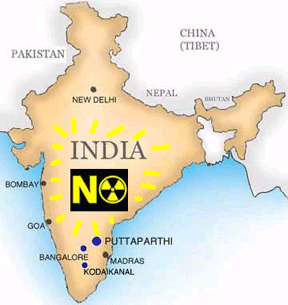 demanded that the Centre cancel nuclear deals with all countries, including USA, Russia, France and Japan. “People should not be made scapegoats for the sake of multinational companies,”
Will lay permanent siege to Koodankulam plant if it goes critical: PMANE, The Asian Age, Jan 07, 2012 | Madurai An anti-nuclear forum spearheading the ongoing stir against Koodankulam Nuclear Power Plant on Saturday said it would intensify the agitation by laying a ‘permanent siege’ to the plant if it goes critical.
“The government should respect the sentiments of the local people. If they don’t, they will not hesitate to lay a permanent siege of the plant,” S P Udhaykumar, convenor of the People’s Movement Against Nuclear Energy (PMANE) told reporters here. He said there is no compromise on PMANE’s stand that the Centre should shelve the project. Continue reading
1 This Month

of the week – Shut Down Drone Warfare!



Tell the Ukrainian Government to Drop Prosecution of Peace Activist Yurii Sheliazhenko

Petition to revoke the licensing of the Near Surface Nuclear Disposal Facility (NSDF) at Chalk River. https://www.ourcommons.ca/petitions/en/Petition/Details?Petition=e-7247

of the week – STOP SMALL MODULAR REACTORS IN CANADA
To see nuclear-related stories in greater depth and intensity – go to https://nuclearinformation.wordpress.com
-
Archives
- March 2026 (222)
- February 2026 (268)
- January 2026 (308)
- December 2025 (358)
- November 2025 (359)
- October 2025 (376)
- September 2025 (258)
- August 2025 (319)
- July 2025 (230)
- June 2025 (348)
- May 2025 (261)
- April 2025 (305)
-
Categories
- 1
- 1 NUCLEAR ISSUES
- business and costs
- climate change
- culture and arts
- ENERGY
- environment
- health
- history
- indigenous issues
- Legal
- marketing of nuclear
- media
- opposition to nuclear
- PERSONAL STORIES
- politics
- politics international
- Religion and ethics
- safety
- secrets,lies and civil liberties
- spinbuster
- technology
- Uranium
- wastes
- weapons and war
- Women
- 2 WORLD
- ACTION
- AFRICA
- Atrocities
- AUSTRALIA
- Christina's notes
- Christina's themes
- culture and arts
- Events
- Fuk 2022
- Fuk 2023
- Fukushima 2017
- Fukushima 2018
- fukushima 2019
- Fukushima 2020
- Fukushima 2021
- general
- global warming
- Humour (God we need it)
- Nuclear
- RARE EARTHS
- Reference
- resources – print
- Resources -audiovicual
- Weekly Newsletter
- World
- World Nuclear
- YouTube
-
RSS
Entries RSS
Comments RSS
 nuclear-news