Corruption to continue in Japan’s nuclear industry?
the official who ordered the cover-up of the data is now responsible for working out safety measures at nuclear plants
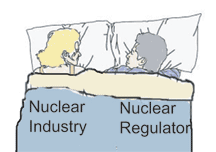
 Cover-up of estimated costs to dispose of radioactive waste raises serious questions, Mainichi Daily News, By Tadashi Kobayashi, Kenji Shimizu and Seiichi Ota, Mainichi Shimbun 2 Jan 2012, Revelations that officials from the Agency for Natural Resources and Energy concealed the estimated costs of disposing of spent nuclear fuel highlights the distorted logic of government officials who stick to reprocessing radioactive waste even by lying.
The cover-up is essentially similar to a case in which some high-ranking government officials hid a 2002 Russian diplomatic document in which Moscow offered to accept spent nuclear fuel from Japan, in that both helped promote the reprocessing of radioactive waste at a plant in Rokkasho, Aomori Prefecture. Continue reading
21 keys to closing the nuclear industry in 2012 – Harvey Wasserman
Worldwide, the industry is crumbling. The collapse of its private investment base, and the shutdowns in Japan, Germany, Switzerland, Spain, Mexico, Israel and elsewhere are rapidly shrinking the technology’s credible reach.
Green energy will soon constitute the world’s largest industry, financially and in terms of employment.
Fukushima has taught us that as long as reactors operate, the apocalyptic clock is ticking….. we can make 2012 the year nuke power finally dies.

 2012 Is the Year to Finally Bury Nuke Power Harvey Wasserman Huffington Post, 01/ 3/12 The year 2012 has opened with news that Fukushima’s radioactive cloud may already have killed some 14,000 Americans, according to a major study just published in the International Journal of Health Services.
Germany and Japan, the world’s third and fourth largest economies, along with numerous others countries, have definitively turned away from the “Peaceful Atom.”
But it hasn’t yet been buried. That’s up to us. And 2012 is the year to do it.
We are already very close. The mythical “Nuclear Renaissance” has been gutted by Fukushima, low gas prices and the escalating Solartopian revolution in green energy. Solar panels, wind turbines, sustainable bio-fuels, geo-thermal, ocean thermal, increased efficiency and much more have simply priced atomic energy out of the market.
There is virtually no private money to build new reactors — except where there are huge government subsidies and guarantees. In 2012 we must make those all go away.
Likewise, there are increasingly powerful grassroots movements focused on shutting reactors that still operate. Germany has shut 7, and the rest will be gone by 2022, if not earlier. In Japan, just 11 of more than 50 reactors now operate. Because local governments can prevent nukes from re-opening once they go down for refueling, Japan could emerge from 2012 without a single nuke on line.
The biggest US battle is at Vermont Yankee. March 21 is D-Day for forcing a nuclear corporation to honor a solemn contract it signed with a sovereign state, agreeing to shut down if the state doesn’t approve continued operations. The legislature wants the reactor shut, which Entergy now refuses to do.
But with some 430 reactors still operating worldwide, and with several score ostensibly on order, here are some of 2012′s keys to finally ridding the planet of this radioactive curse: Continue reading
Dilemma of USA’s Nuclear Waste Confidence Rule
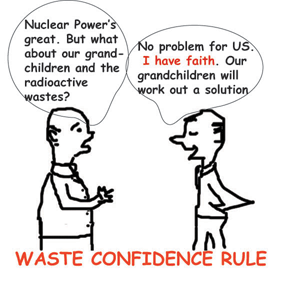 Environmental Impact Statement (EIS) is part of the agency’s 2010 Waste Confidence Decision and Rule regulations,
“There has been talk of creating regional disposal sites but really there should not be any new nuclear power plants built until they can figure out what to do with the nuclear waste we have now.’’
Federal regulators seek public comment on nuclear fuel storage, Agency to review 200-year storage plan, APP.com by Bob Vosseller, 4 Jan 12 The federal Nuclear Regulatory Commission is seeking public feedback on a report about the impact of storing spent fuel from the nation’s commercial nuclear power plants for as long as 200 years.
According to a release from NRC officials Tuesday, the feedback would be used for the agency’s plan to update its Environmental Impact Statement, or EIS.
The EIS is a document used for decision-making and to determine whether there are any negative environmental effects caused by a proposed action. Continue reading
Nuclear trafficking and the danger of a “dirty bomb”
The Seoul Nuclear Summit, The National Interest, JAN-FEB 2012 issue Miles A. Pomper, Michelle E. Dover , January 4, 2012 “
 “……….3. Illicit trafficking. Over the past two decades, the IAEA’s Illicit Trafficking Database has recorded hundreds of cases of criminal activity involving radioactive materials, including well over a dozen involving HEU or plutonium. Since illicit nuclear trafficking often makes use of the same tactics as do other black markets in humans, arms and drugs, it is considered imperative that law enforcement and border security are trained in what to look for in nuclear smuggling. The South Caucasus and Central Asia are of particular concern, in part because they are situated between the “supply” in Russia and potential buyers; these regions already have established networks for drugs, humans and arms, and all these could be used for nuclear trafficking as well. Officials could blunt the threat of nuclear smuggling by raising the level of border security in these countries and by providing training, detection equipment and response plans…..
for most countries, particularly those without fissile material, the threat of a dirty bomb is greater than that of the detonation of a nuclear device. One possibility could be making the current voluntary IAEA Code of Conduct on the Safety and Security of Radioactive Sources a legally binding measure. Another might be to launch a broad, international scientific effort to look for technological alternatives to the most high-risk radioactive sources. Securing radioactive sources is not limited to on-site measures; it also requires a comprehensive tracking system and police training on how to respond to stolen nuclear material. …. http://nationalinterest.org/article/the-seoul-nuclear-summit-6284
USA helped Japan in the criminal sources of its nuclear industry
The criminal roots of Japan’s nuclear industry as facilitated by the United States of America Paul Langley’s Nuclear History Blog, 5 Jan 12 http://www.thebulletin.org/web-edition/features/japans-nuclear-history-perspective-eisenhower-and-atoms-war-and-peace
Japan’s nuclear history in perspective: Eisenhower and atoms for war and peace….. http://nuclearhistory.wordpress.com/2012/01/03/the-criminal-roots-of-japans-nuclear-industry-as-facilitated-by-the-united-states-of-america/
France turning against nuclear energy, as its costs soar
to fulfill its safety recommendations will cost over $13 billion, no small sum considering French operators were already planning to spend $52 billion over the next three decades to consolidate or upgrade existing infrastructure. As always when adversity hits business in the pocketbook, the final cost will be passed all the way down to the French consumer’s monthly electricity bill—
62% of French respondents supporting a gradual phasing out of nuclear power—over 20 to 30 years—and 15% calling for a rapid halt.
 The Fukushima Effect: France Starts to Turn Against Its Much Vaunted Nuclear Industry TIME, By BRUCE CRUMLEY | January 4, 2012 “……..The recent French introspection about the merits of nuclear power is posing some serious questions about the nation’s energy independence, industrial future, and role as one of the world’s biggest business proponents of civil nuclear technology.
The newest development in France’s post-Fukushima mulling came Tuesday, when the country’s independent watchdog agency delivered a government-commissioned audit of the nation’s 58 nuclear power plants, calling for significant safety upgrades. Continue reading
74% of Japanese want to close nuclear power, but govt tied to nuclear industry
 Japanese Don’t Want a Nuclear Future: The Ticker, Bloomberg, William Pesek, 5 Jan “……..In a June Asahi newspaper poll, 74 percent favored Japan over time decommissioning all 54 reactors. Actions by the government, reinforced by Prime MinisterYoshihiko Noda‘s press conference today, suggest the opposite is afoot. Japanese want a nuclear-free future, and yet the government is back to coddling the power industry.
Why the disconnect? Japan’s nuclear-industrial complex is every bit as powerful as the nexus of business and the military in the U.S. There’s just too much money involved, and Japan’s “nuclear village” is circling the wagons. The moment Noda’s predecessor, Naoto Kan, announced plans to rein in the industry’s incestuous ties with government bureaucrats, his premiership was over. Continue reading
Virginia Uranium seeks public subsidy to cover long term damage
Virginia Uranium is seeking a public subsidy to cover the risks associated with their venture. This could result in a scenario not unlike the recent public bailout that covered the sub-prime loan risks taken by mortgage banks.
Uranium offers short-term boost, long-term risks, Star-Tribune Peter Hairston January 4, The long-awaited National Research Council, or NRC, report on uranium mining in Virginia concludes, as one could expect, that there are benefits and risks to uranium mining.
The potential public benefits to the Pittsylvania County region have been estimated and extensively publicized. What has not been given due attention in the NRC report or in public discourse is the allocation of the public risks in relation to the potential private benefits.
When this is considered in light of the basic, conservative principles of free market economics, it is clear that current uranium mining plans will result in the public bearing the principal risks, while the mining company gains the principal profits. Continue reading
Security failings at Delaware nuclear reactor
Nuclear plants investigated Security shortcomings found at Salem/Hope Creek complex by Delaware Onliner, JEFF MONTGOMERY The News Journal, 4 Jan 12 Federal regulators are investigating undisclosed security failings at PSEG Nuclear’s big Salem/Hope Creek reactor site along the Delaware River, and warning of possible sanctions and additional citations against the company.
The action at PSEG’s complex in New Jersey, southeast of Augustine Beach, was one of several security-related shortcomings reported at nuclear plants around the country in recent months.
Nuclear Regulatory Commission officials on Tuesday declined to release details of inspection findings leading to the security citation at Salem/Hope Creek, relayed to PSEG in mid-December but made public only recently….. http://www.delawareonline.com/article/20120104/NEWS08/201040345/Nuclear-plants-investigated?odyssey=tab%7Ctopnews%7Ctext%7CHome
Iran’s latest nuclear claim does not mean it is closer to the bomb
Analysis: Nuclear fuel test won’t hasten Iran bomb: experts By Fredrik Dahl VIENNA Jan 4, 2012 (Reuters) – Iran’s latest claim of a breakthrough in its nuclear program seems unlikely to bring it any closer to having atomic bombs soon, but serves rather as another defiant message to the West. This week’s announcement that Iran has successfully made and tested fuel rods for use in nuclear power plants appeared designed to show that sanctions are failing to halt its technical advances and to strengthen its hand in any renewed negotiations with the major powers.
Spent fuel can be reprocessed to make plutonium, potential bomb material, but Western worries about Iran’s nuclear program are focused on its enrichment of uranium, which can also provide the core of nuclear weapons if refined much more.
“The (fuel rod) development itself doesn’t put them any closer to producing weapons,” said Peter Crail of the Arms Control Association, a U.S.-based research and advocacy group.
It could be a way of telling Tehran’s foes that time is running out if they want to revive an atomic fuel swap deal that collapsed two years ago but is still seen by some experts as offering the best chance to start building badly needed trust.
Diplomats believe Iran has in the past overstated its nuclear progress to gain leverage in its standoff with Western capitals, and the testing of domestically made fuel does not mean the country is about to start using it to run reactors…….. http://www.reuters.com/article/2012/01/04/us-nuclear-iran-fuel-idUSTRE8030ND20120104
Plans for Seoul Nuclear Summit in March 2012
President Obama called for a world without nuclear weapons and identified nuclear terrorism as the most serious threat to international security
The Seoul Nuclear Summit, The National Interest, JAN-FEB 2012 issue Miles A. Pomper, Michelle E. Dover , January 4, 2012 “….late this March, fifty or so leaders will descend on Seoul to track progress since the last summit and make a batch of fresh commitments. Continue reading
1 This Month

of the week – Shut Down Drone Warfare!


Tell the Ukrainian Government to Drop Prosecution of Peace Activist Yurii Sheliazhenko

Petition to revoke the licensing of the Near Surface Nuclear Disposal Facility (NSDF) at Chalk River. https://www.ourcommons.ca/petitions/en/Petition/Details?Petition=e-7247
To see nuclear-related stories in greater depth and intensity – go to https://nuclearinformation.wordpress.com
-
Archives
- March 2026 (237)
- February 2026 (268)
- January 2026 (308)
- December 2025 (358)
- November 2025 (359)
- October 2025 (376)
- September 2025 (257)
- August 2025 (319)
- July 2025 (230)
- June 2025 (348)
- May 2025 (261)
- April 2025 (305)
-
Categories
- 1
- 1 NUCLEAR ISSUES
- business and costs
- climate change
- culture and arts
- ENERGY
- environment
- health
- history
- indigenous issues
- Legal
- marketing of nuclear
- media
- opposition to nuclear
- PERSONAL STORIES
- politics
- politics international
- Religion and ethics
- safety
- secrets,lies and civil liberties
- spinbuster
- technology
- Uranium
- wastes
- weapons and war
- Women
- 2 WORLD
- ACTION
- AFRICA
- Atrocities
- AUSTRALIA
- Christina's notes
- Christina's themes
- culture and arts
- Events
- Fuk 2022
- Fuk 2023
- Fukushima 2017
- Fukushima 2018
- fukushima 2019
- Fukushima 2020
- Fukushima 2021
- general
- global warming
- Humour (God we need it)
- Nuclear
- RARE EARTHS
- Reference
- resources – print
- Resources -audiovicual
- Weekly Newsletter
- World
- World Nuclear
- YouTube
-
RSS
Entries RSS
Comments RSS
 nuclear-news