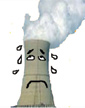
Nuclear industry might not have a future
“Right now, just the plain economics of nuclear power are underwater,”…over the past decade, construction costs have skyrocketed and natural gas got more plentiful and cheaper.
 If Germany comes along and figures out how to power a very big economy, including baseload
needs, without nuclear, then that to me becomes a real, if not a death blow, a real challenge to nuclear, because it breaks the whole nuclear story that this is the only environmentally friendly way to provide baseload.”
After Fukushima: A Changing Climate For Nuclear NPR by CHRISTOPHER JOYCE December 24, 2011 This year has something unpleasant in common with the years 1979 and
1986. In 1979, a nuclear reactor at Three Mile Island in Pennsylvania melted down. In 1986, the Soviet reactor at Chernobyl blew up and burned.
This year’s meltdown occurred in Fukushima in Japan, and nuclear power isn’t likely to be the same as a result. Nuclear power had enjoyed 25 years of relative quiet, but the
Fukushima accident reminded people that despite improvements isafety, nuclear plants could still go horribly wrong…..
But Marc Chupka, who advises electric utilities as an economist with
the Brattle Group in Washington, wonders who’s going to pay for them.
“Right now, just the plain economics of nuclear power are underwater,”
he says. He notes that over the past decade, construction costs have
skyrocketed and natural gas got more plentiful and cheaper.
“Things change significantly over relatively short periods of time,”
Chupka says, noting that it takes about a dozen years to plan and
build a new nuclear plant. “That makes it an incredibly challenging
environment to plan for the long term. And that adds to the risk and
it makes investors understandably skittish.”…..
The cleanup will cost many billions, and the government says: No more nukes.
Germany says the same: The government will throw its weight and wealth
into solar and wind energy to replace nuclear power.
George Perkovich, director of the Nuclear Policy Program at the
Carnegie Endowment for International Peace, says if Germany succeeds,
nuclear could be in even deeper trouble.
Nuclear’s strength is that plants run 24/7, unlike solar and wind
generators. They provide continuous and reliable electricity,
so-called baseload power. But, says Perkovich, “If Germany comes along
and figures out how to power a very big economy, including baseload
needs, without nuclear, then that to me becomes a real, if not a death
blow, a real challenge to nuclear, because it breaks the whole nuclear
story that this is the only environmentally friendly way to provide
baseload.”…. http://www.npr.org/2011/12/24/144194064/after-fukushima-a-changing-climate-for-nuclear
No comments yet.
1 This Month


Tell the Ukrainian Government to Drop Prosecution of Peace Activist Yurii Sheliazhenko

Petition to revoke the licensing of the Near Surface Nuclear Disposal Facility (NSDF) at Chalk River. https://www.ourcommons.ca/petitions/en/Petition/Details?Petition=e-7247


of the week – STOP SMALL MODULAR REACTORS IN CANADA
To see nuclear-related stories in greater depth and intensity – go to https://nuclearinformation.wordpress.com
-
Archives
- March 2026 (183)
- February 2026 (268)
- January 2026 (308)
- December 2025 (358)
- November 2025 (359)
- October 2025 (376)
- September 2025 (258)
- August 2025 (319)
- July 2025 (230)
- June 2025 (348)
- May 2025 (261)
- April 2025 (305)
-
Categories
- 1
- 1 NUCLEAR ISSUES
- business and costs
- climate change
- culture and arts
- ENERGY
- environment
- health
- history
- indigenous issues
- Legal
- marketing of nuclear
- media
- opposition to nuclear
- PERSONAL STORIES
- politics
- politics international
- Religion and ethics
- safety
- secrets,lies and civil liberties
- spinbuster
- technology
- Uranium
- wastes
- weapons and war
- Women
- 2 WORLD
- ACTION
- AFRICA
- Atrocities
- AUSTRALIA
- Christina's notes
- Christina's themes
- culture and arts
- Events
- Fuk 2022
- Fuk 2023
- Fukushima 2017
- Fukushima 2018
- fukushima 2019
- Fukushima 2020
- Fukushima 2021
- general
- global warming
- Humour (God we need it)
- Nuclear
- RARE EARTHS
- Reference
- resources – print
- Resources -audiovicual
- Weekly Newsletter
- World
- World Nuclear
- YouTube
-
RSS
Entries RSS
Comments RSS
 nuclear-news
Leave a comment