America no closer to finding a tomb for its accumulating nuclear wastes
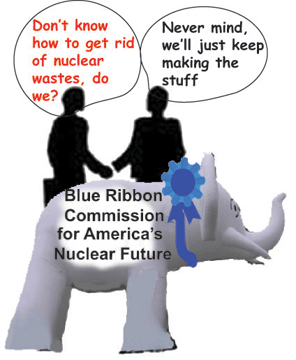 In July, with little fanfare, the Obama administration’s Blue Ribbon Commission on America’s Nuclear Future released a draft report to the Secretary of Energy on a post-Yucca Mountain solution. The report calls for development of “one or more geologic disposal facilities.”
So far, federal officials say they haven’t even started looking for a specific state or single site.
Northland rock considered for nuclear waste storage With Nevada’s Yucca Mountain out of the running as the permanent graveyard for U.S. nuclear waste, scientists now are looking for other places to entomb the stuff, including rock formations common in northern Minnesota and Wisconsin. That’s the message from a 114-page study from the Sandia National Laboratory that surfaced last week. By: John Myers, Duluth News Tribune, 25 Dec 11,
While there’s no official effort under way to pick a specific nuclear
waste repository, the study said areas where earthquakes are rare and
that have stable rock in the granite family may be the best
candidates.
That could be any area of the East Coast, from Georgia to Maine, where
granite is common. But the study also notes the Lake Superior region
of Minnesota, Wisconsin and Michigan’s Upper Peninsula is “the most
stable region of granite outcrops in the U.S.”…..
Plenty to bury
There are 104 operating commercial reactors in the U.S. with plans
still in the works to build about 26 more. Radioactive waste is now
stored in temporary casks at 120 sites in 39 states, according to the
U.S. Department of Energy. That includes casks in Minnesota near the
Mississippi River outside the Prairie Island nuclear plant at Red
Wing…..
In July, with little fanfare, the Obama administration’s Blue Ribbon
Commission on America’s Nuclear Future released a draft report to the
Secretary of Energy on a post-Yucca Mountain solution. The report
calls for development of “one or more geologic disposal facilities.”
“Deep geological disposal is the most promising and accepted method
currently available for safely isolating spent fuel and high-level
radioactive waste from the environment for very long periods of time,”
the commission concluded in its report.
But the commission stopped short of deciding how the federal
government will move forward in what’s certainly to be a socially and
politically charged battle to find a specific home or homes for the
nation’s growing stock of radioactive waste.
Then, in August, the Sandia National Laboratory in Albuquerque, N.M.,
a division of the U.S. Department of Energy, quietly released its
study that highlights where to look for alternatives to Yucca
Mountain. The report titled “Granite Disposal of U.S. High-Level
Radioactive Waste” was first featured in an Associated Press story
last week, the first time it became public.
So far, federal officials say they haven’t even started looking for a
specific state or single site.
“There is no leading candidate of any kind, because there is no
program at the moment for siting repositories,” Andrew Orrell,
director of nuclear energy and fuel cycle programs at Sandia, told the
Associated Press.
Orrell noted that in addition to granite, salt beds, clay, shale and
deep holes bored into the earth in other locations – as deep as three
miles down – could be potential resting areas for the nation’s nuclear
waste. http://www.duluthnewstribune.com/event/article/id/218171/group/homepage/
No comments yet.
1 This Month
Chernobyl: The Lost Tapes – A good documentary on Chernobyl on SBS available On Demand for the next 3 weeks– https://www.sbs.com.au/ondemand/tv-program/chernobyl-the-lost-tapes/2352741955560

of the week–London Campaign for Nuclear Disarmament

Tell the Ukrainian Government to Drop Prosecution of Peace Activist Yurii Sheliazhenko
To see nuclear-related stories in greater depth and intensity – go to https://nuclearinformation.wordpress.com
-
Archives
- April 2026 (152)
- March 2026 (251)
- February 2026 (268)
- January 2026 (308)
- December 2025 (358)
- November 2025 (359)
- October 2025 (376)
- September 2025 (257)
- August 2025 (319)
- July 2025 (230)
- June 2025 (348)
- May 2025 (261)
-
Categories
- 1
- 1 NUCLEAR ISSUES
- business and costs
- climate change
- culture and arts
- ENERGY
- environment
- health
- history
- indigenous issues
- Legal
- marketing of nuclear
- media
- opposition to nuclear
- PERSONAL STORIES
- politics
- politics international
- Religion and ethics
- safety
- secrets,lies and civil liberties
- spinbuster
- technology
- Uranium
- wastes
- weapons and war
- Women
- 2 WORLD
- ACTION
- AFRICA
- Atrocities
- AUSTRALIA
- Christina's notes
- Christina's themes
- culture and arts
- Events
- Fuk 2022
- Fuk 2023
- Fukushima 2017
- Fukushima 2018
- fukushima 2019
- Fukushima 2020
- Fukushima 2021
- general
- global warming
- Humour (God we need it)
- Nuclear
- RARE EARTHS
- Reference
- resources – print
- Resources -audiovicual
- Weekly Newsletter
- World
- World Nuclear
- YouTube
-
RSS
Entries RSS
Comments RSS
 nuclear-news
Leave a comment