Steps for USA and Russia towards nuclear disarmament
 There is, however, some unfinished business concerning the 20 year-old Presidential Nuclear Initiatives (PNI’s) that both governments could take up now to help lay the foundation for future talks.
the United States and Russia have grown accustomed to sharing considerable information about their longer-range strategic nuclear forces. For years, they have routinely exchanged and updated information on the disposition of retiring nuclear-capable bombers and
missiles. Similar processes could be applied to the types and numbers of tactical nuclear systems affected by the P.N.I.’s.
The next logical step would be for both countries to disclose, on a reciprocal basis, the location, types and numbers of tactical nuclear weapons that remain.
Unfinished Business, NYT, FRANK KLOTZ, SUSAN KOCH and FRANKLIN MILLER December 13, 2011“……..the subject of reducing tactical nuclear weapons has again come to the fore. Signing the New Strategic Arms Reduction Treaty in April 2010, President Obama announced that the United States intended to pursue further reductions in all categories of nuclear weapons — including, for the first time, tactical and nondeployed warheads. Voting to approve the treaty, the U.S. Senate called for negotiations with Russia to address the
disparity in U.S. and Russian tactical nuclear weapons and to secure and reduce those weapons in a verifiable manner.
The specific size of that disparity is a matter of debate. Neither the United States nor Russia has publicly disclosed the number and locations of the tactical nuclear weapons they possess.
Unofficial estimates vary widely. Continue reading
Weapons continue to be the big export industry
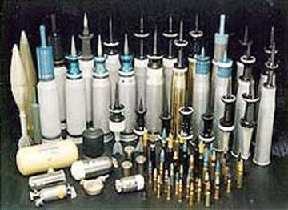 the U.S. continues to be the leading arms exporter, followed by Russia, France, Britain, China, Germany and Italy.
The region with the greatest growth has been the Middle East, where spending has increased 62 percent in the last decade.
The Mightiest Merchants Of Death Strategy Page, December 13, 2011: Although arms exports declined a third last year, over half those exports were from the United States.
American sales of weapons and military equipment to other countries totaled $35 billion last year. The three biggest recipients were Afghanistan, Taiwan and India. The $5.4 billion in sales to Afghanistan were paid for by the U.S. taxpayer, but the firms supplying the gear were paid, so it’s a sale. The U.S. has long got the most export sales, despite having the most expensive weapons. …
Most countries, if they could afford to buy American, did so. The others searched for someone offering cheap but effective weapons. The supplier has often been Russia. Continue reading
USA nuclear lobby aims to oust Gregory Jaczko, safety conscious head of Nuclear Regulatory Commission
it’s also clear that the nuclear industry is using the conflict to attempt to neutralize or remove Jaczko from the NRC, where he has been a consistent advocate for tighter safety controls
Commissioner William Magwood, who is leading the charge against Jaczko, has deep [nuclear] industry ties. His appointment was opposed by over 100 watchdog groups for that reason. Notably, Magwood did consulting work for Tepco—the company that runs the Fukushima plant.
 Action and dysfunction in the Beltway swamp. Republicans Intensify Attacks on the Nuclear Safety Chief The Nation George Zornick on December 14, 2011 If there was any doubt that an imbroglio around the leadership of Gregory Jaczko, [at left] chairman of the Nuclear Regulatory Commission, would be used to try to force his ouster from that agency, a Wednesday
hearing before a House panel removed it.
All five members of the NRC appeared before the House Committee on Oversight and Government Reform, which is chaired by Representative Darrell Issa. Four commissioners publicly aired their grievances about Jaczko’s leadership, which include charges of bullying and intimidation of staff, along with refusing to share information with fellow commissioners.
Jaczko said he did nothing wrong, and cited a report from the NRC inspector general clearing him of legal wrongdoing when it came to sharing information among his colleagues. But Republicans went directly for the jugular. Continue reading
The world might have to learn to live with a nuclear Iran
 Can the world live with a near-nuclear Iran?, By Mohammed Ayoob, December 14, 2011 — (CNN) –– Some analysts have attributed the recent downing of a U.S. RQ-170 Sentinel high-altitude reconnaissance drone in Iran to that nation’s increasingly sophisticated capability to
launch cyber attacks. Others have dismissed the idea that Iran was capable of bringing down an RQ-170, arguing that Iranian air defenses do not have the capability to track an aircraft with radar-evadingtechnology.
Either way, the incident clearly demonstrates American concerns regarding Iran’s nuclear capacity, as the drone was likely sent over Iranian territory to spy on its nuclear program.
I find the argument that Iran is engaged in developing a nuclear weapons program credible. I am also convinced that Iran will not test a device, but rather will acquire the capability to produce a weapon quickly if its strategic environment deteriorates to such an extent
that it feels it must.
I am further convinced that an Israeli or American strike or strikes against its nuclear facilities would put Iran’s nuclear program back by a few years but would not be able to terminate it. In fact, such strikes would provide Tehran with the legitimacy to go ahead and
acquire nuclear weapons capability in full view of the world and with international sympathy.
It is time for world leaders to recognize the inevitability of Iran acquiring nuclear weapons capability, even if it remains untested, with Tehran following the policy and adopting the rhetoric of deliberate ambiguity. Continue reading
Nuclear “renaissance” dubious, and too late to influence Climate Change
 Nuclear Energy at a Crossroads, OilPrice.com. by Tyler Hamilton , 13 December 2011 For years the nuclear power lobby has muscled its way into international climate negotiations and asserted itself as a critical part of any serious effort to reduce global greenhouse-gas emissions.
Not so much during climate talks in Durban, South Africa, these past two weeks. There were some media mentions and the occasional sound bite from industry officials, but the nuclear lobby — still sufferingfrom a Fukushima hangover — stayed relatively quiet this time around.
Even Patrick Moore, Greenpeace [alleged?] co-founder turned nuclear booster, seems to have moved on. His gig these days is defending the oil sands, part of a recent advertising campaign from the Canadian Association of Petroleum Producers.
The Fukushima disaster in Japan certainly served a blow to the nuclear power industry. The low price of natural gas and the global economic downturn — and reduced demand for electricity — hasn’t helped matters. The economics of building new nuclear plants also remain in question. A report just released by the Ontario Sustainable Energy Association
points out that even before the Fukushima accident, the decades-long trend of reactor projects being delayed and coming in dramatically over budget was still a reality, as recent experiences in Finland and France clearly show. Continue reading
Nuclear waste disposal problem looming large and urgent for USA
 U.S. anxious to secure nuclear waste disposal site as China emerges on scene Mainichi Daily News, Japan, By Haruyuki Aikawa, Europe General Bureau, December 14, 2011 “……As the world shifts away from the business of recycling plutonium-based nuclear fuel, the construction of facilities to handle nuclear waste remains a nagging issue. After plans to construct an international disposal facility in Australia fell through, the United States and Japan moved forward in negotiations to build such a facility in Mongolia, an inland country which is believed to hold rich deposits of uranium…..
After the Mainichi Shimbun reported the plans in May, an opposition campaign was launched in Mongolia, and in September this year, Mongolian President Tsakhiagiin Elbegdorj issued an order prohibiting negotiations, effectively putting an end to the plans…… at the end of March that the rise of emerging nations had weakened the United States’ grip. While it still has power, it wants to secure a place that will accept spent nuclear fuel. The project previously proposed in Mongolia strongly highlights the United States’ anxiousness. … http://mdn.mainichi.jp/features/news/20111214p2a00m0na013000c.html
Despite media coverage against renewable energy, British public supports it
Over at BusinessGreen, James Murray describes the survey results as “explosive”, especially given that they “follow months during which the right-wing press has waged an increasingly virulent campaign against climate change, wind farms, renewable energy, and the greenlevies that pay for it”.

 British public strongly support renewable energy, survey says, The Guardian, 14 Dec 11 56% of UK population wants to see more investment in wind power, finds a YouGov survey
Does the UK have a “silent majority” in support of further investment in renewables? You wouldn’t necessarily think so if you listen to the very vocal, media-driven opposition against, say, wind power, but a recent YouGov survey commissioned by the Sunday Times suggests the true picture might be a little different.
The Sunday Times itself chose not to report the YouGov findings related to renewables (you can draw your own conclusions as to why), but if you look beyond the headline polling about the 1,696 respondents’ political leanings you start to reach some rather intriguing environmentally themed results ….
But the real point of interest can be found on page nine, which asks: “Thinking about the country’s future energy provision, do you think the government should be looking to use more or less of the following?”
Solar power
More than at present – 74%
Less than at present – 6%
Maintain current levels – 12%
Not sure – 9%
Wind farms
More than at present – 56%
Less than at present – 19%
Maintain current levels – 15%
Not sure – 9%… Continue reading
AREVA’s loss making uranium projects halted, in Africa and USA
 Areva halts Trekkopje uranium development, The Namibian, By: JO-MARÉ DUDDY, 14 Dec 11 AREVA yesterday said it was putting its investment in the US$1 billion Trekkopje uranium project on hold as the French nuclear fuel and services giant braced itself for a worldwide loss of up to US$2 billion for 2011.
Central to Areva’s financial woes is a provision for an asset write-down of US$1,97 billion for property and equipment at its UraMin operations, which include Trekoppje as well as Bakouma in the Central African Republic and Ryst Kuil in South Africa.
In addition, state-owned Areva slashed its uranium resource estimates at Trekkopje by nearly 42 per cent. ….
The company’s investment freeze also includes shelving a controversial nuclear enrichment plant project in Idaho in the US. Areva would cut its total investments by 34 per cent over the 2012-16 period, compared to the period 2007-11, Oursel said.
Russia’s global nuclear ambitions
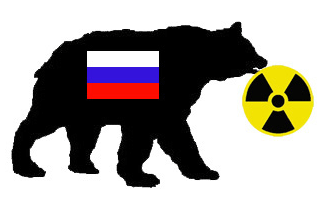 A new ARMZ race, Asia Times, 14 Dec 11 By Peter Lee The people who brought about Chernobyl are pressing to become the world’s leading source for nuclear power equipment, materials, and services.
Russia’s quasi-state nuclear power authority, Rosatom, has ambitions of becoming the world’s one-stop shop for nuclear plants, uranium fuel and spent fuel services. Currently accounting for 20% of the world’s nuclear power stations and 17% of global nuclear fuel fabrication, Rosatom wants to double in size and become the dominant player in uranium ore and spent fuel in the process.
In places like Kazakhstan, Canada, Niger, Australia, the United States and Mongolia, Rosatom’s (AtomRedMetZoloto) Uranium Holding Co, or ARMZ, is seeking to dominate worldwide uranium production. Over the past two decades, Russia has aggressively leveraged the nuclear legacy of the Cold War competition between the United States and the Soviet Union. In the nuclear arms race with the United States, the USSR always opted for quantity and size rather than quality….
Secrecy caused delay in dealing with Fukushima nuclear disaster
Secret Weapons Program Inside Fukushima Nuclear Plant? U.S.-Japan security treaty fatally delayed nuclear workers’ fight against meltdown Global Research, 12/4/11 by Yoichi Shimatsu “….Death of Deterrence …. in 2009, the International Atomic Energy Agency (IAEA) issued a muted warning on Japan’s heightened drive for a nuclear bomb— and promptly did nothing. The White House has to turn a blind eye to the radiation streaming through American skies or risk exposure of a blatant double standard on nuclear proliferation by an ally. Besides, Washington’s quiet approval for a Japanese bomb doesn’t quite sit well with the memory of either Pearl Harbor or Hiroshima.
In and of itself, a nuclear deterrence capability would be neither objectionable nor illegal— in the unlikely event that the majority of Japanese voted in favor of a constitutional amendment to Article 9. Legalized possession would require safety inspections, strict controls and transparency of the sort that could have hastened the Fukushima emergency response. Covert weapons development, in contrast, is rife with problems. In the event of an emergency, like the one happening at this moment, secrecy must be enforced at all cost— even if it means countless more hibakusha, or nuclear victims.
Instead of enabling a regional deterrence system and a return to great-power status, the Manchurian deal planted the time bombs now spewing radiation around the world. The nihilism at the heart of this nuclear threat to humanity lies not inside Fukushima 1, but within the national security mindset. The specter of self-destruction can be ended only with the abrogation of the U.S.-Japan security treaty, the root cause of the secrecy that fatally delayed the nuclear workers’ fight against meltdown. http://www.globalresearch.ca/index.php?context=va&aid=24275
Effects of a nuclear explosion just above the atmosphere
High-Altitude Nuclear Explosions Dangerous, but not for Reasons Gingrich Cites Scientific American By Michael Moyer | December 14, 2011 | “………In the June 2004 issue of Scientific American, the national security journalist Daniel G. Dupont wrote “Nuclear Explosions in Orbit” [subscription required], a story that details the sequence of events that would follow a nuclear detonation just above the atmosphere. Continue reading
USA has a Nuclear Party, as well as Republicans and Democratss
this isn’t just about Republicans vs. Democrats….”There is a sort of nuclear party that transcends Republican and Democratic labels,” …… “The four signers of the letter are all very much in the nuclear party, and the chairman is not.”
 U.S. Nuclear Agency Suffers Leadership Meltdown NPR, by CHRISTOPHER JOYCE December 14, 2011 The government organization charged with keeping nuclear power safe is
having a meltdown. The Nuclear Regulatory Commission consists of five commissioners who direct the work of hundreds of nuclear engineers and other experts. They write the rules for how nuclear reactors operate.
Now four of those commissioners say the chairman of the NRC is a bully who’s destroying their ability to do their job. Continue reading
Fort Calhoun nuclear plant to stay closed, as new problems found
Regulators up scrutiny of Fort Calhoun nuclear plant after finding more problems Washington Post, 13 Dec OMAHA, Neb. — Several new problems have been found at a Nebraska power plant that suffered flood damage earlier this year, federal regulators said Tuesday, so inspectors will be watching the plant north of Omaha even more closely as repairs from flooding are made.
The tougher oversight for the Omaha Public Power District plant in Fort Calhoun will likely further delay its restart from early next year until sometime in the spring as it makes repairs from the summer flooding. Continue reading
Arnie Gundersen on the state of the Fukushima nuclear fuel cores

 Fukushima – Could it Have a China Syndrome? FAIREWINDS ASSOCIATES, Arnie Gundersen, 14 Dec 11 “…….the good news is I do not think a China Syndrome can happen. I do not think this core can keep melting into the bottom of the earth. And I do not think there will be a steam explosion either. That is the good news.
Here is the bad news.
That nuclear core is in direct contact with tons of water. And that containment, while not leaking down, is leaking out the sides. That contaminated water is going into every other building on site. And there is literally thousands and thousands of tons of water in other buildings. That water contains radioactive cesium, radioactive strontium, and it also contains nuclear fuel. There will be uranium in that water and plutonium in that water as well. We know for sure that that water is leaking into the ground water and into the Pacific Ocean. So while it is important to know that we are not going to release the nuclear core directly into the center of the earth, the problem is not over. And as a matter of fact, the problem will last for tens, perhaps even as long as 30 years because this contaminated water is in the basements of all the buildings on site. And not only does it contain cesium (that hangs around for 300 years), strontium (hangs around for 300 years), but it also contains plutonium and uranium and they have half lives of tens of thousands of years.
So the problem is, what do we do with all that water that is contaminated? It is already leaking into the groundwater. It is already leaking into the ocean. TEPCO is frantically catching it and putting it into tanks. But just today, TEPCO announced that they are running out of tank space on site, and eventually they are going to have to release those tanks into the Pacific Ocean. Now they will try to clean up some of the isotopes like cesium. But they have been unable to capture all the strontium. Strontium is a bone seeker that causes leukemia… http://fairewinds.com/content/fukushima-could-it-have-china-syndrome
Problems of foreign ownership hamper USA’s nuclear power expansion
Nuclear expansion review halted over foreign ownership worries Chron.com, By TRACY IDELL HAMILTON, December 14, 2011 The Nuclear Regulatory Commission has suspended its review of the foreign ownership portion of the application to expand the South Texas Project nuclear plant over concerns that the owners haven’t done enough to ensure domestic control of the plant.
Toshiba Corp., based in Japan, could obtain an 85 percent ownership stake in the two nuclear plants proposed for the site outside of Bay City, the NRC found, meaning the company could have “the power to exercise ownership, control or domination over NINA,” or Nuclear
Innovation North America.
NINA is a partnership between Toshiba and NRG Energy, which shares ownership of STP’s existing nuclear plants with CPS Energy and Austin Energy…..
The commission asked NRG for more information on its “foreign ownership Negation Action Plan,” in late summer and fall, but that information appears to be insufficient…..http://www.chron.com/business/article/Nuclear-expansion-review-halted-over-foreign-2403395.php
1 This Month

of the week – Shut Down Drone Warfare!


Tell the Ukrainian Government to Drop Prosecution of Peace Activist Yurii Sheliazhenko

Petition to revoke the licensing of the Near Surface Nuclear Disposal Facility (NSDF) at Chalk River. https://www.ourcommons.ca/petitions/en/Petition/Details?Petition=e-7247
To see nuclear-related stories in greater depth and intensity – go to https://nuclearinformation.wordpress.com
-
Archives
- March 2026 (230)
- February 2026 (268)
- January 2026 (308)
- December 2025 (358)
- November 2025 (359)
- October 2025 (376)
- September 2025 (257)
- August 2025 (319)
- July 2025 (230)
- June 2025 (348)
- May 2025 (261)
- April 2025 (305)
-
Categories
- 1
- 1 NUCLEAR ISSUES
- business and costs
- climate change
- culture and arts
- ENERGY
- environment
- health
- history
- indigenous issues
- Legal
- marketing of nuclear
- media
- opposition to nuclear
- PERSONAL STORIES
- politics
- politics international
- Religion and ethics
- safety
- secrets,lies and civil liberties
- spinbuster
- technology
- Uranium
- wastes
- weapons and war
- Women
- 2 WORLD
- ACTION
- AFRICA
- Atrocities
- AUSTRALIA
- Christina's notes
- Christina's themes
- culture and arts
- Events
- Fuk 2022
- Fuk 2023
- Fukushima 2017
- Fukushima 2018
- fukushima 2019
- Fukushima 2020
- Fukushima 2021
- general
- global warming
- Humour (God we need it)
- Nuclear
- RARE EARTHS
- Reference
- resources – print
- Resources -audiovicual
- Weekly Newsletter
- World
- World Nuclear
- YouTube
-
RSS
Entries RSS
Comments RSS
 nuclear-news