Nuclear energy production and consumption grinding down worldwide
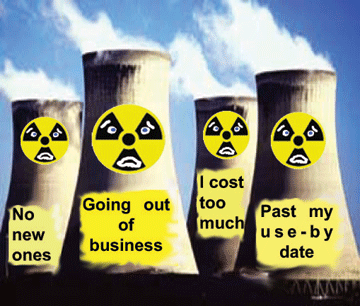 Much of the decline in installed capacity is the result of halted reactor construction around the world. ….. these numbers can hardly encourage the industry,” said Worldwatch President Robert Engelman.”The high cost of nuclear electricity generation and the widespread public perceptions that it poses unacceptable safety risks make it unlikely this form of power will help slow human-caused climate change or offer an attractive alternative to rising fossil-fuel prices any
time soon.”….
Global Nuclear Generation Capacity Falls E News Park Forest 06 DECEMBER 2011 New analysis indicates countries are turning to other energy sources as a result of high costs, low demand, and recent disasters. WASHINGTON–. Due to increasing costs of production, a slowed demand for electricity, and fresh memories of disaster in Japan, production of nuclear power fell in 2011, according to the latest Vital Signs Online (VSO) report from the Worldwatch Institute (www.Worldwatch.org).
…… global installed nuclear capacity—-the potential power generation from all existing plants—-declined to 366.5 gigawatts (GW) in 2011, from 375.5 GW at the end of 2010.
Not surprisingly, this drop in installed capacity corresponds with a decline in global consumption of nuclear energy. Nuclear’s share of world commercial primary energy usage fell to around 5 percent in 2010, having peaked at about 6 percent in 2001 and 2002. Only four countries—-the Czech Republic, Romania, Slovakia, and the United Kingdom—-increased their share of nuclear power by over 1 percentage point between 2009 and 2010.
Much of the decline in installed capacity is the result of halted reactor construction around the world. ….. these numbers can hardly encourage the industry,” said Worldwatch President Robert Engelman.”The high cost of nuclear electricity generation and the widespread public perceptions that it poses unacceptable safety risks make it unlikely this form of power will help slow human-caused climate change or offer an attractive alternative to rising fossil-fuel prices any
time soon.”….
The current global decline in installed nuclear power capacity stands
in stark contrast to nuclear’s surge in popularity throughout the
2000s. Although many factors are behind the decline, it is largely the
result of high costs, slowed electricity demand, and lower natural gas
prices in recent months. The reactor meltdown at Japan’s Fukushima
plant seven months ago also likely added to the severity of the
decline. Only 10 of Japan’s 54 reactors are currently connected to the
grid, China froze construction on 25 reactors immediately after the
Fukushima explosions, and both Germany and Switzerland announced plans
to phase out nuclear power following the disaster.
“Whereas renewable energy sources are growing at rates of up to 70
percent and more on an annual basis, nuclear energy is the only major
energy technology experiencing negative growth,” says Alexander Ochs,
Director of Worldwatch’s Climate and Energy program. “Not only is
nuclear too risky from a health and security point of view, it’s also
just too expensive.”
Although nuclear power remains an important energy source for many
countries, including Russia and France, it is likely that its
prominence will continue to decrease. To maintain current generation
levels, the world would need to install an additional 18 GW by 2015
and another 175 GW by 2025. In the aftermath of Fukushima and in the
context of a fragile global economy, an increase that sharp is
improbable.
Further highlights from the report:
Together, China, India, Iran, Pakistan, Russia, and South Korea have
contributed around 5 GW of new installed capacity since the beginning
of 2010. During this same period, nearly 11.5 GW of installed capacity
has been shut down in France, Germany, Japan, and the United Kingdom.
Germany alone has taken around 8 GW of installed nuclear capacity
offline this year.
Currently, 65 reactors are under construction around the world;
however, 20 of these have been under construction for more than 20
years.
Construction on the first nuclear power plant to be built in France in
15 years has been delayed until 2016, and its projected cost has grown
from €3.3 billion (Approximately USD 4.4 billion) to €6 billion
(Approximately USD 8 billion).
The average age of decommissioned reactors worldwide has risen to 23 years.
In 2009, the U.S. Nuclear Regulatory Commission received 26 nuclear
reactor permit applications, but only four of those sites have plans
for construction.
http://www.enewspf.com/latest-news/science-a-environmental/29363-global-nuc
No comments yet.
1 This Month


Tell the Ukrainian Government to Drop Prosecution of Peace Activist Yurii Sheliazhenko

Petition to revoke the licensing of the Near Surface Nuclear Disposal Facility (NSDF) at Chalk River. https://www.ourcommons.ca/petitions/en/Petition/Details?Petition=e-7247


of the week – STOP SMALL MODULAR REACTORS IN CANADA
To see nuclear-related stories in greater depth and intensity – go to https://nuclearinformation.wordpress.com
-
Archives
- March 2026 (204)
- February 2026 (268)
- January 2026 (308)
- December 2025 (358)
- November 2025 (359)
- October 2025 (376)
- September 2025 (258)
- August 2025 (319)
- July 2025 (230)
- June 2025 (348)
- May 2025 (261)
- April 2025 (305)
-
Categories
- 1
- 1 NUCLEAR ISSUES
- business and costs
- climate change
- culture and arts
- ENERGY
- environment
- health
- history
- indigenous issues
- Legal
- marketing of nuclear
- media
- opposition to nuclear
- PERSONAL STORIES
- politics
- politics international
- Religion and ethics
- safety
- secrets,lies and civil liberties
- spinbuster
- technology
- Uranium
- wastes
- weapons and war
- Women
- 2 WORLD
- ACTION
- AFRICA
- Atrocities
- AUSTRALIA
- Christina's notes
- Christina's themes
- culture and arts
- Events
- Fuk 2022
- Fuk 2023
- Fukushima 2017
- Fukushima 2018
- fukushima 2019
- Fukushima 2020
- Fukushima 2021
- general
- global warming
- Humour (God we need it)
- Nuclear
- RARE EARTHS
- Reference
- resources – print
- Resources -audiovicual
- Weekly Newsletter
- World
- World Nuclear
- YouTube
-
RSS
Entries RSS
Comments RSS
 nuclear-news
Leave a comment