For USA’s nuclear industry – could things get any worse?
 Nuclear’s Annus Horribilis, AOL, Margaret Ryan, November 30, 2011 For the nuclear industry, 2011 was Biblical. Earthquakes. Tsunamis. Tornadoes. Floods. Fires. 2011 had everything but plagues of locusts.
Since 2001, nuclear critics had been worried about airplanes smashing into plants or dirty bombs. This year nature reminded everyone it can still throw a haymaker, and the reverberations from 2011’s onslaught appear set to dominate US nuclear power in 2011
March 2011 brought the 9.0 magnitude earthquake off northeastern Japan that sparked a tsunami whose waves may have exceeded 45 feet. Tokyo Electric Power Company’s oldest nuclear station, Fukushima Daiichi, apparently survived the earthquake, but its four oldest reactors didn’t survive that wall of water. Nuclear experts are still figuring out what all went wrong, and tens of thousands still haven’t returned home as Japanese authorities try to decontaminate radioactive hot spots.
In April, massive tornadoes that devastated the southeast swept near the Tennessee Valley Authority’s Browns Ferry plant.
In June, droughts sparked wildfires across the Southwest, including one that threatened the Los Alamos National Laboratory, where nuclear weapons materials are stored.
June also brought record floods across the upper Midwest. For weeks Omaha Public Power District’s Fort Calhoun nuclear plant was essentially an island.
August saw the 5.8 magnitude Virginia earthquake just 11 miles from Dominion Energy’s North Anna plant. The plant shut safely, and returned to service mid-November after extensive checks found no damage even though ground motion briefly exceeded the plant’s design.
Aging Generation Giants All these challenges resurrected questions about the robustness 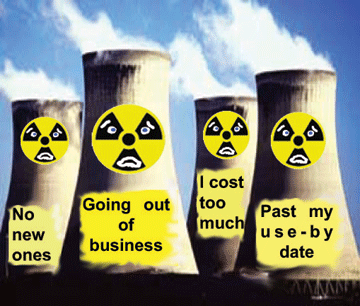 of America’s nuclear fleet as reactors begin to pass the 40-year mark. That was once considered the operating limit, but with safety backfits, regular material checks and planned component replacements, the Nuclear Regulatory Commission says reactors can operate for 60 years. More than half of the 104 reactors in the US have been licensed to do so…..
“most” people in the industry recognize the need to take 2011’s warnings seriously. “They don’t want to be the next Fukushima,”….. “No one wants to lose a billion dollar asset.”….
No comments yet.
1 This Month

of the week – Shut Down Drone Warfare!


Tell the Ukrainian Government to Drop Prosecution of Peace Activist Yurii Sheliazhenko

Petition to revoke the licensing of the Near Surface Nuclear Disposal Facility (NSDF) at Chalk River. https://www.ourcommons.ca/petitions/en/Petition/Details?Petition=e-7247
To see nuclear-related stories in greater depth and intensity – go to https://nuclearinformation.wordpress.com
-
Archives
- April 2026 (57)
- March 2026 (251)
- February 2026 (268)
- January 2026 (308)
- December 2025 (358)
- November 2025 (359)
- October 2025 (376)
- September 2025 (257)
- August 2025 (319)
- July 2025 (230)
- June 2025 (348)
- May 2025 (261)
-
Categories
- 1
- 1 NUCLEAR ISSUES
- business and costs
- climate change
- culture and arts
- ENERGY
- environment
- health
- history
- indigenous issues
- Legal
- marketing of nuclear
- media
- opposition to nuclear
- PERSONAL STORIES
- politics
- politics international
- Religion and ethics
- safety
- secrets,lies and civil liberties
- spinbuster
- technology
- Uranium
- wastes
- weapons and war
- Women
- 2 WORLD
- ACTION
- AFRICA
- Atrocities
- AUSTRALIA
- Christina's notes
- Christina's themes
- culture and arts
- Events
- Fuk 2022
- Fuk 2023
- Fukushima 2017
- Fukushima 2018
- fukushima 2019
- Fukushima 2020
- Fukushima 2021
- general
- global warming
- Humour (God we need it)
- Nuclear
- RARE EARTHS
- Reference
- resources – print
- Resources -audiovicual
- Weekly Newsletter
- World
- World Nuclear
- YouTube
-
RSS
Entries RSS
Comments RSS
 nuclear-news
Leave a comment