Appeal to save Grand Canyon’s sacred lands, biodiversity, water – from uranium mining
Pollution from past uranium mining already plagues the Grand Canyon and surrounding region. Proposals for new mining have prompted protests, litigation and proposed legislation. Scientists, tribal and local governments and businesses have voiced opposition. Additional mining threatens to industrialize iconic and regionally sacred wildlands, destroy wildlife habitat and permanently pollute or deplete aquifers feeding Grand Canyon’s biologically rich springs and creeks.
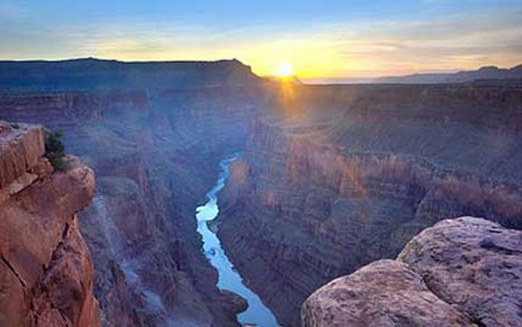
Appeal Challenges Uranium Mine Threatening Grand Canyon, 1 Dec 11, GRAND CANYON NATIONAL PARK, Ariz—Conservation groups and American Indian tribes today filed an appeal in the 9th Circuit Court challenging a lower court ruling that allowed a uranium mine near Grand Canyon National Park to re-open without updating decades-old environmental reviews. The Arizona 1 uranium mine is located near Kanab Creek immediately north of Grand Canyon National Park.
In 2010, conservation groups and tribes sued the Bureau of Land Management for failing to modernize 23-year-old mining plans and environmental reviews prior to allowing Denison Mines to resume uranium mining after the mine was shuttered in 1992. A federal judge in Phoenix this fall sided with the Bureau and the uranium industry saying no new plans or reviews were needed, prompting today’s appeal.
“These uranium mines have been closed for nearly two decades. The public has a right to evaluate their impacts to water and wildlife before they re-open. Relying on old and outdated plans and reviews doesn’t cut it,” said Taylor McKinnon, with the Center for Biological Diversity. “Allowing this decision to stand would shield mines from any further federal or public review once they have initial approval. That might be wonderful for the uranium industry but it’d be terrible policy for our public lands.”
The Arizona 1 is one of four existing uranium mines located in Grand Canyon’s 1-million-acre watershed where the Obama administration has proposed a 20-year ban on new mining claims and uranium development on existing claims lacking valid existing rights. A final environmental impact statement was issued for the 1-million acre ban in October; a decision finalizing those protections could come as early as today.
“We look forward to celebrating Secretary Salazar’s decision to order the 20-year ban,” said Roger Clark of the Grand Canyon Trust. “It is supported by an unprecedented coalition of tribal, business, and civic leaders, hunting, fishing, ranching, and conservation groups, and water, wildlife, city, and county officials.”
Today’s appeal seeks to require the Bureau to complete new mining plans and environmental reviews under the National Environmental Policy Act, Federal Land Policy and Management Act and Endangered Species Act prior to allowing decades-old mines to re-open. That precedent would then apply to the other three existing mines in the 1-million-acre area should Denison try to open them.
“It is irresponsible to continue to allow these mines to go forward under both outdated plans and an antiquated mining law putting at risk some of our most iconic public lands, including Grand Canyon, plus allowing foreign corporations to so easily place claims and pay no royalties to the American people,” said Sandy Bahr, director of Sierra Club’s Grand Canyon Chapter. “History tells us that the land, the water, and the people need stronger protections.”
Pollution from past uranium mining already plagues the Grand Canyon and surrounding region. Proposals for new mining have prompted protests, litigation and proposed legislation. Scientists, tribal and local governments and businesses have voiced opposition. Additional mining threatens to industrialize iconic and regionally sacred wildlands, destroy wildlife habitat and permanently pollute or deplete aquifers feeding Grand Canyon’s biologically rich springs and creeks.
Plaintiffs on today’s appeal include the Center for Biological Diversity, Grand Canyon Trust, the Sierra Club, the Havasupai Tribe and the Kaibab Paiute Tribe. Plaintiffs are represented by attorneys Amy Atwood of the Center for Biological Diversity, Neil Levine of Grand Canyon Trust and Roger Flynn of the Western Mining Action Project.
| Taylor McKinnon, Center for Biological Diversity (928) 310-6713 Roger Clark, Grand Canyon Trust (928) 774-7488 Sandy Bahr, Sierra Club (602) 999-5790 |
http://www.biologicaldiversity.org/news/press_releases/2011/grand-canyon-uranium-11-28-2011.html
No comments yet.
1 This Month

of the week – Shut Down Drone Warfare!


Tell the Ukrainian Government to Drop Prosecution of Peace Activist Yurii Sheliazhenko

Petition to revoke the licensing of the Near Surface Nuclear Disposal Facility (NSDF) at Chalk River. https://www.ourcommons.ca/petitions/en/Petition/Details?Petition=e-7247
To see nuclear-related stories in greater depth and intensity – go to https://nuclearinformation.wordpress.com
-
Archives
- March 2026 (237)
- February 2026 (268)
- January 2026 (308)
- December 2025 (358)
- November 2025 (359)
- October 2025 (376)
- September 2025 (257)
- August 2025 (319)
- July 2025 (230)
- June 2025 (348)
- May 2025 (261)
- April 2025 (305)
-
Categories
- 1
- 1 NUCLEAR ISSUES
- business and costs
- climate change
- culture and arts
- ENERGY
- environment
- health
- history
- indigenous issues
- Legal
- marketing of nuclear
- media
- opposition to nuclear
- PERSONAL STORIES
- politics
- politics international
- Religion and ethics
- safety
- secrets,lies and civil liberties
- spinbuster
- technology
- Uranium
- wastes
- weapons and war
- Women
- 2 WORLD
- ACTION
- AFRICA
- Atrocities
- AUSTRALIA
- Christina's notes
- Christina's themes
- culture and arts
- Events
- Fuk 2022
- Fuk 2023
- Fukushima 2017
- Fukushima 2018
- fukushima 2019
- Fukushima 2020
- Fukushima 2021
- general
- global warming
- Humour (God we need it)
- Nuclear
- RARE EARTHS
- Reference
- resources – print
- Resources -audiovicual
- Weekly Newsletter
- World
- World Nuclear
- YouTube
-
RSS
Entries RSS
Comments RSS
 nuclear-news
Leave a comment