The lingering nuclear disaster of Chernobyl
 the global death toll by 2004 was closer to 1 million and said health effects included birth defects, pregnancy losses, accelerated aging, brain damage, heart, endocrine, kidney, gastrointestinal and lung diseases.
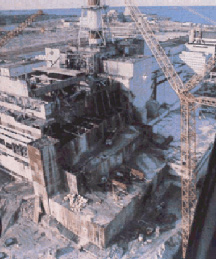
The physical and financial legacies of that disaster are obvious: a 30-km uninhabited ring around the Chernobyl plant, billions of dollars spent cleaning the region and a major new effort to drum up 600 million euros ($840 million) in fresh funds that Kiev says is needed to build a more durable casement over the stricken reactor.
Just as powerful are the scars that are less easily seen: fear and an abiding suspicion that despite the reassuring reports by authorities and scientific bodies people may still be dying from radiation after-effects….
The official short-term death toll from the accident was 31 but many more people died of radiation-related sicknesses such as cancer. The total death toll and long-term health effects remain a subject of intense debate even 25 years after the disaster.
“(The disaster) brought suffering on millions of people,” said the Emergency Ministry’s Holosha.
“About 600,000 people were involved in mitigating the consequences of the accident. About 300,000 of them were Ukrainians. Out of those, 100,000 are disabled now.”
A 2008 United Nations study cited a “dramatic increase in thyroid cancer incidence” in the Ukraine and just across the border in Belarus. Children seemed to be especially vulnerable because they drank milk with high levels of radioactive iodine.
“One arrives at between 12,000 and 83,000 children born with congenital deformations in the region of Chernobyl, and around 30,000 to 207,000 genetically damaged children worldwide,” German physicians’ organization IPPNW said in a report in 2006.
Those figures are far lower than health officials had predicted. Indeed, the UN says that overall health effects were less severe than initially expected and that only a few thousand people had died as a result of the accident.
But a 2009 book by a group of Russian and Belarussian scientists published by the New York Academy of Sciences argued that previous studies were misled by rigged Soviet statistics.
“The official position of the Chernobyl Forum (a group of UN agencies) is that about 9,000 related deaths have occurred and some 200,000 people have illnesses caused by the catastrophe,” authors Alexei Yablokov, Vasily Nesterenko and Alexei Nesterenko wrote in “Chernobyl: Consequences of the catastrophe for people and the Environment”.
“A more accurate number estimates nearly 400 million human beings have been exposed to Chernobyl’s radioactive fallout and, for many generations, they and their descendants will suffer the devastating consequences.”
The authors argued that the global death toll by 2004 was closer to 1 million and said health effects included birth defects, pregnancy losses, accelerated aging, brain damage, heart, endocrine, kidney, gastrointestinal and lung diseases.
“It is clear that tens of millions of people, not only in Belarus, Ukraine and Russia, but worldwide, will live under measurable chronic radioactive contamination for many decades,” they wrote….
No comments yet.
1 This Month

of the week – Shut Down Drone Warfare!


Tell the Ukrainian Government to Drop Prosecution of Peace Activist Yurii Sheliazhenko

Petition to revoke the licensing of the Near Surface Nuclear Disposal Facility (NSDF) at Chalk River. https://www.ourcommons.ca/petitions/en/Petition/Details?Petition=e-7247
To see nuclear-related stories in greater depth and intensity – go to https://nuclearinformation.wordpress.com
-
Archives
- March 2026 (237)
- February 2026 (268)
- January 2026 (308)
- December 2025 (358)
- November 2025 (359)
- October 2025 (376)
- September 2025 (257)
- August 2025 (319)
- July 2025 (230)
- June 2025 (348)
- May 2025 (261)
- April 2025 (305)
-
Categories
- 1
- 1 NUCLEAR ISSUES
- business and costs
- climate change
- culture and arts
- ENERGY
- environment
- health
- history
- indigenous issues
- Legal
- marketing of nuclear
- media
- opposition to nuclear
- PERSONAL STORIES
- politics
- politics international
- Religion and ethics
- safety
- secrets,lies and civil liberties
- spinbuster
- technology
- Uranium
- wastes
- weapons and war
- Women
- 2 WORLD
- ACTION
- AFRICA
- Atrocities
- AUSTRALIA
- Christina's notes
- Christina's themes
- culture and arts
- Events
- Fuk 2022
- Fuk 2023
- Fukushima 2017
- Fukushima 2018
- fukushima 2019
- Fukushima 2020
- Fukushima 2021
- general
- global warming
- Humour (God we need it)
- Nuclear
- RARE EARTHS
- Reference
- resources – print
- Resources -audiovicual
- Weekly Newsletter
- World
- World Nuclear
- YouTube
-
RSS
Entries RSS
Comments RSS
 nuclear-news
Leave a comment