Nuclear power growing more unpopular – several global polls show

 Nuclear power ‘gets little public support worldwide’, By Richard Black, Environment correspondent, BBC News, 26 Nov 11 There is little public appetite across the world for building new nuclear reactors, a poll for the BBC indicates.
In countries with nuclear programmes, people are significantly more opposed than they were in 2005, with only the UK and US bucking the trend. Most believe that boosting efficiency and renewables can meet their needs.
Just 22% agreed that “nuclear power is relatively safe and an important source of electricity, and we should build more nuclear power plants”. In contrast, 71% thought their country “could almost entirely replace coal and nuclear energy within 20 years by becoming highly energy-efficient and focusing on generating energy from the Sun and wind”. Globally, 39% want to continue using existing reactors without building new ones, while 30% would like to shut everything down now.
The global research agency GlobeScan, commissioned by BBC News, polled 23,231 people in 23 countries from July to September this year, several months after an earthquake and giant tsunami devastated Japan’s Fukushima Daiichi power station.
Rising tide GlobeScan had previously polled eight countries with nuclear programmes, in 2005. In most of them, opposition to building new reactors has risen markedly since. In Germany it is up from 73% in 2005 to 90% now – which is reflected in the government’s recent decision to close its nuclear programme.
More intriguingly, it also rose in pro-nuclear France (66% to 83%) and Russia (61% to 83%)…..
The BBC/GlobeScan poll is broadly consistent with other global polls as well. In June, both Ipsos-Mori and the JapaneseAsahi Shimbun newspaper found drops in support for the technology in most countries, with support continuing in a number including the US. The Ipsos-Mori poll found that nuclear enjoyed the lowest support of any established technology for generating electricity, with 38%.
Coal fared not much better, at 48%, while solar, wind and hydro all found favour with more than 90% of those surveyed.
“That renewable energy combined with efficiency can replace coal and nuclear is not only a majority popular belief, but a fact supported by a growing number of authoritative reports,” commented Jan Beranek, who leads the energy team in Greenpeace International. “Nuclear power is a relatively tiny industry with huge economic, technical, safety, environmental, and political problems. “And the Fukushima accident reminded the world that all reactors have inherent risks.”…..http://www.bbc.co.uk/news/science-environment-15864806
India’s nuclear ambitions, and Australia’s uranium cash cow, now at risk
In the shadow of increasingly fierce grassroots opposition, India’s nuclear ambitions – and Australia’s future uranium cash cow – are looking decidedly less promising.
 India’s nuclear ambitions come up against people power, BY:AMANDA HODGE, IDINTHAKARAI, TAMIL NADU :The Australian . November 26, 2011 1 India’s Koodankulam nuclear power project is like the proverbial cockroach in an atomic storm. It has survived the fall of the Soviet Union, the assassination of an Indian prime minister and the Boxing Day tsunami, when waves surged over the site where it now stands.
The first of six reactors to be built on the shore of India’s southernmost tip in Tamil Nadu was to have been switched on next month, 23 years after Mikhail Gorbachev and the slain Rajiv Gandhi signed off on the friendship project.
Instead it has hit another obstacle – an emerging national anti-nuclear campaign that has gained serious momentum since Japan’s Fukushima meltdown in March. Continue reading
Anti nuclear movement winning hearts and minds in India
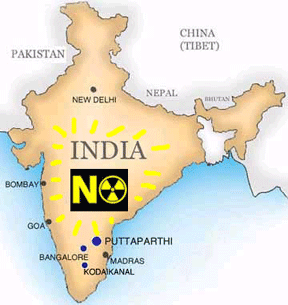 Anti-nuke lobby seems to be winning the battle in India:Expert IBN Live ,Nov 25,2011 Bangalore, Nov 25 (PTI) A key member of the Indian nuclear establishment today cautioned that if protestors of Koodankulam project in Tamil Nadu succeed in their objective, the country’s entire nuclear programme could be in jeopardy. “..if they (protestors in Koodankulam) are able to succeed, then they can succeed in shutting down the entire nuclear programme …..Member of the Atomic Energy Commission M R Srinivasan told PTI. His warning came even as the protest by locals against the Koodankulam nuclear power project in Tamil Nadu’s Tirunelveli district entered the 100th day yesterday. Srinivasan, a former Secretary to the Department of Atomic Energy, said the “anti-nuclear movement” in the country has become “very strong with lot of support from elsewhere”.
“It seems they (anti-nuclear lobby) are winning the battle”, he said. Srinivasan said “anti-nuclear people are working in an orchestrated way” in Koodankulam. “They are all joining up together…anti-nuclear people in the United States, Australia, Finland, Germany”. “It’s orchestrated completely. Why should school children sit (in protest) morning to evening? Do they understand the issues involved?. They have been told by their parents, they have been told by some religious leaders. So, it (the protest) goes on”. http://ibnlive.in.com/generalnewsfeed/news/antinuke-lobby-seems-to-be-winning-the-battle-in-indiaexpert/914642.html
A nuclear Iran is likely and acceptable to the world
 World will accept Nuclear Iran, says Israeli economist Times of India Nov 25, 2011, JERUSALEM: A leading Israeli investment firm today said the world is likely to grudgingly accept a nuclear Iran given the high price any military strike on its nuclear facilities is going to exact.
 “A sharp rise in the price of oil, the costs of war and the damage to global trade would be too great and deter world powers from taking any serious action,” Amir Kahanovich, chief economist at Clal Finance, one of Israel’s largest brokerage houses, said.
This assessment is in sharp contrast to Israel’s stated official position that Tehran’s nuclear aspirations are unacceptable and that all options are on the table to foil the Islamic Republic’s nuclear ambitions.
Even for Israel the economic cost of a military confrontation that could include retaliatory missile attacks by Tehran and proxies in Gaza and Lebanon would be too high, he predicted.
“Unfortunately, it appears that a nuclear Iran is the most reasonable scenario,” the economist inferred. His remarks came after President Shimon Peres said earlier this month that an attack on Iran was becoming increasingly more likely.
Nuclear power for India – neither safe nor necessary

 NUCLEAR EMERGENCY IN JAPAN: LESSONS FOR INDIA, Aid Netherlands, Shankar Sharma November 25, 2011 “…..While it is clear as to why Japan has put so much importance for the safety and reliability of its nuclear power plants (it is relying on its nuclear power industry for about 30% of its total electricity supply), can we assume similar checks and balances in India where the installed capacity of nuclear power is only about 2.8%?
In this background and with the potential for nuclear catastrophe our society has to seek answer to a credible question: whether the planned addition of more than 60,000 MW of nuclear power by 2031-32 (as per Integrated Energy Policy, IEP) is in the interest of our society?. It is also the high time that the proposed Jaitapur nuclear power park in Maharastra, and similar nuclear power parks in West Bengal, Andhra Pradesh and Gujarath are put to such a critical and objective analysis. A document by DAE (A Strategy for the Growth of Electricity in India: http://www.dae.gov.in/publ/doc10/index.htm) indicates the aspiration of the department to increase the nuclear power capacity to 274,560 MW by 2052. It is very unlikely that the huge risks involved in such a large number of nuclear reactors in the form of vast nuclear power parks can be acceptable to a densely populated and poor country like ours.
The other question that needs to be answered honestly is that in the backdrop of all the associated high risks, are nuclear power plants essential to our society? Can we not manage the legitimate demand for electricity from so many other benign options? …..http://www.nl-aid.org/continent/south-asia/nuclear-emergency-in-japan-lessons-for-india/
Japanese soldiers to enter Fukushima radiation zone
Once More Into the Breach, TIME by Kirk Spitzer , November 25, 2011 TOKYO – Japanese troops are being sent once again into the heart of the Fukushima radiation zone to battle contamination from the stricken nuclear power plant. Specially trained troops will enter the 20-kilometer (12.4 miles) exclusion zone around the plant next month to decontaminate abandoned government buildings and facilities…..
About 400 troops from the Ground Self Defense Force’s Central Nuclear Biological Chemical Weapon Defense Unit will be sent to Fukushima. They’ve been there before: Four members of the unit were injured in a hydrogen explosion at the plant on March 12. Several helicopter pilots and crew received large doses of radiation while dumping seawater on one of the damaged reactors.
The soldiers are expected to finish their work in about a month. No word on when, or if, all the contamination will be gone…… http://battleland.blogs.time.com/2011/11/25/once-more-into-the-breach/#ixzz1eqfdOOoZ
India’s Nuclear Corporation tries to make nuclear energy into “fun”
 Nuclear corporation turns to catchy jingles to push Kudankalam project, DNA,
  Nov 25, 2011, Chennai | Agency: IANS Catchy jingles aired on two FM radio stations instead of dull and drab facts – this is the Nuclear Power Corporation of India Ltd’s new effort to convince the locals around the Kudankalam project that the atomic power plant is not bad after all.
“In an attempt to reach out to people, we have decided to air two one minute jingles on Suryan FM and Hello FM radio stations in Tirunelveli and Tuticorin districts as a part of public awareness programme,” said a senior NPCIL official preferring anonymity.
The NPCIL have approved two foot tapping jingles of one minute each with messages that nuclear power is reliable as against other energy sources like thermal/wind/hydro and about the importance of atomic power for nation building.
“The idea is to catch the people’s mind space which was earlier lost to the anti-nuclear activists,” NPCIL officials said. A new, energized print and visual media blitz is what NPCIL officials are planning to counter the anti-nuke propaganda based on “lies, untruths and unscientific claims”…..
Officials now reluctantly admit that they had perhaps committed an error by not taking the anti-Kudankalam Nuclear Power Plant propaganda seriously….http://www.dnaindia.com/india/report_nuclear-corporation-turns-to-catchy-jingles-to-push-kudankalam-project_1617428
Kudankulam anti nuclear protestors- are their lives in danger?
Kudankulam N-plant: Protesters allege threat to lives, NDTV – Nov 24, 2011 Kudankulam: Days after talks between government representatives and villagers protesting against the setting up of a nuclear power plant at Kudankulam in Tamil Nadu failed, protesters are alleging a threat to their lives. … http://www.ndtv.com/article/india/kudankulam-n-plant-protesters-allege-threat-to-lives-152712
100 days of anti nuclear protest stall India’s nuclear program
The protest, which began on August 16 at Idinthakarai near Kudankulam, has been a success as it has managed to get the state government pass a resolution in the Cabinet in favour of the local community.
Anti-nuclear protest enters 100th day at Kudankulam, Economic Times 25 NOV, 2011, JOE A SCARIA ,ET BUREAU CHENNAI: The anti-nuclear protest that has stalled the commissioning of the multi-crore nuclear plant at Kudankulam entered the 100th day on Thursday. The protestors from Tamil Nadu’s southern-most districts, Kanyakumari, Tirunelveli and Tuticorin, held an inter-religious prayer meeting at the plant site. The plant staff, including the engineersfrom Russia, continued to stay at home. Continue reading
Economic, environmental, resources crises to be solved in Denmark through 100% renewable energy
Denmark faced three global crises which will hit it “with a force that is so far absolutely unheard of” — an economic and financial crisis, a climate crisis and a resources crisis. “This proposal will address all three crises.”
 Denmark aims for 100 pct renewable energy in 2050
* Proposes to get 52 pct of power from renewables in 2020
* Aims for entire energy supply from renewables in 2050
* Minister says investment in green energy can pay off
By Mette Fraende COPENHAGEN, Nov 25 (Reuters) – Danish government proposals on Friday called for sourcing just over half of its electricity from wind turbines by 2020 and all of its energy from renewable sources in 2050. Continue reading
Renewable energy now winning the race against fossil fuels
Renewable power trumps fossil fuels for first time L.A. Times, 25 Nov 11 Renewable energy is surpassing fossil fuels for the first time in new power-plant investments, shaking off setbacks from the financial crisis and an impasse at the United Nations global warming talks.
Special radiation limit for infants food in Japan
Japan plans to set special radiation limit for infant food Mainichi Daily News, TOKYO (Kyodo) 26 Nov 11 — Japan’s health ministry on Thursday proposed categorizing food and drink products in four groups, including one for infant foods, in setting tougher radiation standard levels.
While the Ministry of Health, Labor and Welfare has been working to lower the upper limit on radioactive cesium exposure to 1 millisievert per year from the current provisional level of 5 millisieverts, it has decided to give special consideration to infants who are more vulnerable to radiation than older people.
The other three categories are ordinary food, milk and drinking water. Most foods will be categorized as ordinary food and be put under unified supervision, while milk, drinking water and infant foods, including powdered milk and baby foods, will be examined separately…. http://mdn.mainichi.jp/mdnnews/news/20111125p2g00m0dm020000c.html
Iran and Kuwait – the double standards of the International Atomic Energy Agency (IAEA)
It would be hard to find a more volatile place [than Kuwait] to build a nuclear installation. Oh, and the land is low lying and subject to silting and shifting.
 Nuclear Madness: Iran, Kuwait or the IAEA?, Morning Star, 25 November 2011, by Felicity Arbuthnot As the sabre-rattling against Iran becomes more deafening – with threats of potentially creating a few Chenobyls or a Fukushima by bombing working nuclear power plants – another potential nuclear madness is planned.
The International Atomic Energy Agency (IAEA) appears to be behaving in a partisan and shameless way regarding Iran, much as it did with Iraq.
With Iraq, accusations abounded that the inspection teams were more about spying than neutral observation. “The way back to the UN was via Tel Aviv,” one former inspector memorably remarked.
Gareth Porter has meticulously and comprehensively trashed the International Atomic Energy Agency’s (IAEA) latest report on Iran, showing disturbing parallels with the tragic Iraq fiasco. Continue reading
For India sustainable banking and nuclear energy are incompatible
NUCLEAR EMERGENCY IN JAPAN: LESSONS FOR INDIA, Aid Netherlands, Shankar Sharma November 25, 2011 “.……Tall claims have been made about the capability of Indian nuclear establishments, especially the Atomic Energy Regulatory Board (AERB), to ensure complete safety of nuclear power projects. The fact that the people manning AERB are generally deputed from Department of Atomic Energy (DAE) OR Nuclear Power Corporation Ltd., which is the operator of the nuclear power plants in the country, cannot assure the complete operational independence of AERB. As far as Chernobyl disaster is concerned Indian nuclear authorities have said that “… secrecy was part of the Soviet culture…” How transparent are the issues with our own nuclear establishments? Mr. A Gopalakrishnan, A former Chairman of AERB, has expressed concern about the complete dependence of AERB on DAE for resources.
There have been suggestions from Indian nuclear authorities that the safe storage of nuclear waste is technically feasible during its active life time. Is it really so, and if so, what about the huge costs involved? Are the efforts to keep nuclear waste safe for thousands of years worthy of all the risks involved? In this regard there are credible and serious concerns that whereas the present generation may get the benefit of electricity from nuclear power, the future generations have to deal with all the risks and costs associated with the spent fuel. Is this fair or socially responsible?….
The exorbitant capital and operating costs, cost and time over runs, subsidies and hidden costs in the Indian context of nuclear power plants have also been quietly ignored by IEP. International studies have established that if we take into account the true costs associated with disposing nuclear waste, decommissioning the worn out plants, and insuring reactors against catastrophic failures into objective account building nuclear plants in a competitive electricity market is not simply economical…..
There seems to be growing skepticism even to finance the nuclear power. “Too many well known banks that otherwise have taken laudable steps towards sustainability, are still investing heavily in the nuclear industry, putting the world on the wrong energy track. Sustainable banking and financing nuclear energy are simply incompatible” said Johan Frijns, BankTrack coordinator…..”. http://www.nl-aid.org/continent/south-asia/nuclear-emergency-in-japan-lessons-for-india/
Iran is ‘the most threatened country in the world’
few observers believe Iran would dare attack Israel, a suicidal move if ever there was one. And it’s why Israel grasps at excuses to preemptively attack Iran, a far more plausible scenario than an Iranian attack on Israel.
…Iran is the most threatened country in the world….
Why everybody except Iran can have nuclear weapons, GERALD CAPLAN, Globe and Mail , Nov. 25, 2011 It is deeply regrettable that Iran may one day join the not-so-exclusive club of nations that possess nuclear weapons. It is a potential danger the world doesn’t need. If you’ll forgive an outburst of preposterous idealism, it would be kind of neat to have a world with no nuclear arms whatsoever.
But for the life of me I don’t see how the world convinces Iran it’s not entitled to such weapons when Pakistan, North Korea, Russia, India, China, the United States, France, Britain and Israel all have them. Continue reading
1 This Month

of the week – Shut Down Drone Warfare!


Tell the Ukrainian Government to Drop Prosecution of Peace Activist Yurii Sheliazhenko

Petition to revoke the licensing of the Near Surface Nuclear Disposal Facility (NSDF) at Chalk River. https://www.ourcommons.ca/petitions/en/Petition/Details?Petition=e-7247
To see nuclear-related stories in greater depth and intensity – go to https://nuclearinformation.wordpress.com
-
Archives
- March 2026 (237)
- February 2026 (268)
- January 2026 (308)
- December 2025 (358)
- November 2025 (359)
- October 2025 (376)
- September 2025 (257)
- August 2025 (319)
- July 2025 (230)
- June 2025 (348)
- May 2025 (261)
- April 2025 (305)
-
Categories
- 1
- 1 NUCLEAR ISSUES
- business and costs
- climate change
- culture and arts
- ENERGY
- environment
- health
- history
- indigenous issues
- Legal
- marketing of nuclear
- media
- opposition to nuclear
- PERSONAL STORIES
- politics
- politics international
- Religion and ethics
- safety
- secrets,lies and civil liberties
- spinbuster
- technology
- Uranium
- wastes
- weapons and war
- Women
- 2 WORLD
- ACTION
- AFRICA
- Atrocities
- AUSTRALIA
- Christina's notes
- Christina's themes
- culture and arts
- Events
- Fuk 2022
- Fuk 2023
- Fukushima 2017
- Fukushima 2018
- fukushima 2019
- Fukushima 2020
- Fukushima 2021
- general
- global warming
- Humour (God we need it)
- Nuclear
- RARE EARTHS
- Reference
- resources – print
- Resources -audiovicual
- Weekly Newsletter
- World
- World Nuclear
- YouTube
-
RSS
Entries RSS
Comments RSS
 nuclear-news