Long range nuclear missile test fired by India

 India fires its longest-range missile, capable of going deep into China, China Post, 16 Nov 11, BHUBANESHWAR, India–India on Tuesday successfully test fired one of its longest-range missiles capable of carrying a one-ton nuclear warhead deep inside China, officials said….. the nuclear-capable, two-stage missile which is powered by solid fuel was fired beyond the Bay of Bengal into the Indian Ocean. Agni means fire in Sanskrit.
“Agni-IV has a maximum range of 3,500 kilometers (2,170 miles) but this time the launch parameter was 3,000 kilometers,” the official spokesman said….. Defense ministry sources said military scientists were also giving the final shape to the 5,000-km range Agni-V, scheduled to be test-fired for the first time early next year.
India has also said it may develop an intercontinental ballistic missile….. India is among the world’s top 10 military spenders. It plans to splurge US$50 billion by 2015 to upgrade its military. It has fought three wars with rival Pakistan since their independence in 1947 and a brief but bloody border conflict with China in 1962. http://www.chinapost.com.tw/asia/india/2011/11/16/323102/India-fires.htm
Climate change documentary – media self censors the facts
 Broadcasters lose their nerve over BBC’s climate change program, Environmental News Network, 15 Nov 11 The final episode of the BBC’s Frozen Planet documentary series that focuses on climate change has been canned in the US and other countries, prompting fierce criticism. All seven episodes of the multi-million pound nature series, written and presented by Sir David Attenborough, will be screened in the UK — but the final show, entitled ‘On Thin Ice’, has been shelved by several foreign TV channels, including the Discovery channel in the US.
The last programme in the series looks at the man-made threat to the environment and examines how Earth’s ice caps are changing and the likely consequences for the rest of the planet. But US audiences will not be shown the final episode, where many fear a show that promotes the theory of global warming could upset viewers.
The package of six episodes has been sold to 30 countries and networks were provided with the option to buy a seventh ‘optional extra’ episode, along with behind-the-scenes footage. The documentary series is said to be an epic portrait of two disappearing wildernesses — the Arctic and the Antarctic – before they change forever, and is already hugely popular with viewers in the UK. However, according to the BBC, ten countries have chosen not to screen the final episode.
In the US, Frozen Planet is being aired by Discovery, which was jointly involved in the production of the series. The seven programmes cost £15 million to produce and took four years to film and edit.It is understood the Frozen Planet DVD will be sold overseas, including the US, containing all seven episodes as broadcast in the UK.
Ben Stewart of Greenpeace today said: “It’s regrettable that millions of viewers in the US won’t be getting the full story when they watch this mesmerising series. It’s like pressing the stop button on Titanic just when the iceberg appears. http://www.enn.com/ecosystems/article/43567
Nuclear industry’s future on the line
“Fukushima is having a resounding effect in those countries where they wanted to hear it. Countries that never wanted to pursue nuclear power or who came at it reluctantly are using the event as a way to back out gracefully,”
Even as some countries continue to progress their plans, the resultant delays from additional safety checks, coupled with higher costs, has already prompted changes in estimates of the role nuclear power will play in the global energy mix.
The industry knows it needs to regain the public’s trust. It cannot afford another accident.
 Nuclear power stands at a crossroads, FT, By Sylvia Pfeifer, November 15, 2011 Off the west coast of Finland on a thickly wooded island, Europe’s most advanced nuclear reactor is taking shape. The reactor, being built by France’sAreva for its Finnish customer, the utility TVO, is western Europe’s latest generation, pressurised water reactor. However, at more than €2.6bn ($3.54bn) over budget and five years late, the project is hardly the best poster child for Europe’s ambitions at a time when atomic power is under scrutiny following the crisis in Japan in the spring. Continue reading
USA debating how to censor the Internet
 Right now, the US Congress is debating a law that would give them the power to censor the world’s Internet — creating a blacklist that could target YouTube, WikiLeaks and even groups like Avaaz!
Under the new law, the US could force Internet providers to block any website on suspicion of violating copyright or trademark legislation, or even failing to sufficiently police their users’ activities. And, because so much of the Internet’s hosts and hardware are located in the US, their blacklist would clamp down on the free web for all of us. Continue reading
TEPCO executives’ delusion that nuclear business will go on as before
the biggest policy threat to the nuclear industry is local. Since the disaster, Japanese mayors and governors have been blocking utilities from restarting reactors that have shut down
Anti-nuclear mood melts Tepco’s hopes of normality FT.com By Jonathan Soble in Tokyo, 16 Nov 11, Call it fortitude or fantasy, but executives at Tokyo Electric Power (Tepco), the owner of Fukushima Daiichi nuclear power station, still talk of the meltdowns at three of the facility’s reactors in March as a merely temporary setback for their business.
“The sooner we get back to normal, the better,” Toshio Nishizawa, Tepco’s president, recently told the Financial Times. “Whatever happens, our core business will not change.” Continue reading
Obama sets uranium policy for Australia as he flips by
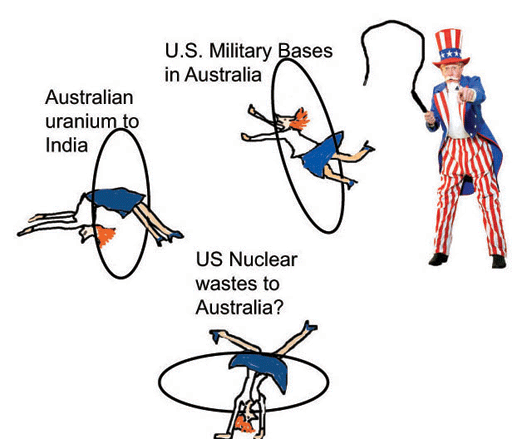 Gillard uranium move linked to US: report, Business Spectator, 16 Nov 2011 Prime Minister Julia Gillard’s move to open the door to uranium exports to India reportedly follows talks with the Obama administration. The US has been pursuing a closer partnership with India and considers Australia a key part of its strategy, The Australian reported on Wednesday.
Ms Gillard has denied that the decision was made to coincide with President Barack Obama’s visit to Australia and said it was her decision alone.The Australian, however, reported that US and Australian officials have been in intense strategic discussions about India for several months. http://www.businessspectator.com.au/bs.nsf/Article/Gillard-uranium-move-linked-to-US-report-NMLD2?OpenDocument&src=hp3
 India can thank Uncle Sam for Julia Gillard’s uranium backflip, First Post India, 16 Nov 11 Uttara Choudhury New York: Australian Prime Minister Julia Gillard’s dramatic decision to open the door to uranium exports to India came after talks with the Obama administration, which viewed the ban as a “fly in the ointment” to greater engagement between Washington, New Delhi and Australia in the Indian Ocean region…….
Gillard announced on Tuesday that she will ask the Australian Labour Party to dump its ban on uranium sales to India, at its national conference next month. The ban was imposed by former prime minister Kevin Rudd in 2008 as India wasn’t a signatory to the Nuclear Non-proliferation Treaty. Gillard has denied her decision to seek to overturn the ban is in order to fall in line with the US. She bristled when questioned on the timing of the announcement which coincided with Obama’s state visit to Australia. Gillard said the decision was hers alone…..
She did, however, point to the US-India civil nuclear agreement of 2008, which lifted the “de facto international ban” on the sale of uranium to India….. While Beijing has learned to live with American forces on its eastern periphery, the possibility of an intimate US-India military relationship, as well as India’s position astride China’s key maritime shipping lanes, has generated fears of encirclement…
Alarm in India over expansion of nuclear industry
Activists sound alarm bells over India’s nuclear future, ABC Radio AM , By Indian correspondent Richard Lindell, November 16, 2011 India’s government has predictably welcomed Prime Minister Julia Gillard’s idea that Australia open up its uranium sales, but at home, India’s plans to expand its nuclear industry continue to face tough opposition.
From Jaitapur in the west to Koodankulam in the south, locals are protesting against nuclear power plants in their backyards. Residents who fear India could be the scene of a Fukushima have clashed with police, while others have resorted to hunger strikes.
India for Nuclear Disarmament co-founder Praful Bidwai says Japan has shown the world how disastrous nuclear power can be. ”If an advanced and relatively large nuclear power state like Japan can have a nuclear catastrophe, then a backward country like India is even more likely to witness a nuclear catastrophe in the 20 reactors that we have,” he said.
“The second big lesson I think is … about the inherently hazardous nature of nuclear power generation, which is the only form of energy production anywhere on Earth which is capable of undergoing a catastrophic accident.”…..India has not made Ms Gillard’s sales job any easier. On the day Ms Gillard announced her position on sales of uranium for peaceful purposes, India test-fired a nuclear-ready missile into international waters off the Bay of Bengal.
If India gets Australia’s uranium, Pakistan wants it, too
Pakistan says it should be allowed to buy uranium, ABC Radio National PM Michael Edwards , November 15, 2011, MARK COLVIN: Pakistan says that if Australia sells uranium to India, it too should be eligible for exports of the product. India’s chief rival is also a nuclear power and, like India, a non-signatory of the Nuclear Non-Proliferation Treaty.
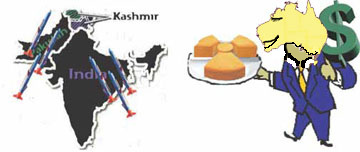
Pakistan says it could use Australian uranium to boost its civilian nuclear power program. And its High Commissioner to Australia says itwould be discrimination to sell to India and not to Pakistan… http://www.abc.net.au/pm/content/2011/s3367265.htm
iPhone radiation counter to go on sale in JapAn
Japanese firm makes iPhone radiation counter, SMH 16 Nov 11 A Japanese company has unveiled a cheap Geiger counter for the iPhone to enable people worried about the Fukushima nuclear accident to check their environment for radiation.
The probe, 14 centimetres long by 5cm wide, connects to the iPhone and the screen displays radiation readings in combination with a special app such as the Geiger Bot.
The device was developed on the initiative of a young researcher who wanted to make a cheap and easy-to-use Geiger counter available following the world’s worst nuclear disaster since Chernobyl…..
The first models for iPhones will go on sale in the next few days priced at Y9800 ($124).
…. http://www.smh.com.au/digital-life/smartphone-apps/japanese-firm-makes-iphone-radiation-counter-20111116-1ni5z.html#ixzz1dvFz1SO7
Escalating costs of Japan’s nuclear safety plans
Japan’s Nuclear Safety Steps May Cost 19 Billion Yen Per Reactor, Nov. 15 (Bloomberg) –– Additional safety measures required at Japan’s nuclear power plants in the wake of the Fukushima disaster may cost 19.4 billion yen ($252 million) per reactor, the government said.
Iran’s nukes – a matter of national pride
At Tehran University, a group of hard-line students starts a petition urging Iran to withdraw from an international treaty regulating nuclear development. There’s no doubt Iran carefully stage manages much of its backlash to Western pressures over its nuclear efforts. But not all.
Iran’s defiance remains one of the few patches of common ground in a nation with multiple divisions: Hard-liners against opposition groups; power struggles between the ruling clerics and President Mahmoud Ahmadinejad; infighting among various parliament factions.
“Iranians don’t agree on much these days, but you could say the nuclear issue is one where they more or less speak in a common voice,” said William O. Beeman, aUniversity of Minnesota professor who follows Iranian affairs. Continue reading
USA to increase its military presence in Australia
 Obama looks to counter China’s influence with Australian naval base, National Post, Peter Goodspeed: Nov 15, 2011 When Barack Obama arrives in Australia Wednesday he will announce plans to establish a permanent U.S. military presence in a move designed to reassert U.S. interest in the region and counter China’s growing influence in Asia.
In a move that is more symbolic than substantial, the U.S. President will outline plans to rotate 2,000 U.S. Marines a year through a naval base in Darwin, Northern Territory. This will be part of a deal that calls for joint training and military manoeuvres as well as allowing Washington to pre-position military supplies in Australia……
the new basing agreement marks a dramatic change in the thrust of U.S. foreign policy.As Washington prepares to withdraw from a decade-old military involvement in the Middle East and Afghanistan and braces for a possible US$500-billion in military spending cuts over the next five years, U.S. policy makers are pivoting to refocus their attention on Asia.
In an essay for Foreign Policy magazine last month, Hillary Clinton, the U.S. Secretary of State, heralded the dawn of “America’s Pacific Century,” insisting it is in Washington’s interest to reassert its influence in Asia.
Guilty plea in nuclear materials trafficking
Woman pleads guilty in US on Pakistan reactor deal Google News, 16 Nov 11 WASHINGTON — The former boss of a US company’s Chinese subsidiary pleaded guilty to illegally supplying material to Pakistan for use in a nuclear reactor and is now cooperating with US investigators…. http://www.google.com/hostednews/afp/article/ALeqM5jpFZDocKmk3MLn9RQXrDUsmItKMQ?docId=CNG.fca116c64091d56b372d5ceeb38eb
Radiation from CTs – a bigger risk with repeated scans
CT scans produce widely differing radiation doses, CBC News Nov 15, 2011 A Manitoba study has found the amount of radiation patients receive from a CT scan can vary widely and should be reduced to better protect against the risk of cancer.
CBC News obtained the study through a freedom of information request to CancerCare Manitoba. The study recorded the dose of radiation to patients getting a CT scan at 13 Manitoba hospitals and compared that to similar surveys done elsewhere.
The researchers found that the average effective radiation dose for abdomen-pelvis scans was 21 per cent higher than in Saskatchewan and 15 per cent higher than in British Columbia. For a chest scan, the radiation dose for Manitoba was three per cent higher than in Saskatchewan and 25 per cent higher than in B.C….
The study notes CT — computed tomography — has become an invaluable tool for diagnosing medical conditions but there is increased worry because in recent years several international studies have linked CT radiation to cancer. In the 2009-2010 fiscal year, Manitoba patients underwent more than 160,000 CT scans.
For patients who will need a number of scans during the course of their illness, the study said cumulative radiation doses can be quite large and could reach the threshold associated with an increase in cancer risk…. http://www.cbc.ca/news/canada/manitoba/story/2011/11/14/iteam-ct-scan-radiation-manitoba.html?cmp=rss
Radiation risks in hospitals
Alarm fatigue, radiation overexposure among most dangerous health IT risks Fierce Health Care, November 15, 2011 By Karen M. Cheung Two seemingly innocent, everyday occurrences at hospitals–alarms and CT scans–are among the most dangerous technology hazards, according to a new ECRI Institute report. For all the countless benefits that technology provides, ECRI warns of the top 10 hazards for 2012, including alarm fatigue and overexposure to radiation therapy and CTs, similar to last year’s list. … http://www.fiercehealthcare.com/story/alarm-fatigue-radiation-overexposure-among-most-dangerous-hospital-it-risks/2011-11-15
1 This Month


Tell the Ukrainian Government to Drop Prosecution of Peace Activist Yurii Sheliazhenko

Petition to revoke the licensing of the Near Surface Nuclear Disposal Facility (NSDF) at Chalk River. https://www.ourcommons.ca/petitions/en/Petition/Details?Petition=e-7247


of the week – STOP SMALL MODULAR REACTORS IN CANADA
To see nuclear-related stories in greater depth and intensity – go to https://nuclearinformation.wordpress.com
-
Archives
- March 2026 (204)
- February 2026 (268)
- January 2026 (308)
- December 2025 (358)
- November 2025 (359)
- October 2025 (376)
- September 2025 (258)
- August 2025 (319)
- July 2025 (230)
- June 2025 (348)
- May 2025 (261)
- April 2025 (305)
-
Categories
- 1
- 1 NUCLEAR ISSUES
- business and costs
- climate change
- culture and arts
- ENERGY
- environment
- health
- history
- indigenous issues
- Legal
- marketing of nuclear
- media
- opposition to nuclear
- PERSONAL STORIES
- politics
- politics international
- Religion and ethics
- safety
- secrets,lies and civil liberties
- spinbuster
- technology
- Uranium
- wastes
- weapons and war
- Women
- 2 WORLD
- ACTION
- AFRICA
- Atrocities
- AUSTRALIA
- Christina's notes
- Christina's themes
- culture and arts
- Events
- Fuk 2022
- Fuk 2023
- Fukushima 2017
- Fukushima 2018
- fukushima 2019
- Fukushima 2020
- Fukushima 2021
- general
- global warming
- Humour (God we need it)
- Nuclear
- RARE EARTHS
- Reference
- resources – print
- Resources -audiovicual
- Weekly Newsletter
- World
- World Nuclear
- YouTube
-
RSS
Entries RSS
Comments RSS
 nuclear-news