Opt out of the cancer risk X ray scanners at USA airports
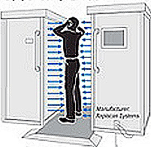
 How Homeland Security Increases Your Cancer Risk,The Nation, Jon Wiener on November 2, 2011 In the airport security screening line in Kauai a few months ago, I
asked an American Airlines pilot what he thought about the new X-ray scanners in front of us—the ones that are replacing metal detectors at airports around the country. He offered a startling one-word answer: “reprehensible.”
I said “Usually I opt out, because I didn’t like being X-rayed by people who are not X-ray technicians.” He replied, “If enough people opted out, they’d have to get rid of the scanners.”
Now ProPublica’s Michael Grabell reports that the cancer danger from the new scanners—which look under a traveler’s clothing—is greater than we had feared. “Research suggests that anywhere from six to 100 Americans could get cancer each year from the machines,” Grabell says.
“Still, the TSA has repeatedly defined the scanners as ‘safe,’ glossing over the accepted scientific view that even low doses of ionizing radiation—the kind beamed directly at the body by the X-ray scanners—increase the risk of cancer.”
Nevertheless, millions of Americans are now being sent thru the scanners.
Official US policy used to be that X-rays were banned for anything
other than medical use. The machines now found in airports, Grabell
reports, were once banned from the California penal system. Then came
9/11, officials anxious about another hijacking, and corporations
selling expensive products to the government—including the new
scanners—that they claimed could keep America safe.
Meanwhile other countries, Grabell reports, have concluded that
radiation from airport X-ray scanners poses “unacceptable health
risks.”…..
The FDA never evaluated the safety of the scanners now being installed
at American airports. They were prevented from doing so, Grabell
reports, because of a Catch-22: “the scanners do not have a medical
purpose, so the FDA cannot subject them to the rigorous evaluation it
applies to medical devices.”…..
The problem is that, although the scanners emit extremely low levels
of ionizing radiation—the TSA is correct about that—the effects of
radiation are cumulative over a lifetime. The National Academy of
Sciences concluded in 2006 that even extremely low doses of radiation
create a cancer risk. The medical profession has concluded that
exposure should be minimized. And the European Parliament in July
passed a resolution that security “scanners using ionizing radiation
should be prohibited” because of health risks.
The real key to the adoption of back-scatter technology by the TSA may
be found in what Grabell calls “an intense and sophisticated lobbying
campaign” by the manufacturer, Rapiscan Systems, detailed in the
ProPublica report. As a result Rapiscan won a $173 million, multi-year
contract for its backscatter machines.
There’s another problem: the scanners emit a tiny amount of ionizing
radiation—if they are properly calibrated. But calibration has proven
to be a disastrous problem even at top hospitals’ radiation treatment
units. Cedars-Sinai hospital in Los Angeles, where the elite of
Hollywood and Beverly Hills get their medical care, was recently found
to have exposed patients to much higher doses of radiation than
permitted on CT scans for eighteen months in 2006 because the machines
had been set incorrectly and the technicians did not check.
Who checks the airport scanners? …..
Until the TSA stops using X-rays in airport security, travelers do
have an option: when you get to the front of the line, tell them, “I’d
like to opt out.” Then they take you around the machine and you get
the pat-down. It takes a while longer, but it doesn’t cause cancer.
http://www.thenation.com/blog/164354/how-homeland-security-increases-your-cancer-risk
No comments yet.
1 This Month



Tell the Ukrainian Government to Drop Prosecution of Peace Activist Yurii Sheliazhenko

Petition to revoke the licensing of the Near Surface Nuclear Disposal Facility (NSDF) at Chalk River. https://www.ourcommons.ca/petitions/en/Petition/Details?Petition=e-7247


of the week – STOP SMALL MODULAR REACTORS IN CANADA
To see nuclear-related stories in greater depth and intensity – go to https://nuclearinformation.wordpress.com
-
Archives
- March 2026 (222)
- February 2026 (268)
- January 2026 (308)
- December 2025 (358)
- November 2025 (359)
- October 2025 (376)
- September 2025 (258)
- August 2025 (319)
- July 2025 (230)
- June 2025 (348)
- May 2025 (261)
- April 2025 (305)
-
Categories
- 1
- 1 NUCLEAR ISSUES
- business and costs
- climate change
- culture and arts
- ENERGY
- environment
- health
- history
- indigenous issues
- Legal
- marketing of nuclear
- media
- opposition to nuclear
- PERSONAL STORIES
- politics
- politics international
- Religion and ethics
- safety
- secrets,lies and civil liberties
- spinbuster
- technology
- Uranium
- wastes
- weapons and war
- Women
- 2 WORLD
- ACTION
- AFRICA
- Atrocities
- AUSTRALIA
- Christina's notes
- Christina's themes
- culture and arts
- Events
- Fuk 2022
- Fuk 2023
- Fukushima 2017
- Fukushima 2018
- fukushima 2019
- Fukushima 2020
- Fukushima 2021
- general
- global warming
- Humour (God we need it)
- Nuclear
- RARE EARTHS
- Reference
- resources – print
- Resources -audiovicual
- Weekly Newsletter
- World
- World Nuclear
- YouTube
-
RSS
Entries RSS
Comments RSS
 nuclear-news
Leave a comment