Indian government’s nuclear plans fraught with problems
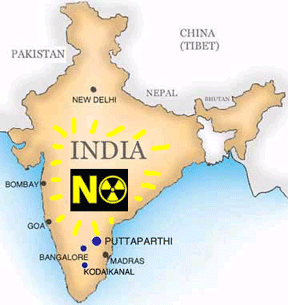 The anti-nuclear lobby has filed a Public Interest Litigation (PIL), while protests are on the rise at Jaitapur in Maharashtra, a new site for a large reactor project, which got the approval for work to begin.
In Kudankulam, protests have been getting bigger. The Chief Minister, Ms J. Jayalalithaa herself wrote to the PM,
There is also the question of ageing of the existing reactors.
Daunting road ahead for nuclear power, THE HINDU, M. SOMASEKHAR, 2 Nov 11 The Department of Atomic Energy is bullish on the power programme, but achieving the target of 20,000 MW by 2020 is plagued by resource crunch, technology issues and environmental problems.
In the last 10 years, with consistent backing by both the BJP-led NDA Alliance and the Congress(I)-led UPA Alliance, the Nuclear Power Corporation, which drives the power programme, has added roughly 2800 MW only.
…….the question of ageing of the existing reactors. For example, the reactors at the Tarapur Atomic Power Station are around 40 years old, while the Rajasthan, Madras and Narora plants also are inching close to 30 years. If the average life cycle of a reactor is 40 years, then the NPCIL is sure to have more than half a dozen of the existing 20 operational plants ready for decommissioning by 2020. This will bring in additional costs and challenges of decommissioning as well.
With questions raised regarding the design of the French EPR reactors, which were supposedly offered to India when the nation’s premier Mr Nicolas Sarkozy had come to India last year, the slow progress in agreement with American companies for reactors (nuclear liability issues), and the growing din of protests, the target of reaching 20,000 MW by 2020 definitely looks distant…..
The Department has always been bullish on the power programme. It has recently said that 14 units of the 700 MW reactors would be set up in the next few years, which means an addition of roughly 10,000 MW. It is proactively trying to tell the media and people that its reactors are safe, and that it is alive to people’s concerns……
The Department of Atomic Energy (DAE) had, during the mid-1980s, set a target of installing a capacity of 10,000 MW by 2000. It barely managed to reach around 2000 MW. The reasons attributed were, resource crunch, technology issues, environmental problems, among other issues.
The recent nuclear disaster in Fukushima, Japan, the shortage of uranium, the questions raised about the French reactor design of Areva, the growing opposition to new power projects proposed in the country, as well as the earlier record of the DAE have cast aspersions on how close it will get to the ambitious figure of 20,000 MW…..
genuine fears among the people regarding the general safety of the operating reactors in the country, though the nuclear establishment is quick to respond to the contrary.
The consequence of all these developments has been a slowdown in the expansion programme of the Nuclear Power Corporation, which spearheads the nuclear energy programme. The PM has asked for a thorough examination of the safety features of the reactors. The anti-nuclear lobby has filed a Public Interest Litigation (PIL), while protests are on the rise at Jaitapur in Maharashtra, a new site for a large reactor project, which got the approval for work to begin.
In Kudankulam, protests have been getting bigger. The Chief Minister, Ms J. Jayalalithaa herself wrote to the PM, who, in turn, has assured that all safety aspects are in place…..
There is also the question of ageing of the existing reactors. For example, the reactors at the Tarapur Atomic Power Station are around 40 years old, while the Rajasthan, Madras and Narora plants also are inching close to 30 years. If the average life cycle of a reactor is 40 years, then the NPCIL is sure to have more than half a dozen of the existing 20 operational plants ready for decommissioning by 2020. This will bring in additional costs and challenges of decommissioning as well.
With questions raised regarding the design of the French EPR reactors, which were supposedly offered to India when the nation’s premier Mr Nicolas Sarkozy had come to India last year, the slow progress in agreement with American companies for reactors (nuclear liability issues), and the growing din of protests, the target of reaching 20,000 MW by 2020 definitely looks distant…. http://www.thehindubusinessline.com/opinion/article2592039.ece?homepage=true
No comments yet.
1 This Month
10 March A LIVE WEBINAR THE REAL EFFECTS OF NUCLEAR POWER
What the Industry Isn’t Telling Us
1:00 PM Mountain, 2 pm Central, 3 pm Eastern. Live on the Keepers of the Water Facebook page



18 March Webinar @ 1 PM EST: An Assessment of SMR Projects: The Case of Canada
register for the zoom:
https://us02web.zoom.us/webinar/register/WN_o8BIIOUvQ2ONJR1nta65DQ#/registration


of the week – STOP SMALL MODULAR REACTORS IN CANADA
To see nuclear-related stories in greater depth and intensity – go to https://nuclearinformation.wordpress.com
-
Archives
- March 2026 (109)
- February 2026 (268)
- January 2026 (308)
- December 2025 (358)
- November 2025 (359)
- October 2025 (376)
- September 2025 (258)
- August 2025 (319)
- July 2025 (230)
- June 2025 (348)
- May 2025 (261)
- April 2025 (305)
-
Categories
- 1
- 1 NUCLEAR ISSUES
- business and costs
- climate change
- culture and arts
- ENERGY
- environment
- health
- history
- indigenous issues
- Legal
- marketing of nuclear
- media
- opposition to nuclear
- PERSONAL STORIES
- politics
- politics international
- Religion and ethics
- safety
- secrets,lies and civil liberties
- spinbuster
- technology
- Uranium
- wastes
- weapons and war
- Women
- 2 WORLD
- ACTION
- AFRICA
- Atrocities
- AUSTRALIA
- Christina's notes
- Christina's themes
- culture and arts
- Events
- Fuk 2022
- Fuk 2023
- Fukushima 2017
- Fukushima 2018
- fukushima 2019
- Fukushima 2020
- Fukushima 2021
- general
- global warming
- Humour (God we need it)
- Nuclear
- RARE EARTHS
- Reference
- resources – print
- Resources -audiovicual
- Weekly Newsletter
- World
- World Nuclear
- YouTube
-
RSS
Entries RSS
Comments RSS
 nuclear-news
Leave a comment