Airport radiation scanners are not stringently regulated
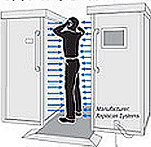
 The US government skirted over the radiation safety concerns of airport X-ray machines 109 2 Nov 11One of the most important principles of radiation safety is that X-ray machines should only be used when there’s a clear medical benefit. But now backscatter X-ray machines are found throughout America’s airports. How did we get here?
According to a new report by ProPublica and the PBS NewHour, the US government has gone ahead with the controversial scanners despite serious concerns from radiation safety experts. The scanners are expected to be in place in every American airport security lane by as early as 2014. This is a big reversal from as recently as 1998, when the device’s own inventor, Steven W. Smith, told a panel of radiation safety experts, said he didn’t think such devices would be used at lower-security facilities – such as airports.
Crucially, their investigation points to the fact that, unlike medical scanners, the airport X-ray machines were approved by the Transportation Security Administration (TSA) instead of the Food and Drug Administration (FDA). This means the airport scanners do not have to meet the same standards as their medical counterparts, and the government’s stance that the machines are “safe” comes from an agency primarily concerned with security, not public health. The main security advantage of the scanners is that they can detect explosives that would otherwise elude traditional metal detectors…..
was this increased cancer risk worth introducing in the first place, and did the government do its due diligence in making these backscatter machines as a crucial part of airport security? The ProPublica and NewsHour investigation focuses mostly on the latter, and they point to a number of areas in which gaps and loopholes in existing regulations allowed the machines to gain such fast acceptance despite demonstrated health risks. Here’s a sample:
Although they deliberately expose humans to radiation, the airport X-ray scanners are not medical devices, so they are not subject to the stringent regulations required for diagnostic X-ray machines. If they were, the manufacturer would have to submit clinical data showing safety and effectiveness and be approved through a rigorous process by the FDA. If the machines contained radioactive material, they would have to report to the Nuclear Regulatory Commission.
But because it didn’t fit into either category, the Secure 1000 was classified as an electronic product. The FDA does not review or approve the safety of such products. However, manufacturers must provide a brief radiation safety report explaining the dose and notify the agency if any overexposure is discovered. According to the FDA, no such incidents have been reported. Under its limited oversight of electronic products, the FDA could issue mandatory safety regulations. But it didn’t do so, a decision that flows from its history of supervising electronics….
No comments yet.
1 This Month



Tell the Ukrainian Government to Drop Prosecution of Peace Activist Yurii Sheliazhenko

Petition to revoke the licensing of the Near Surface Nuclear Disposal Facility (NSDF) at Chalk River. https://www.ourcommons.ca/petitions/en/Petition/Details?Petition=e-7247


of the week – STOP SMALL MODULAR REACTORS IN CANADA
To see nuclear-related stories in greater depth and intensity – go to https://nuclearinformation.wordpress.com
-
Archives
- March 2026 (222)
- February 2026 (268)
- January 2026 (308)
- December 2025 (358)
- November 2025 (359)
- October 2025 (376)
- September 2025 (258)
- August 2025 (319)
- July 2025 (230)
- June 2025 (348)
- May 2025 (261)
- April 2025 (305)
-
Categories
- 1
- 1 NUCLEAR ISSUES
- business and costs
- climate change
- culture and arts
- ENERGY
- environment
- health
- history
- indigenous issues
- Legal
- marketing of nuclear
- media
- opposition to nuclear
- PERSONAL STORIES
- politics
- politics international
- Religion and ethics
- safety
- secrets,lies and civil liberties
- spinbuster
- technology
- Uranium
- wastes
- weapons and war
- Women
- 2 WORLD
- ACTION
- AFRICA
- Atrocities
- AUSTRALIA
- Christina's notes
- Christina's themes
- culture and arts
- Events
- Fuk 2022
- Fuk 2023
- Fukushima 2017
- Fukushima 2018
- fukushima 2019
- Fukushima 2020
- Fukushima 2021
- general
- global warming
- Humour (God we need it)
- Nuclear
- RARE EARTHS
- Reference
- resources – print
- Resources -audiovicual
- Weekly Newsletter
- World
- World Nuclear
- YouTube
-
RSS
Entries RSS
Comments RSS
 nuclear-news
Leave a comment