How the media underplays seriousness of Fukushima radiation
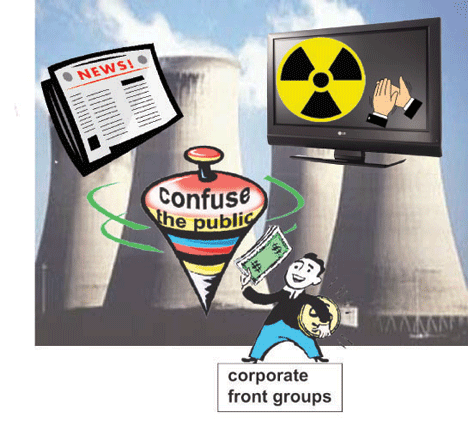 Radioactive contamination of soil, tap water, rain water, groundwater, beef, fish, vegetables, animal feed and incinerator ash are almost always said to be of little or “no immediate” danger, which helps explain why Fukushima has faded from public consciousness.
Radiation Reporting: Blind, Idiotic, Corrupt — or All Three Huntington News, , October 26, 2011 BY JOHN LAFORGE The ongoing radiation catastrophe stemming from three out-of-control nuclear reactors in Fukushima, Japan has taken a back seat to far graver news events of late: Michael Jackson’s doctor, fund-raising by presidential hopefuls, the World Series, and Netflix stock.
Radioactive contamination of soil, tap water, rain water, groundwater, beef, fish, vegetables, animal feed and incinerator ash are almost always said to be of little or “no immediate” danger, which helps explain why Fukushima has faded from public consciousness.
“An exposure of 100 millisieverts per year is considered the lowest level at which any increase in cancer risk is evident,” the French Press Agency reported Oct. 6. But the U.S. Nuclear Regulatory Commission’s official published position on radiation risk is that, “any amount of radiation may pose some risk for causing cancer and hereditary effect, [and] … any increase in dose, no matter how small, results in an incremental increase in risk.”
Contaminated spinach and milk “do not pose an immediate health threat,” reported Giles Snyder of NPR’s Weekend Edition, April 19. Yet the National Council on Radiation Protection declares that “every increment of radiation exposure produces an incremental increase in the risk of cancer.”
“The nuclear crisis caused the worst radiation leak since Chernobyl,” the AP said Oct. 7, as if the accident were over. The same news agency said Sept. 22 that “radiation leaks continue.”…. http://www.huntingtonnews.net/12126
No comments yet.
1 This Month

of the week – Shut Down Drone Warfare!


Tell the Ukrainian Government to Drop Prosecution of Peace Activist Yurii Sheliazhenko

Petition to revoke the licensing of the Near Surface Nuclear Disposal Facility (NSDF) at Chalk River. https://www.ourcommons.ca/petitions/en/Petition/Details?Petition=e-7247
To see nuclear-related stories in greater depth and intensity – go to https://nuclearinformation.wordpress.com
-
Archives
- March 2026 (251)
- February 2026 (268)
- January 2026 (308)
- December 2025 (358)
- November 2025 (359)
- October 2025 (376)
- September 2025 (257)
- August 2025 (319)
- July 2025 (230)
- June 2025 (348)
- May 2025 (261)
- April 2025 (305)
-
Categories
- 1
- 1 NUCLEAR ISSUES
- business and costs
- climate change
- culture and arts
- ENERGY
- environment
- health
- history
- indigenous issues
- Legal
- marketing of nuclear
- media
- opposition to nuclear
- PERSONAL STORIES
- politics
- politics international
- Religion and ethics
- safety
- secrets,lies and civil liberties
- spinbuster
- technology
- Uranium
- wastes
- weapons and war
- Women
- 2 WORLD
- ACTION
- AFRICA
- Atrocities
- AUSTRALIA
- Christina's notes
- Christina's themes
- culture and arts
- Events
- Fuk 2022
- Fuk 2023
- Fukushima 2017
- Fukushima 2018
- fukushima 2019
- Fukushima 2020
- Fukushima 2021
- general
- global warming
- Humour (God we need it)
- Nuclear
- RARE EARTHS
- Reference
- resources – print
- Resources -audiovicual
- Weekly Newsletter
- World
- World Nuclear
- YouTube
-
RSS
Entries RSS
Comments RSS
 nuclear-news
Leave a comment