Nuclear power as cure for climate change- the big con
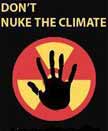 The Big Con Is Nuclear Power Really a Trump Card Against Global Warming?, CounterPunch, by TAKASHI HIROSE OCTOBER 19, 2011 In recent years there seemed to be a nuclear power renaissance. One reason for this has been the adoption by its promoters of the theme of global warming, and their claim that nuclear power is clean energy because it does not produce carbon emissions. But is nuclear power in fact the clean-energy solution its promoters claim?
Only one third of the heat energy produced in a nuclear reactor is transformed into electricity. In Japan, the remaining two thirds of the energy that remains in the water vapor– that is, twice as much energy as contained in the generated electricity – is disposed of in the sea. In the cooling system, seawater is used to cool the water vapor, which condenses again to water and is circulated through the reactor once again. This heated seawater is called “thermal discharge”. How much heat does this thermal discharge carry into the sea? The amount is startling.
Before the Fukushima accident, that is, at the end of 2010, Japan’s 54 nuclear reactors were producing a total of 49,112,000 kilowatts of electricity. So every day they were throwing away twice that much, approximately 100,000,000 kilowatts of energy, in the form of heat, into the sea.
This means that every day they were pumping into the sea energy equivalent to 100 of the atomic bombs dropped on Hiroshima. The Hiroshima bomb destroyed the city in an instant and ended the lives of some 140,000 people, but when energy 100 times that great is “dropped” into the sea daily, what effect does that have? That it would not be destructive of the ocean’s ecology is unimaginable. Before saying that “nuclear power plants supply one third of the demand for electricity”, it needs to be said that “twice as much energy as the electricity they produce is used to heat up the sea.”
I want to ask, what kind of global warming debate is it that never discusses this fact? In Japan, the number one global warming agent is the nuclear power plants…….
I received a request from TEPCO to translate a 1970s report from the Organization for Economic Co-operation and Development (OECD). In it was the following passage.
“When thermal discharge from nuclear power plants is released into the sea, the heat does not immediately disperse. Rather it concentrates and remains suspended in what are called “hot spots”. For this reason it has a very large effect on sea life near the shore. In the shallows, even a difference of two or three degrees can kill fish eggs or young fish.”
I translated this English correctly and delivered the manuscript to TEPCO. The report of which it was a part was apparently suppressed within the company. To this day it has never appeared……..
Translated by Douglas Lummis, ideaspeddler@gmail.com
Takashi Hirose can be contacted at takhi@jcom.home.ne.jp
This is excerpted from the concluding chapter of Takashi Hirose
Fukushima Meltdown: The World’s First Earthquake-Tsunami-Nuclear Disaster now available in English from Amazon Kindle Books.
http://www.counterpunch.org/2011/10/19/is-nuclear-power-really-a-trump-card-against-global-warming/
No comments yet.
1 This Month

of the week – Shut Down Drone Warfare!


Tell the Ukrainian Government to Drop Prosecution of Peace Activist Yurii Sheliazhenko

Petition to revoke the licensing of the Near Surface Nuclear Disposal Facility (NSDF) at Chalk River. https://www.ourcommons.ca/petitions/en/Petition/Details?Petition=e-7247
To see nuclear-related stories in greater depth and intensity – go to https://nuclearinformation.wordpress.com
-
Archives
- March 2026 (244)
- February 2026 (268)
- January 2026 (308)
- December 2025 (358)
- November 2025 (359)
- October 2025 (376)
- September 2025 (257)
- August 2025 (319)
- July 2025 (230)
- June 2025 (348)
- May 2025 (261)
- April 2025 (305)
-
Categories
- 1
- 1 NUCLEAR ISSUES
- business and costs
- climate change
- culture and arts
- ENERGY
- environment
- health
- history
- indigenous issues
- Legal
- marketing of nuclear
- media
- opposition to nuclear
- PERSONAL STORIES
- politics
- politics international
- Religion and ethics
- safety
- secrets,lies and civil liberties
- spinbuster
- technology
- Uranium
- wastes
- weapons and war
- Women
- 2 WORLD
- ACTION
- AFRICA
- Atrocities
- AUSTRALIA
- Christina's notes
- Christina's themes
- culture and arts
- Events
- Fuk 2022
- Fuk 2023
- Fukushima 2017
- Fukushima 2018
- fukushima 2019
- Fukushima 2020
- Fukushima 2021
- general
- global warming
- Humour (God we need it)
- Nuclear
- RARE EARTHS
- Reference
- resources – print
- Resources -audiovicual
- Weekly Newsletter
- World
- World Nuclear
- YouTube
-
RSS
Entries RSS
Comments RSS
 nuclear-news
Leave a comment