How corporate America, the CIA and Walt Disney talked Japan into nuclear technology
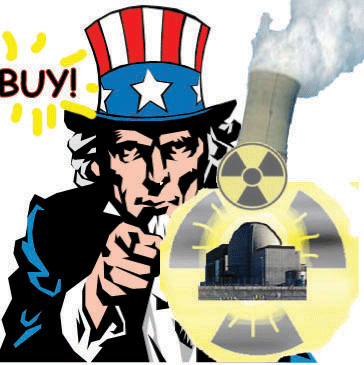 The plan had the advantage of making allies dependent on technology from corporate giants General Electric Co. and Westinghouse,
 Tepco ‘Deal With Devil’ Signals End to Japan’s Postwar Era Bloomberg, October 21, 2011,“……….Hiroshima Bombing Japan’s development into the world’s third-biggest user of nuclear energy dates from the last days of the war. Yasuhiro Nakasone, who would later become Prime Minister and a powerful advocate of atomic energy, was serving as a naval officer in Japan when Hiroshima was bombed. After the war, he began the work of persuading the U.S. to sell Japan nuclear technology…..
Japan’s interest coincided with U.S. concern about what to do with its own surplus of weapons-grade plutonium, and the suspicion that created in the Soviet Union, Laura E. Hein wrote in “Fueling Growth — The Energy Revolution and Economic Policy in Postwar Japan.”
U.S. President Dwight Eisenhower’s solution was the “Atoms for Peace” program to use U.S. plutonium to provide nuclear fuel for its allies.
The plan had the advantage of making allies dependent on technology from corporate giants General Electric Co. and Westinghouse, according to Michael Donnelly, a professor of political science at the University of Toronto who studies Japan’s nuclear program.
“I can’t believe that any decision of this sort would not involve consideration that nuclear energy programs would benefit American manufacturers,” Donnelly said in a phone interview.
CIA Involvement Still, officials in both the U.S. and Japan had to work on persuading the public that nuclear technology could have a civilian use. Nuclear supporters in Japan were helped by the U.S. Central Intelligence Agency, says Tetsuo Arima, a professor of media studies at Tokyo’s Waseda University who studied declassified documents on postwar relations between the two countries in the U.S. National Archives and Records Administration to establish the link.
Among the CIA’s Japanese allies in the propaganda effort was Matsutaro Shoriki, owner of the Yomiuri newspaper and Nippon Television, Japan’s first commercial TV station. The newspaper — now the world’s biggest with 10 million copies published daily — wrote a series of pro-nuclear articles from Jan. 1954 viewed by the U.S. government as a success, according to the book “Nuclear Power, Shoriki and the CIA,” written by Arima and published in 2008.
Walt Disney The Walt Disney Co. was also roped into the effort. The 1957 cartoon “Our Friend, The Atom,” released as part of the company’s Tomorrowland project and depicting the positive benefits of a world harnessing atomic energy, was run on Shoriki’s TV channel, Arima wrote….
In 1955, the U.S.-Japan Atomic Energy Agreement gave Japan the right to buy nuclear fuel and technology from the U.S…. Intense Pressure……
http://www.businessweek.com/news/2011-10-21/tepco-deal-with-devil-signals-end-to-japan-s-postwar-era.html
No comments yet.
1 This Month

of the week – Shut Down Drone Warfare!


Tell the Ukrainian Government to Drop Prosecution of Peace Activist Yurii Sheliazhenko

Petition to revoke the licensing of the Near Surface Nuclear Disposal Facility (NSDF) at Chalk River. https://www.ourcommons.ca/petitions/en/Petition/Details?Petition=e-7247
To see nuclear-related stories in greater depth and intensity – go to https://nuclearinformation.wordpress.com
-
Archives
- March 2026 (244)
- February 2026 (268)
- January 2026 (308)
- December 2025 (358)
- November 2025 (359)
- October 2025 (376)
- September 2025 (257)
- August 2025 (319)
- July 2025 (230)
- June 2025 (348)
- May 2025 (261)
- April 2025 (305)
-
Categories
- 1
- 1 NUCLEAR ISSUES
- business and costs
- climate change
- culture and arts
- ENERGY
- environment
- health
- history
- indigenous issues
- Legal
- marketing of nuclear
- media
- opposition to nuclear
- PERSONAL STORIES
- politics
- politics international
- Religion and ethics
- safety
- secrets,lies and civil liberties
- spinbuster
- technology
- Uranium
- wastes
- weapons and war
- Women
- 2 WORLD
- ACTION
- AFRICA
- Atrocities
- AUSTRALIA
- Christina's notes
- Christina's themes
- culture and arts
- Events
- Fuk 2022
- Fuk 2023
- Fukushima 2017
- Fukushima 2018
- fukushima 2019
- Fukushima 2020
- Fukushima 2021
- general
- global warming
- Humour (God we need it)
- Nuclear
- RARE EARTHS
- Reference
- resources – print
- Resources -audiovicual
- Weekly Newsletter
- World
- World Nuclear
- YouTube
-
RSS
Entries RSS
Comments RSS
 nuclear-news
Leave a comment