France’s distressed nuclear companies desperate to sell reactors to South Africa
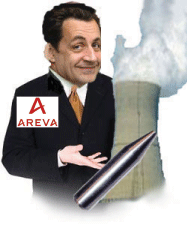 The French companies Areva and EDF need to sell reactors abroad to survive and, after Fukushima, the number of countries investing in new nuclear industry is very limited. Hence France’s strong nuclear lobby and “friendship” with South African politicians over the past few years.
 Nuclear power will cost the country dearly, Mail and Guardian RIANNE TEULE: ENERGY Oct 14 2011 The Mail & Guardian’s front-page story last week (October 7) highlighted the upcoming nuclear battle for a total of R1-trillion worth of reactors in
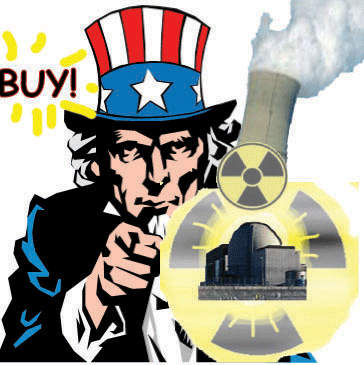 South Africa and the fact that the country is being forcefully lobbied by the French and other nuclear countries. The exorbitant costs and the nuclear industry’s desperation prove that it is absolute lunacy for South Africa to choose the nuclear route.
That R1-trillion would take Africa a long way towards alleviating energy poverty or achieving the Millennium Development Goals, improving the lives of billions. How can anyone justify spending this sum of money on building six nuclear reactors that will not produce any power until 2024? Nuclear power delivers too little, too late and at too high a price……..
But one cannot rely solely on the industry’s information to get the facts on nuclear power. Unlike what proponents are saying, nuclear energy will not combat climate change. The reactors take too long to build and even then only make a very small contribution to reducing greenhouse-gas emissions.
Also, nuclear’s contribution to job creation is limited, as is shown in Greenpeace’s latest briefing on green jobs. There will be an increase in nuclear jobs during the construction phase, dropping sharply afterwards. By contrast, renewable energies provide a sustainable, long-term increase in green jobs up to a total of 111 000 jobs by 2030 if South Africa follows a clean-energy pathway.
1 Comment »
Leave a comment
1 This Month

of the week – Shut Down Drone Warfare!


Tell the Ukrainian Government to Drop Prosecution of Peace Activist Yurii Sheliazhenko

Petition to revoke the licensing of the Near Surface Nuclear Disposal Facility (NSDF) at Chalk River. https://www.ourcommons.ca/petitions/en/Petition/Details?Petition=e-7247
To see nuclear-related stories in greater depth and intensity – go to https://nuclearinformation.wordpress.com
-
Archives
- March 2026 (244)
- February 2026 (268)
- January 2026 (308)
- December 2025 (358)
- November 2025 (359)
- October 2025 (376)
- September 2025 (257)
- August 2025 (319)
- July 2025 (230)
- June 2025 (348)
- May 2025 (261)
- April 2025 (305)
-
Categories
- 1
- 1 NUCLEAR ISSUES
- business and costs
- climate change
- culture and arts
- ENERGY
- environment
- health
- history
- indigenous issues
- Legal
- marketing of nuclear
- media
- opposition to nuclear
- PERSONAL STORIES
- politics
- politics international
- Religion and ethics
- safety
- secrets,lies and civil liberties
- spinbuster
- technology
- Uranium
- wastes
- weapons and war
- Women
- 2 WORLD
- ACTION
- AFRICA
- Atrocities
- AUSTRALIA
- Christina's notes
- Christina's themes
- culture and arts
- Events
- Fuk 2022
- Fuk 2023
- Fukushima 2017
- Fukushima 2018
- fukushima 2019
- Fukushima 2020
- Fukushima 2021
- general
- global warming
- Humour (God we need it)
- Nuclear
- RARE EARTHS
- Reference
- resources – print
- Resources -audiovicual
- Weekly Newsletter
- World
- World Nuclear
- YouTube
-
RSS
Entries RSS
Comments RSS
 nuclear-news
[…] – Fukushima lesson is being forgotten by nuclear industry even though it hasn’t even started y… […]
Pingback by 15O Buller » Blog Archive » Fukushima – what’s not on the news | November 1, 2011 |