In water-scarce Australia, uranium miner BHP guzzles it for free
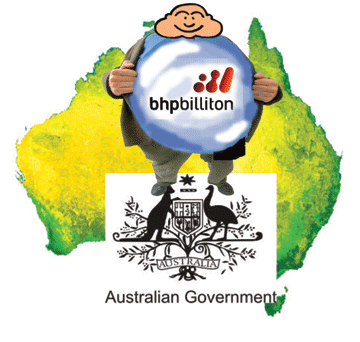
 Public resources for private profit: free water for the largest open-pit mine in the world Coober Pedy Regional Times, by: Nectaria Calan, 13 Oct 11 In August mining giant BHP Billiton announced record financial results for the 2011 financial year, recording a total net profit of US$23.95 billion, nearly double its 2010 figure of US$13.01 billion.
Despite its profits more than tripling in the last three years, BHP has never paid a cent for the water used at its Olympic Dam copper and uranium mine. The mine currently takes
an average of 37 million litres of water a day from the Great Artesian Basin (GAB). Under the Roxby Downs Indenture Act BHP is not required to pay for this water usage.
The Indenture Act applies specifically to the Olympic Dam mine, and provides for wide-ranging legal exemptions from s eve r a l South Aus t r a l i an l aws , including the
Aboriginal Heritage Act, the Environmental Protection Act, and the Natural Resources Management Act (which incorporates water management). It is essentially a
contract between BHP and the state government, which overrides key legislation in South Australia with the terms set out in the indenture agreement. The Special Water Licence for the mine is granted under the Indenture Act. It does not allocate a fee for the water
used at the mine, essentially providing BHP with a massive subsidy. The new open-pit mine at Olympic Dam will require an additional 200 million litres of water per day, with water intake from the Basin proposed to in crease to the current licence limit of 42 million litres per day. *During the construction phase, it is projected that 44 million litres per day will be required, pending further government approvals. This sits uneasily alongside the recently
announc ed thi rd s t age of the Gr e a t Ar t e s i an Ba s in Sustainability Initiative (GABSI), for which the State and Commonwealth Governments have committed $2 million,
to preserve an additional 3.8 million litres a day.
The water intake from the GAB is already affecting the unique Mound Springs found in the Lake Eyre region. Fed by the underlying Artesian Basin, they are integral to the desert ecosystem and sacred to the Arabunna people.
Arabunna elder Kevin Buzzacott observes that, “since the establishment of the mine by Western Mining Corporation, people like myself, born and bred in the area, have noticed
the water level of the springs dropping. One is just about gone.”
The Great Artesian Basin Wellfields Report, published yearly by BHP in accordance with the Indenture Act, shows reduced flow rates for several springs, particularly those monitored from the mid-1980’s, when the mine was established….
No comments yet.
1 This Month

of the week – Shut Down Drone Warfare!


Tell the Ukrainian Government to Drop Prosecution of Peace Activist Yurii Sheliazhenko

Petition to revoke the licensing of the Near Surface Nuclear Disposal Facility (NSDF) at Chalk River. https://www.ourcommons.ca/petitions/en/Petition/Details?Petition=e-7247
To see nuclear-related stories in greater depth and intensity – go to https://nuclearinformation.wordpress.com
-
Archives
- March 2026 (244)
- February 2026 (268)
- January 2026 (308)
- December 2025 (358)
- November 2025 (359)
- October 2025 (376)
- September 2025 (257)
- August 2025 (319)
- July 2025 (230)
- June 2025 (348)
- May 2025 (261)
- April 2025 (305)
-
Categories
- 1
- 1 NUCLEAR ISSUES
- business and costs
- climate change
- culture and arts
- ENERGY
- environment
- health
- history
- indigenous issues
- Legal
- marketing of nuclear
- media
- opposition to nuclear
- PERSONAL STORIES
- politics
- politics international
- Religion and ethics
- safety
- secrets,lies and civil liberties
- spinbuster
- technology
- Uranium
- wastes
- weapons and war
- Women
- 2 WORLD
- ACTION
- AFRICA
- Atrocities
- AUSTRALIA
- Christina's notes
- Christina's themes
- culture and arts
- Events
- Fuk 2022
- Fuk 2023
- Fukushima 2017
- Fukushima 2018
- fukushima 2019
- Fukushima 2020
- Fukushima 2021
- general
- global warming
- Humour (God we need it)
- Nuclear
- RARE EARTHS
- Reference
- resources – print
- Resources -audiovicual
- Weekly Newsletter
- World
- World Nuclear
- YouTube
-
RSS
Entries RSS
Comments RSS
 nuclear-news
Leave a comment