At last, France reveals, and questions, the safety of its nuclear industry
institutions are showing greater boldness in convicting nuclear operators guilty of negligence or issuing reprimands and demanding immediate corrective measures from giants like EDF or Areva..
With accusing fingers increasingly pointing towards the nuclear industry, a hesitant debate is beginning to open up in France. Socialist leader Segolene Royal who was defeated by Nicolas Sarkozy in France’s last presidential poll but hopes once again to be her party’s candidate, said she would close down the EPR under construction at Flamanville and completely abandon the EPR technology being pushed by Areva.
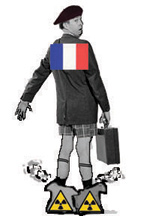 Post-Fukushima, France breaks silence on nuclear safety, The Hindu VAIJUNARAVANE, 11 Oct 11 “…….Doubts have been raised about the benefits of the EPR reactor, of which India plans to buy six. For a country as given to debate and argument as France, there has been a deafening silence surrounding the choice of nuclear as the prime source of energy. With a population of 62 million, France boasts 59 nuclear reactors — the highest per capita in the world, with over 75 per cent of its electricity coming from the power of the atom.
In the post-Fukushima period, however, that tacit silence is being broken with increasing frequency not just by anti-nuclear associations or candidates hoping to win elections but by French courts and the Nuclear Safety Authority.
Both these institutions are showing greater boldness in convicting nuclear operators guilty of negligence or issuing reprimands and demanding immediate corrective measures from giants like EDF or Areva, currently engaged in the design and construction of France’s first mega reactor (the EPR) capable of producing 1,650 MWe of electricity. India is slated to buy six of these massive reactors from Areva. To be located at Jaitapur, Maharashtra, they carry a price tag upwards of €40 billion.
On September 30, Socatri, a subsidiary of Areva, was found guilty of contaminating underground water tables in a 2008 leak of toxic liquid uranium at the Tricastin nuclear facility in southern France. The appeals court in the French city of Nimes, which handed down the sentence, fined the company €300,000 for pollution and gross negligence. It was also asked to pay damages to anti-nuclear associations and local residents. More seriously, the company was reprimanded for delays in communicating the leaks to the Nuclear Safety Authority.
The appellate court said Socatri/Areva was guilty of “introducing toxic substances into underground water, bringing about a significant modification of normal underground water flows.” Significantly, Socatri/Areva had been let off with a €40,000 fine in a trial held in October 2010. The Fukushima events have evidently led the country to take the risks involved in nuclear power more seriously.
“The trial in Nimes once again placed the spotlight on the degree of negligence which caused the accident in 2008. The judge rightly summed up the totality of acts of omission such as abandoning ageing facilities until they become decrepit to the point of rusting and, of course, the actions that followed the accident. They waited over 24 hours before signalling the leak,” said Etienne Ambroselli, spokesperson of the association Sortir du Nucleaire (Quit Nuclear).
“Thirty cubic metres of effluents containing uranium contaminated river waters, cutting off local drinking water supplies and preventing locals from bathing. According to a report prepared by CRIRAD [the Commission for Independent Research and Information on Radioactivity] the pollution was 27 times higher than the authorised limit for radioactive emissions,” the association said in a communiqué. For its part, the Anti-nuclear Collective is asking the population and the workers at Tricastin to call for shutting down the four reactors located at the facility…..
No comments yet.
1 This Month

of the week – Shut Down Drone Warfare!


Tell the Ukrainian Government to Drop Prosecution of Peace Activist Yurii Sheliazhenko

Petition to revoke the licensing of the Near Surface Nuclear Disposal Facility (NSDF) at Chalk River. https://www.ourcommons.ca/petitions/en/Petition/Details?Petition=e-7247
To see nuclear-related stories in greater depth and intensity – go to https://nuclearinformation.wordpress.com
-
Archives
- March 2026 (244)
- February 2026 (268)
- January 2026 (308)
- December 2025 (358)
- November 2025 (359)
- October 2025 (376)
- September 2025 (257)
- August 2025 (319)
- July 2025 (230)
- June 2025 (348)
- May 2025 (261)
- April 2025 (305)
-
Categories
- 1
- 1 NUCLEAR ISSUES
- business and costs
- climate change
- culture and arts
- ENERGY
- environment
- health
- history
- indigenous issues
- Legal
- marketing of nuclear
- media
- opposition to nuclear
- PERSONAL STORIES
- politics
- politics international
- Religion and ethics
- safety
- secrets,lies and civil liberties
- spinbuster
- technology
- Uranium
- wastes
- weapons and war
- Women
- 2 WORLD
- ACTION
- AFRICA
- Atrocities
- AUSTRALIA
- Christina's notes
- Christina's themes
- culture and arts
- Events
- Fuk 2022
- Fuk 2023
- Fukushima 2017
- Fukushima 2018
- fukushima 2019
- Fukushima 2020
- Fukushima 2021
- general
- global warming
- Humour (God we need it)
- Nuclear
- RARE EARTHS
- Reference
- resources – print
- Resources -audiovicual
- Weekly Newsletter
- World
- World Nuclear
- YouTube
-
RSS
Entries RSS
Comments RSS
 nuclear-news
Leave a comment