Germany maps the way for Europe’s renewable energy and smart grid
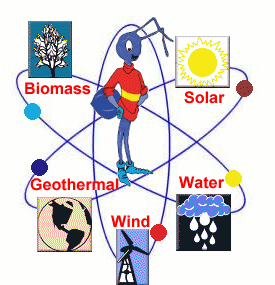 Germany Can Do Without Nuclear Power, In energy policy as elsewhere, we need more Europe, not less. WSJ, By GUIDO WESTERWELLE, foreign minister of Germany. Civilian nuclear power has been the subject of highly charged debate in German politics and society for many years. The tragedy in Fukushima triggered a further profound reassessment in Germany of the risks of nuclear power. Ultimately, Fukushima accelerated our change of direction. Five months after the accident, Germany decided by law that nuclear energy will be phased out by 2022.
The broad, democratic consensus we have reached in Germany, founded on wide-ranging deliberations with engineers, planners and economists, is that this change of track on energy policy is possible—technically, conceptually and economically. Our intention now is to map out our long-term progress along that road, heading for energy provision that is clean, affordable and safe.
This decision represents a huge step forward on Germany’s road towards sustainable energy provision sourced largely from renewables. Our climate targets will remain unaffected. We still aim to contribute to the EU-wide target of lowering CO2 emissions by at least 20% by 2020, as well as to achieve our national target of a 40% reduction. We will act responsibly in our work, seeking to ensure security of supply, affordability and respect for the climate and the environment……
the share of renewables in our electricity production passed the 20% mark for the first time in the first half of 2011. New capacities, better systems management and improved efficiency will offset the loss in capacity caused by the gradual shutdown of our remaining reactors. Low-carbon fossil fuel power plants will bridge the gap until new capacities have been completed. But in the medium term, our dependency on external energy sources will decrease significantly. By 2020 we plan to produce 35% of Germany’s electricity from renewable, i.e. local, sources, and 50% of it by 2030.At the same time, substantial technological and economic opportunities will materialize. The renewable energy business promises growth, jobs and returns that other industries can only dream of. On the other hand, our decision requires enormous investment and poses a variety of challenges, both economic and technological.
Germany´s energy future is clearly European. While each country must decide its own energy mix, the EU’s efforts and the member states’ domestic energy policies need to complement each other. National grids need to be connected into a high-performance European super-grid. The potential for greater energy efficiency, better integration and more diversification of the European energy sector is huge, and hugely expandable. In energy policy as elsewhere, we need more Europe, not less…. http://online.wsj.com/article/SB10001424053111903791504576584753796497200.html
Also, solutions which yesterday seemed utopian or unaffordable are today technically and economically viable, or tangibly close to realization. We are helping to implement the Desertec concept in North Africa, which enables clean electricity from solar, wind and photovoltaic power to be generated on a large scale in desert regions and delivered in part to Europe. Emerging and developing countries on all continents can benefit from these technologies to make their growth more sustainable.
No comments yet.
1 This Month
10 March A LIVE WEBINAR THE REAL EFFECTS OF NUCLEAR POWER
What the Industry Isn’t Telling Us
1:00 PM Mountain, 2 pm Central, 3 pm Eastern. Live on the Keepers of the Water Facebook page


18 March Webinar @ 1 PM EST: An Assessment of SMR Projects: The Case of Canada
register for the zoom:
https://us02web.zoom.us/webinar/register/WN_o8BIIOUvQ2ONJR1nta65DQ#/registration


of the week – STOP SMALL MODULAR REACTORS IN CANADA
To see nuclear-related stories in greater depth and intensity – go to https://nuclearinformation.wordpress.com
-
Archives
- March 2026 (9)
- February 2026 (268)
- January 2026 (308)
- December 2025 (358)
- November 2025 (359)
- October 2025 (376)
- September 2025 (258)
- August 2025 (319)
- July 2025 (230)
- June 2025 (348)
- May 2025 (261)
- April 2025 (305)
-
Categories
- 1
- 1 NUCLEAR ISSUES
- business and costs
- climate change
- culture and arts
- ENERGY
- environment
- health
- history
- indigenous issues
- Legal
- marketing of nuclear
- media
- opposition to nuclear
- PERSONAL STORIES
- politics
- politics international
- Religion and ethics
- safety
- secrets,lies and civil liberties
- spinbuster
- technology
- Uranium
- wastes
- weapons and war
- Women
- 2 WORLD
- ACTION
- AFRICA
- Atrocities
- AUSTRALIA
- Christina's notes
- Christina's themes
- culture and arts
- Events
- Fuk 2022
- Fuk 2023
- Fukushima 2017
- Fukushima 2018
- fukushima 2019
- Fukushima 2020
- Fukushima 2021
- general
- global warming
- Humour (God we need it)
- Nuclear
- RARE EARTHS
- Reference
- resources – print
- Resources -audiovicual
- Weekly Newsletter
- World
- World Nuclear
- YouTube
-
RSS
Entries RSS
Comments RSS
 nuclear-news
Leave a comment