People’s continued fight to shut down Japan’s nuclear industry
“The government and TEPCO need to admit to the crime they’ve committed. Then they need to work on making amends. This accident was not a natural disaster. It was caused by humans,” mayor, Tamotsu Baba, said……
even though Congressman Takano isn’t getting much support in the Japanese government for his campaign to shut down the country’s nuclear power plants, he is getting more attention from the public, and for now, that’s good enough, as he wants to mostly spread the word on a grassroots level, beyond his community and beyond the Tohoku region…..
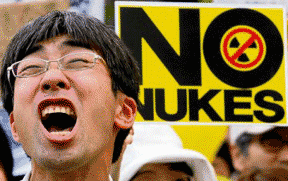 Fighting for a radiation- free Japan, Aj Jazeera, D. Parvaz 16 Sep 2011 Communities in the Tohoku region are struggling for information, decontamination and a say in future policies…. The radiation contamination has created a pristine post-apocalyptic postcard, a place where no one is allowed to live and farmers are forbidden from growing anything. It will be years before the full extent of damage to area residents and ecosystem alike will be known…..”
……. in Namie, which once held 21,000 residents, the rice paddies are neglected, overrun with weeds and dry patches. It is now a ghost town, evacuated since the Daiichi nuclear power plant, operated by Tokyo Electric Power Company (TEPCO), caught fire, exploded and started leaking radiation into the air, water and soil after a magnitude 9.0 earthquake and subsequent tsunami hit Japan six months ago.
The emergency housing units are filled with people who feel they’ve been left in the lurch. Many lost their jobs at the same time as losing their homes, yet they have mortgage payments to maintain. Then there’s the matter of paying for food and utilities while in temporary housing.
“People are better off in the emergency shelters,” said Miyoko Kumano, 56, referring to the gymnasiums and schools that have been home to hundreds of thousands of evacuees from tsunami, earthquake and nuclear evacuation zones since March. All told, the TEPCO disaster has made radiation refugees out of nearly 88,000 people…..
“The government and TEPCO need to admit to the crime they’ve committed. Then they need to work on making amends. This accident was not a natural disaster. It was caused by humans,” mayor, Tamotsu Baba, said……
Over 80,000 people lost their homes in the tsunami and earthquake, and nearly 7,000 still live in emergency shelters.
The culture isn’t one that encourages expressions of complaint and dissent, but there are signs that people are psychologically suffering and that they’re starting to seek help. For instance, a hospital in Kesennuma, where many still live in shelters, has started a clinic to deal with the psychological impacts of the tsunami that killed over 1,000 people there. They say that 10 per cent of the patients seen there are diagnosed with post-traumatic stress disorder and 50 per cent are clinically depressed.
In the shadow of all that, people in the region are also forced to learn the basics of nuclear safety, to try to find a way to trust their government and power company and then move forward. But the trust thing is holding them back.
That TEPCO withheld or was slow to share information has been established. The extent of the government’s culpability is unknown, but many feel that the state has not made their safety a priority. This has created pockets of activism in various communities, where people are taking matters into their own hands…….
The long haul
The work of gathering information they trust while pushing towards a nuclear-free Japan is bound to be a long one, and activists are digging in their heels for a lengthy battle.
“This sort of thing isn’t just for today or tomorrow. It has to be done for the next 20 years,” Tadao Munakata, one such activist, told Al Jazeera….
even though Congressman Takano isn’t getting much support in the Japanese government for his campaign to shut down the country’s nuclear power plants, he is getting more attention from the public, and for now, that’s good enough, as he wants to mostly spread the word on a grassroots level, beyond his community and beyond the Tohoku region…..
No comments yet.
1 This Month
Chernobyl: The Lost Tapes – A good documentary on Chernobyl on SBS available On Demand for the next 3 weeks– https://www.sbs.com.au/ondemand/tv-program/chernobyl-the-lost-tapes/2352741955560

of the week–London Campaign for Nuclear Disarmament

Tell the Ukrainian Government to Drop Prosecution of Peace Activist Yurii Sheliazhenko
To see nuclear-related stories in greater depth and intensity – go to https://nuclearinformation.wordpress.com
-
Archives
- April 2026 (139)
- March 2026 (251)
- February 2026 (268)
- January 2026 (308)
- December 2025 (358)
- November 2025 (359)
- October 2025 (376)
- September 2025 (257)
- August 2025 (319)
- July 2025 (230)
- June 2025 (348)
- May 2025 (261)
-
Categories
- 1
- 1 NUCLEAR ISSUES
- business and costs
- climate change
- culture and arts
- ENERGY
- environment
- health
- history
- indigenous issues
- Legal
- marketing of nuclear
- media
- opposition to nuclear
- PERSONAL STORIES
- politics
- politics international
- Religion and ethics
- safety
- secrets,lies and civil liberties
- spinbuster
- technology
- Uranium
- wastes
- weapons and war
- Women
- 2 WORLD
- ACTION
- AFRICA
- Atrocities
- AUSTRALIA
- Christina's notes
- Christina's themes
- culture and arts
- Events
- Fuk 2022
- Fuk 2023
- Fukushima 2017
- Fukushima 2018
- fukushima 2019
- Fukushima 2020
- Fukushima 2021
- general
- global warming
- Humour (God we need it)
- Nuclear
- RARE EARTHS
- Reference
- resources – print
- Resources -audiovicual
- Weekly Newsletter
- World
- World Nuclear
- YouTube
-
RSS
Entries RSS
Comments RSS
 nuclear-news
Leave a comment