Sea level rise threatens nuclear reactors
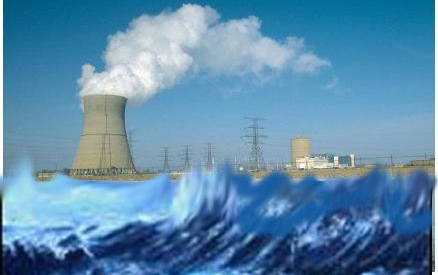 Although two new reactors at Turkey Point are being built at a higher elevation, Florida Power & Light has requested to keep the two current nukes running until 2035. Given that Hurricane Andrew almost inundated them in 1992, what will happen as oceans continue to rise?
“The standards will be 85 years old by then, and that’s a problem,” says Arnie Gundersen, a Vermont-based nuclear engineer and consultant. “If tidal waves knock out the water pumps” — as they did at the Fukushima reactor in Japan earlier this year — “you can have a meltdown.”…..
Global warming could put Turkey Point nuclear reactors under water, Miami New Times By Michael E. Miller , Sep 8 2011 Warning: Global warming is a fact, and the results are already visible. Hurricanes are getting stronger; droughts and floods are more frequent. In South Florida, waters rose roughly six inches between 1930 and 1981. That might not sound like much, but it’s just the tip of a rapidly melting iceberg. “We are the most vulnerable metropolitan area in the world when it comes to sea-level rise,” University of Miami professor Harold Wanless says. And, the avuncular geologist adds, that’s nothing.
“Another eight inches, and 65 percent of the county’s water control structures will fail,” he says. Salt water will seep across South Florida, destroying crops, corroding cars, and costing billions in damages. But eight inches is a drop in the bucket. Wanless expects South Florida seas to rise by at least four, probably six, feet by 2100. …..
Although two new reactors at Turkey Point are being built at a higher elevation, Florida Power & Light has requested to keep the two current nukes running until 2035. Given that Hurricane Andrew almost inundated them in 1992, what will happen as oceans continue to rise?
“The standards will be 85 years old by then, and that’s a problem,” says Arnie Gundersen, a Vermont-based nuclear engineer and consultant. “If tidal waves knock out the water pumps” — as they did at the Fukushima reactor in Japan earlier this year — “you can have a meltdown.”…..
Although two new reactors at Turkey Point are being built at a higher elevation, Florida Power & Light has requested to keep the two current nukes running until 2035. Given that Hurricane Andrew almost inundated them in 1992, what will happen as oceans continue to rise?
“The standards will be 85 years old by then, and that’s a problem,” says Arnie Gundersen, a Vermont-based nuclear engineer and consultant. “If tidal waves knock out the water pumps” — as they did at the Fukushima reactor in Japan earlier this year — “you can have a meltdown.”
No comments yet.
1 This Month


Tell the Ukrainian Government to Drop Prosecution of Peace Activist Yurii Sheliazhenko

Petition to revoke the licensing of the Near Surface Nuclear Disposal Facility (NSDF) at Chalk River. https://www.ourcommons.ca/petitions/en/Petition/Details?Petition=e-7247


of the week – STOP SMALL MODULAR REACTORS IN CANADA
To see nuclear-related stories in greater depth and intensity – go to https://nuclearinformation.wordpress.com
-
Archives
- March 2026 (212)
- February 2026 (268)
- January 2026 (308)
- December 2025 (358)
- November 2025 (359)
- October 2025 (376)
- September 2025 (258)
- August 2025 (319)
- July 2025 (230)
- June 2025 (348)
- May 2025 (261)
- April 2025 (305)
-
Categories
- 1
- 1 NUCLEAR ISSUES
- business and costs
- climate change
- culture and arts
- ENERGY
- environment
- health
- history
- indigenous issues
- Legal
- marketing of nuclear
- media
- opposition to nuclear
- PERSONAL STORIES
- politics
- politics international
- Religion and ethics
- safety
- secrets,lies and civil liberties
- spinbuster
- technology
- Uranium
- wastes
- weapons and war
- Women
- 2 WORLD
- ACTION
- AFRICA
- Atrocities
- AUSTRALIA
- Christina's notes
- Christina's themes
- culture and arts
- Events
- Fuk 2022
- Fuk 2023
- Fukushima 2017
- Fukushima 2018
- fukushima 2019
- Fukushima 2020
- Fukushima 2021
- general
- global warming
- Humour (God we need it)
- Nuclear
- RARE EARTHS
- Reference
- resources – print
- Resources -audiovicual
- Weekly Newsletter
- World
- World Nuclear
- YouTube
-
RSS
Entries RSS
Comments RSS
 nuclear-news
Leave a comment