Switching support to renewable energy? – Japan’s largest union wavers
Will Japan’s Largest Union Support Renewable Energy? In These Times, 11 Aug 11 By Akito Yoshikane, The Japanese Trade Union Confederation, also known as Rengo, said the country’s nuclear energy policy and the union’s support of it should bequestioned going forward. At an anti-nuclear gathering last Thursday in Hiroshima, the union’s secretary general told reporters, “We have to start discussions concerning nuclear energy from the beginning to decide what we should do in the future.”
That is a change from last August when the union promoted atomic power. …..
TEPCO nuclear company near financial disaster, even with government bailout
TEPCO teetering on financial edge, Chiaki Toyoda and Tadaaki Inoue / Yomiuri Shimbun Staff Writers, 11 Aug 11The harsh business environment facing Tokyo Electric Power Co. has been brought to the fore after the utility posted a record quarterly group net loss, logging a 571.7 billion yen deficit for the April-June period due to the crisis at its Fukushima No. 1nuclear power plant.
TEPCO will receive financial support from a new organization to be set up later this month by the government, which will be tasked with securing funds for the utility to pay compensation to people affected by radiation from the crippled plant.
Yet the utility’s business operations will be precarious, Continue reading
Nuclear Regulatory Commission more interested in its processes than in public safety
“the current commission’s preoccupation with process at the expense of nuclear safety policy.”
U.S. nuclear regulator tied up by process: chairman– By Roberta Rampton, WASHINGTON Aug 10, 2011 (Reuters) – The chairman of the U.S. nuclear regulator said his own commission is hamstrung by an inefficient, “flawed voting system” which distracts from its job of ensuring safety at the country’s power plants. Continue reading
Nuclear power has big carbon footprint, increases global warming
Nuclear Power Boosts Bills and Piles On Radioactive Waste, Kenric Ward, Sunshine State News, August 10, 2011“…..MEASURING CARBON FOOTPRINTS AND FUTURE BILLS
While Gov. Rick Scott and PSC Chairman Art Graham have expressed continued support for nuclear power in Florida, the industry faces high financial and technical hurdles.
“The NRC has yet to even certify the [proposed] AP1000 nuclear reactor design as being safe for construction and operation,” Saporito (Thomas Saporito, a West Palm Beach-based nuclear-power expert who has worked both in the industry and at the NRC) .said.
What’s more, environmentalists say nuclear plants are not as “green” as advertised.
“The carbon footprint made during the years and years of construction significantly contributes to global warming. Once the nuclear plants are operating, billions of BTUs are discharged into the environment. This is heat that was not in the environment prior to the operation of the nuclear power plants. So, these nuclear plants definitely increase global-warming concerns,” Saporito said.
According to the News Service of Florida, most of FPL’s rate request, about $172 million, is related to upgrading its four existing reactors at Turkey Point and St. Lucie. In a filing with state regulators, FPL President and CEO Armando Olivera said the projects would increase the company’s nuclear capacity about 15 percent.– http://www.sunshinestatenews.com/story/nuclear-power-boosts-bills-and-piles-radioactive-waste
Lower deman for uranium is forecast
Uranium One cuts demand forecast by 8%-10% TORONTO Mining Weekly, 9th August 2011 – Canada’s Uranium One has cut its demand growth projections for uranium for its namesake product by 8% to 10% over the next decade,…..
Last month, Australia-based Paladin Resources cut its 2012 uranium production guidance to 7.4-million pounds and 7.9-million pounds from the previous forecast of 8.2-million pounds, mainly because of delays to its stage-three expansion at the Langer Heinrich mine in Namibia.
This was followed by an August 4 announcement by uranium’s perennial under-performer, Rio Tinto’s Energy Resources of Australia, that it had nearly halved the reserves at its Ranger mine……
Yellow cake prices dropped to $49/lb from around $66/lb in the immediate wake of the Japanese disaster, and have since settled at about $52/lb.–
NRC needs to toughen up regulations on nuclear plant safety
The NRC has a deserved reputation of sometimes being too cozy with the industry it regulates. An Associated Press investigation recently showed that in relicensing power reactors the NRC depends largely on the assurances and information provided by plant operators.
Millstone scrutiny warranted, The Day.com 08/10/2011 “……The region should welcome the decision by the Nuclear Regulatory Commission to place the Millstone Power Station Unit 2 in Waterford under greater scrutiny. The additional oversight results from an incident earlier this year during which reactor operators made some troubling mistakes. Continue reading
USA to cut social welfare, health, but increase spending on nuclear weapons
 Some say Social Security and Medicare are under the gun, yet nobody’s talking about the $185 Billion increase to “modernize” America’s Nuclear arsenal and delivery systems…..
President ‘Nuclear Free World’ Obama and the Tea Party have resurrected policies that led to America’s First Great Depression.
The FY 2012 budget for the National Nuclear Security Administration includes 7.6 billion for nuclear weapons research and production.
66 Years of Nuclear Insanity and Real Change will do US good, Eileen Fleming Salem-News.com (CLERMONT, Fla.) 8 August 11, – This August 6th and 9th mark the 66th anniversaries of the most brutal acts of terrorism upon innocent people; America’s atomic bombings of Hiroshima and Nagasaki.
It has been spun ad’nauseum those actions “saved thousands of American lives” but the Pentagon and White House knew that Japan was ready to surrender and all they wanted was to “save face” and retain their emperor.
But the Manhattan Project was the steamroller for the Industrial Military Complex Continue reading
USA to spend $185 billion on nuclear weapons
How to Save a Quarter of a Trillion Dollars, HUFFINGTON POST, Lawrence Wittner, 8 Aug 11 In the midst of the current stampede to slash federal spending, Congress might want to take a look at two unnecessary (and dangerous) “national security” programs that, if cut, would save the United States over a quarter of a trillion dollars over the next decade.
The first of these is the Obama administration’s plan to spend at least $185 billion in the next ten years to “modernize” the U.S. government’s nuclear weapons arsenal. At present, the U.S. government possesses approximately 8,500 nuclear warheads, and it is hard to imagine that this country would be safer from attack if it built more nuclear weapons or “improved” those it already possesses. Indeed, President Barack Obama has declared — both on the 2008 campaign trail and as President – that he is committed to building a world without nuclear weapons. This seems like a perfectly sensible position — one favored by most nations and, as polls show, most people (including most people in the United States). Therefore, the administration should be working on securing further disarmament agreements — not on upgrading the U.S. nuclear arsenal in preparation for future nuclear confrontations and nuclear wars…….
by scrapping plans for nuclear weapons “modernization” and for national missile defense — programs that are both useless and provocative — the United States would save $271 billion (well over a quarter of a trillion dollars) in the next ten years. Whether used to balance the budget or to fund programs for jobs, healthcare, education, and the environment, this money would go a long way toward resolving some of the nation’s current problems.– …http://www.huffingtonpost.com/lawrence-wittner/budget-cuts-nuclear-missile_b_921157.html
UK and Japanese govts collude with nuclear industry to minimise Fukushima news
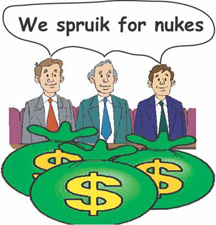 [the UK government] invited Westinghouse, Areva and EDF Energy, all pillars of nuclear power production, to contribute to government briefs and statements. “We need to all be working from the same material to get the message through to the media and the public,” ….Such spin and manipulation of information is likely to continue in the coming months as the industry struggles to recover.
(includes video)After Fukushima: the collusive nuclear industry fightback Independent Australia, 6 August 11, On the 66th anniversary of Hiroshima today, in a week whenrecord levels of radiation have been found at Fukushima, David McNeill looks at the way the nuclear industry has corruptly colluded with regulators in Japan and Britain to quieten valid public safety concerns about nuclear power. Continue reading
Solar energy becoming cheaper than coal
 it’s too bad our elected leaders see no value in spurring the next generation of energy technology rather than preserving tax cuts for oil and coal companies that are making record profits
5 breakthroughs that will make solar power cheaper than coal, Mother Nature Network, Karl Burkart, 8 Aug 11 Solar technology charges forward despite Washington’s backward march. Continue reading
15 years later -work still continuing on getting rid of nuclear reactor
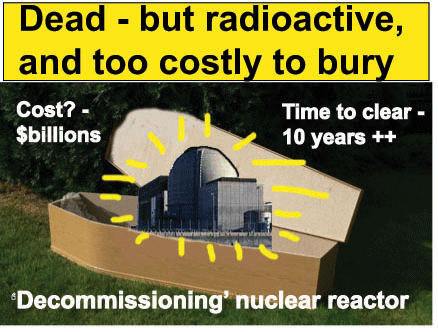
Visitors allowed into the decontamination workshop at Lubmin must wear radioactivity detectors and change into special protective clothing.
Working from inside containers, equipped with portholes, employees use high-pressure water, abrasive dust jets and acid baths to decontaminate the rooms one at a time.
“Don’t think radioactivity just disappears. It stays there as ground dust which has to be disposed of,” says Uwe Kopp, in charge of one of the workshops…..
Contaminated material from the plant is held in dozen of containers and barrels, awaiting a final government decision on a site for long-term storage.
Climate Change Increases Nuclear Danger
 In the coming months, you’re going to hear presidential candidates talk about climate change. You probably won’t hear them say much about nuclear safety. But the two are inextricably linked. A warmer climate leads to more severe storms, which increases the chances of a Japan-style nuclear meltdown…..Either we need to get out of the nuclear energy business or reduce our greenhouse gas emissions — or both.-
Climate change, nuclear power risks linked, Sun Sentinel August 05, 2011|By Anthony Orlando
The Japanese tsunami was a freak occurrence. Once in a thousand years. It can’t happen to our nuclear power plants.
But freak occurrences are happening more often nowadays. Continue reading
Indigenous peoples cop the uranium pollution by rich corporations
“The biggest problem of uranium mining is slow and constant emission of radiation which leads people to suffer from cancer, kidney problems, and other respiratory diseases.Future generations would be the worst sufferers,” she said. Due to uranium mining, groundwater level goes down, while water, used for agriculture and drinking, is polluted.

”Rich countries encourage uranium mining in poor nations”, IBN Live,,Aug 07,2011, Kadapa(AP), Aug 7 (PTI) Developed nations are taking up uranium mining in third world countries despite themselves being endowed with rich deposits of the mineral to avoid possible environmental pollution, Continue reading
Radioactive leakage causes shutdown of nuclear plant
Nine Mile Point nuclear plant shuts down, WSJ 8 Aug 11, SCRIBA, N.Y. — Officials at Constellation Energy are investigating a leakage in a containment structure that caused the shutdown of the Nine Mile Point Unit 2 reactor on Lake Ontario over the weekend.
The Oswego Palladium-Times reports that the reactor remained shut down Sunday after a “higher-than-normal leakage” was discovered inside the facility’s drywell (http://bit.ly/qVJmf3 ). The incident was classified as an “unusual event,” the lowest level of nuclear power plant emergencies.
Constellation Energy Nuclear Group spokeswoman Jill Lyon said the drywell is the containment structure surrounding the reactor vessel and associated piping. She said the reactor will remain shut down until the necessary repairs and post maintenance testing are finished.
Neil Sheehan of the Nuclear Regulatory Commission said it appears the source of the leakage is a valve on a recirculation pump…http://online.wsj.com/article/AP9933d2a7fcba4ef0b37c9e1384b212de.html
$196 million in advance for nukes that might never be built!
FPL to ask customers to pay $196 million to plan nukes, Sun Sentinel By Julie PatelAugust 8, 2011 Florida Power & Light wants to charge customers $196 million next year for costs to plan nuclear projects that may not be built…. FPL has proposed expanding four existing reactors and building two new ones. The proposed expansions still require approvals from federal and state agencies.
“I think it’s the paying in advance that I resent without something concrete in the making,” said Emily Doucette, a retiree in Pompano Beach…..
Critics plan to raise several key issues:
Cost-overruns. FPL should not have abandoned getting bids “with price-assured contracts” and other traditional construction practices meant to control costs for construction work related to the proposed expansions of four existing reactors, according to the Office of Public Counsel, the state’s advocate for utility customers. FPL implemented this “fast-tracked” approach to meet it goals for completion but the consumer advocate’s office argues that the move is leading to “rapidly increasing estimates of the cost to complete the…the projects” and they may end up costing more than FPL’s alternative plan, not to do them.
Transparency. The consumer advocate’s office also recommends that the PSC fine FPL a penalty for allegedly violating a rule that requires utilities to report estimated nuclear planning costs if they want to charge customers for them.
An investigator hired by FPL found last year that the utility provided “inaccurate and incomplete” information to regulators about the growing costs of its nuclear expansions. The consumer advocate’s office examined the issue itself and found that FPL’s cost estimates increased by $444 million in the months before it testified on costs but it did not report the changes….
Uncertainty. Both FPL and Progress Energy Florida are allegedly violating a rule that requires utilities that want to charge customers for nuclear planning costs to have a clear intent to build them, according to the Southern Alliance for Clean Energy. Last year, both utilities announced “delaying major capital expenditures” to build new reactors last year – and instead, said they would focus on the getting the required licenses – because of the uncertainty involved, SACE wrote to the PSC.
The Florida Industrial Power Users Group, a group that represents consumers that are businesses, said utilities should prove the projects are the most reasonable and cost-effective way to serve customers…..http://weblogs.sun-sentinel.com/business/realestate/housekeys/blog/2011/08/fpl_to_ask_customers_to_pay_19.html
1 This Month

Protect Sazan Island from the Trump family! https://secure.avaaz.org/campaign/en/protect_sazan_island_from_the_trump_family_loc/?bqFCVab&v=174511&cl=22707147157&_checksum=5e9dde668860e8231c33699735e16a1fbf22ab2cb01da50c999fe8732b9775ef&utm_source=email&utm_medium=blast_email&utm_campaign=174511


Cuba Is Not a Failed State – It Is a Besieged State
PETITION: “Global Appeal to Endorse Palestinian Right of Return of Refugees”
To see nuclear-related stories in greater depth and intensity – go to https://nuclearinformation.wordpress.com
-
Archives
- June 2026 (129)
- May 2026 (306)
- April 2026 (356)
- March 2026 (251)
- February 2026 (268)
- January 2026 (308)
- December 2025 (358)
- November 2025 (359)
- October 2025 (376)
- September 2025 (257)
- August 2025 (319)
- July 2025 (230)
-
Categories
- 1
- 1 NUCLEAR ISSUES
- business and costs
- climate change
- culture and arts
- ENERGY
- environment
- health
- history
- indigenous issues
- Legal
- marketing of nuclear
- media
- opposition to nuclear
- PERSONAL STORIES
- politics
- politics international
- Religion and ethics
- safety
- secrets,lies and civil liberties
- spinbuster
- technology
- Uranium
- wastes
- weapons and war
- Women
- 2 WORLD
- ACTION
- AFRICA
- Atrocities
- AUSTRALIA
- Christina's notes
- Christina's themes
- culture and arts
- Events
- Fuk 2022
- Fuk 2023
- Fukushima 2017
- Fukushima 2018
- fukushima 2019
- Fukushima 2020
- Fukushima 2021
- general
- global warming
- Humour (God we need it)
- Nuclear
- RARE EARTHS
- Reference
- resources – print
- Resources -audiovicual
- Weekly Newsletter
- World
- World Nuclear
- YouTube
-
RSS
Entries RSS
Comments RSS
 nuclear-news