USA to cut military spending: will it be jobs cut or nuclear arsenal cut?
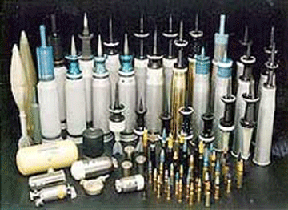 Factbox: For cuts, Pentagon must choose among weapons, personnel (Reuters) Reporting by David Alexander; Editing by Warren Strobel and Kieran Murray, 15 Aug 11– A decision to cut $350 billion in security spending over the next decade will force the Pentagon to make difficult trade-offs that could lead to layoffs, canceled weapons systems or a smaller nuclear arsenal……
NUCLEAR ARSENAL The U.S. government could make substantial savings by reducing the size of its nuclear arsenal. Under the New START nuclear arms treaty with Russia ratified this year, deployed nuclear warheads are due to be cut to 1,550 in seven years. In securing Senate approval, the administration promised to spend billions on modernizing the nuclear arsenal.
Analysts say the United States could save huge amounts of money by reducing the nuclear arsenal even further and eliminating one leg of the so-called triad of delivery systems — missiles, bombers and submarines.
The Sustainable Defense Task Force recommended cutting deployed nuclear warheads to 1,000 on seven nuclear submarines and 160 Minuteman missiles while eliminating the nuclear bomber force.It estimated savings of $113.5 billion through 2020….http://www.reuters.com/article/2011/08/15/us-usa-defense-cuts-idUSTRE77E4JH20110815
—
Dirty tricks in Japan, but also world-wide in the nuclear industry
the same factors are at work in every country that has a nuclear industry. The impulse to minimise the inherent risks of the most dangerous technology man has ever tried to master, the tendency to conceal or downplay accidents, the assertion that each succeeding generation of plants is foolproof and super safe, and the presumption, so often proved wrong by events, that every contingency has been provided for, all these have been evident again and again. Angela Merkel, one of the few leading politicians who is also a scientist, saw the writing on the wall. Her decision to phase out nuclear power has revived a global debate which has been dormant for far too long
 After Fukushima: nuclear dirty tricks, After nearly half a century of producing nuclear power, Japan has finally separated regulation from promotion. Editorial The Guardian, 16 August 2011 The Japanese cabinet decided this week to transfer the country’s nuclear safety agency from the trade ministry, where it nestled in a department also dedicated to the expansion of nuclear power, to the environment ministry, where, at least in theory, there is some chance that its operations will not be subverted or manipulated by Japanese energy firms. After nearly half a century of producing nuclear power, Japan has finally separated regulation from promotion, but the move may well have come too late to restore public trust. Continue reading
Australian TV show spells it out about the Fukushima radiation human guinea pigs
 VIDEO http://www.asianweek.com/2011/08/14/aussie-60-min-and-kaku-fukushima-and-chernobyl-radiation-in-all-of-us/ Aussie 60 Min and Kaku: Fukushima and Chernobyl Radiation In All Of Us Asian Week, BY ARTHUR HU – AUGUST 14, 2011 As usual, US media is carrying next to zero coverage of the continuing nuclear mess as now radiation is affecting rice, mushrooms, hay, beef, tea, fish, seafood, sewage, playgrounds, compost, firewood, and now they can’t even drain swimming pools that are contaminated with fallout. … Continue reading
 Critical need for China to be more transparent about nuclear issues
it’s critical that the nation develop a clear understanding of the challenges and potential dangers. A certain amount of transparency, including when things go wrong, will help alleviate unnecessary misperceptions and misunderstandings in the region and beyond.

 China’s nuclear sub needs, The Diplomat, By Manpreet Sethi, August 15, 2011 The past couple of weeks have seen a number of reports over a rumoured radiation leak from a 094 type Chinese nuclear submarine stationed near Dalian port. The incident is said to have occurred as electronic equipment was being installed on the sub.
Japan will import 1000 tons of nuclear waste every year for 7 years
The Fukushima disaster and the voyage of the 5,100-ton Pacific Grebe highlights the dilemma facing Japan and the world’s nuclear industry:Radioactive waste is deadly and needs to be locked away for thousands of years, so how can any storage site be guaranteed safe and permanent?
“Japan has 1,000 tons of spent fuel coming out of reactors every year, and there are 7 more years before the spent fuel pools are filled,”

 Japan Prepares for Its First Import of Radioactive Waste Since Earthquake, Bloomberg, By Yuriy Humber, Chisaki Watanabe and Stuart Biggs – Aug 14, 2011 Japan is preparing to receive its first import of highly radioactive waste since March, when an earthquake and tsunami caused a meltdown at the Fukushima nuclear power plant.
The vessel Pacific Grebe set sail Aug. 3 to Japan from Britain with more than 30 metric tons of radioactive waste on board. The cargo, Japanese spent fuel reprocessed in the U.K., is returning sealed in 76 stainless steel canisters packed into 130-ton containers. It will arrive early next month at the Mutsu-Ogawara port in northern Honshu for delivery to Japan Nuclear Fuel’s nearby Rokkasho storage site. Continue reading
Confusion: radioactivity in town of Iitate and other “hot spots” in Japan
Murky Science Clouded Japan Nuclear Response,WSJ By YUKA HAYASHI, 15 Aug 11, “………Confusion over what to do about radioactive contamination is playing out in various forms all over Japan. Officials are struggling to figure out where it is safe to live, what is safe to eat and how farmers decontaminate their fields. At present, 116,000 people remain unable to return to their homes due to the radiation threat. Even as the government continues to ask more people to evacuate, it is mulling allowing others to return to towns where contamination is relatively light…..
America’s costly problem of nuclear wastes
 AUDIO http://online.wsj.com/article/SB10001424053111904292504576484133479927502.html Nuclear Waste Piles Up—in Budget Deficit. WSJ, By MARK MAREMONT, 14 Aug 11
Imagine a football field packed 20 feet high with highly radioactive nuclear waste. That’s about the volume of the 65,000 metric tons of spent nuclear fuel stranded at dozens of nuclear sites across the U.S.
It isn’t just a potential public health hazard, as Japan’s recent nuclear disaster showed, but a growing burden on the federal government’s groaning finances. Continue reading
A Christian argument for action on Climate Change
 How do climate sceptics respond to the cloud of witnesses for global warming? By denying the full body of evidence. ……There are similar false arguments against clean energy. ……
The crux of climate change for Christians is the poorest, most vulnerable countries are those hardest hit by global warming.
The poor are least able to adapt to the impact of climate change and ironically, have contributed least to it. The carbon footprint of the poorest 1 billion people on the planet is estimated to be around 3% of the world’s total footprint. This is the social injustice of climate change: poor, developing countries will suffer because of the fossil fuels emitted by developed nations..
Eternity 16 Aug 11, John Cook a leading campaigner on climate change and, yes, a Christian too, puts the case for taking action.“…….Just as an Old Testament judge required multiple witnesses, scientists look for multiple sources of evidence. Our understanding is considered robust when scientists have found independent measurements all pointing to a single, consistent conclusion.
On the question of global warming, natural witnesses are found in our climate. Warming is directly measured by thermometers scattered across the globe, which find that the two hottest years on record were 2005 and 2010.
In addition, we have many natural thermometers painting a similar picture. Ice sheets in Greenland and Antarctica are dissipating at an accelerating rate, shedding hundreds of billions of tonnes of ice every year. Scientists are observing tens of thousands of species shift towards cooler regions. Arctic sea ice is melting faster than even the worst- case predictions. Even tree-lines are shifting in response to warming temperatures.
Nuclear engineering expert advises against Yucca Mt for nuclear waste
 Expert: Yucca not best place for storing nuclear waste, BY KEITH ROGERS, LAS VEGAS REVIEW-JOURNAL, Aug. 12, 2011 There are better places than Yucca Mountain to bury nuclear waste…..That’s what one expert on Energy Secretary Steven Chu’s Blue Ribbon Commission on America’s Nuclear Future believes.
The expert, Per Peterson, a University of California, Berkeley, nuclear engineering professor, said the choices range from stowing it in salt formations that stretch from Texas to Louisiana and that exist in New Mexico, or putting it down deep boreholes below the water table.
In either case, drinking water supplies would be spared of contamination because the water is either too saline already or there is no evident pathway to it, he said.
And, he said, the search should start for a new course on dealing with tens of thousands of tons of highly radioactive waste stored in pools and above ground at reactor sites, once destined for a maze of tunnels in Yucca Mountain, 100 miles northwest of Las Vegas…..http://www.lvrj.com/news/expert-yucca-not-best-place-for-storing-nuclear-waste-127623883.html?ref=883
Legal action planned against uranium mining in Tanzania
| LHRC’s warning over uranium |
| The Citizen, , 15 August 2011 23:13 |
|
By Bernard Lugongo, The Citizen Reporter, Dar es Salaam. The Legal and Human Rights Centre (LHRC) is planning to take the government to court should it go ahead with uranium mining projects in Bahi and Manyoni districts in Dodoma and regions respectively.
The LHRC cautioned yesterday that it was against the projects because they would lead to serious health and environmental impacts on the people living in the area……. |
LHRC also asked the government to learn from other nations, such as Niger, that have already experienced negative effects of uranium mining…..thecitizen.co.tz/news/4-national-news/13781-lhrcs-warning-over-uranium.html
IAEA wants to strengthen current weak international nuclear safety rules
Currently there are no mandatory, international nuclear safety regulations, only IAEA recommendations which national regulators are in charge of enforcing. The U.N. agency conducts review missions, but only at a member state’s invitation
U.N. atom body wants wider nuclear safety checks, Reuters, By Fredrik Dahl,Aug 15, 2011
* Fukushima disaster prompted global nuclear rethink
* IAEA seeks strengthened action to prevent any repeat
* Proposes expansion of international safety checks Continue reading
1 This Month

of the week – Shut Down Drone Warfare!


Tell the Ukrainian Government to Drop Prosecution of Peace Activist Yurii Sheliazhenko

Petition to revoke the licensing of the Near Surface Nuclear Disposal Facility (NSDF) at Chalk River. https://www.ourcommons.ca/petitions/en/Petition/Details?Petition=e-7247
To see nuclear-related stories in greater depth and intensity – go to https://nuclearinformation.wordpress.com
-
Archives
- March 2026 (237)
- February 2026 (268)
- January 2026 (308)
- December 2025 (358)
- November 2025 (359)
- October 2025 (376)
- September 2025 (257)
- August 2025 (319)
- July 2025 (230)
- June 2025 (348)
- May 2025 (261)
- April 2025 (305)
-
Categories
- 1
- 1 NUCLEAR ISSUES
- business and costs
- climate change
- culture and arts
- ENERGY
- environment
- health
- history
- indigenous issues
- Legal
- marketing of nuclear
- media
- opposition to nuclear
- PERSONAL STORIES
- politics
- politics international
- Religion and ethics
- safety
- secrets,lies and civil liberties
- spinbuster
- technology
- Uranium
- wastes
- weapons and war
- Women
- 2 WORLD
- ACTION
- AFRICA
- Atrocities
- AUSTRALIA
- Christina's notes
- Christina's themes
- culture and arts
- Events
- Fuk 2022
- Fuk 2023
- Fukushima 2017
- Fukushima 2018
- fukushima 2019
- Fukushima 2020
- Fukushima 2021
- general
- global warming
- Humour (God we need it)
- Nuclear
- RARE EARTHS
- Reference
- resources – print
- Resources -audiovicual
- Weekly Newsletter
- World
- World Nuclear
- YouTube
-
RSS
Entries RSS
Comments RSS
 nuclear-news