Film exposes the scandal of depleted uranium weapons

Uranio 238 on Youtube:
 Part 1: http://www.youtube.com/watch?v=3EUp5j1481g
Part 2: http://www.youtube.com/watch?v=lNgZs1lyuGQ
Part 3: http://www.youtube.com/watch?v=AZ4h6IeCalo
Part 4: http://www.youtube.com/watch?v=9uodiHzrefI
Depleted uranium documentary wins best short at International Uranium Film Festival, International Coalition to Ban Uranium Weapons, 12 Aug 11, Costa Rican production: URANIUM 238 – The Pentagon´s Dirty Pool wins best short film category of the First International Uranium Film Festival 2011 in Rio de Janeiro, Brazil. Continue reading
Need to rewrite U.S. President’s guidance for use of nuclear weapons

Although the administration’s Nuclear Posture Review is widely said to reduce the role of nuclear weapons, it doesn’t actually reduce the role that nuclear weapons have today because all the adversaries in the current strategic nuclear war plan are exempt from the reduction. They are either nuclear weapon states, not members of the nuclear Non-Proliferation Treaty, or are in violation of their NPT obligations and have chemical or biological weapons. The new guidance would have to remove some of these adversaries from the war plan to reduce the role, or reduce the role that nuclear weapons are required to play against each of them. There are many ways this could be done:
- Reduce the numer of target categories that are held at risk with nuclear weapons.
- Reduce the damage expectancy to be a achieved against individual targets.
- Reduce the number of adversaries in the plan.
- Reduce the number and types of strike options against each adversary.
- Remove the requirement to plan for prompt launch of nuclear forces.
- Remove any requirement to plan for damage limitation strikes.
- End counterforce nuclear planning.
- End the requirement to maintain standing fully operational strike plans…….
we have a new op-ed in the Bulletin of the Atomic Scientists that describes what a new presidential directive could look like: A Presidential Policy Directive for a new nuclear path. http://www.fas.org/blog/ssp/2011/08/nuclearguidance.php
Outrage in Japan over the nuclear industry’s crooked “AstroTurf” manipulations of public opinion
 Japanese government investigations that have uncovered a nationwide pattern of attempts to manipulate the public’s opinion about nuclear power by Japan’s biggest electric utilities. Some of those power companies then pointed the finger back at regulators for having covertly urged such efforts in the first place.
The “AstroTurf”—or fake-grass-roots—campaigns, which ranged from packing events with supporters to planting questions and orchestrating email drives, have now badly backfired, sparking public outrage

 Scandal Taints Japan Nuclear Sector, WSJ By CHESTER DAWSON, AUGUST 13, 2011 SAGA, Japan—The Fukushima Daiichi accident was a big setback for nuclear power in Japan. But the industry’s hamfisted efforts to maintain support in the aftermath of that disaster may have an even bigger impact in eroding the public’s confidence in the sector.
After a series of disclosures in recent weeks painting government regulators and electric utilities as collaborating to stage-manage public community forums on local nuclear power, efforts to restart idled Japanese nuclear reactors have screeched to a halt. Continue reading
Japan doing well with energy conservation – nuclear power not necessary?
 Saving electricity has become a sort of national religion. With many air conditioners set at 82 degrees, businessmen have shed their usual suits in favor of “super cool biz” short-sleeve shirts. Car makers have been forced to operate on weekends to avoid sucking up electricity during peak weekday hours.
Peak electricity usage for the Tokyo area so far this summer was nearly 23% below the peak last summer.
The drop in electrical consumption is shaking Japan’s decades-old commitment to nuclear power
Summer Power Success Raises Heat in Energy Debate, WSJ AUGUST 12, 2011, By Peter Landers It looks as if Japan has just about survived the peak of summer electricity demand without power outages, although the Tohoku region had some close calls…..
Japan’s success at avoiding outages even with most of its nuclear reactors out of service is taking on a more strategic importance, influencing the broader debate over nuclear power’s future. Whether to phase out nuclear power will be a big issue when the Democratic Party of Japan chooses a successor to Prime Minister Naoto Kan later this month or next month……http://blogs.wsj.com/japanrealtime/2011/08/12/summer-power-success-raises-heat-in-energy-debate/
Japan Snaps Back With Less Power, Economy Survives Reactor Shutdowns, and Tokyo Rethinks Nuclear Policy, WSJ, Peter Landers. JULY 29, 2011 TOKYO—When the March 11 tsunami knocked out more than half of the nuclear power plants serving the Tokyo area, it set off one of the biggest unplanned experiments in a modern society: Could a metropolis of 30 million people get by after losing about a fifth of its power supply?
After a steaming July in Japan filled with 90-degree-plus days, the preliminary answer is in, and it is yes. Continue reading
United States Army Going Green
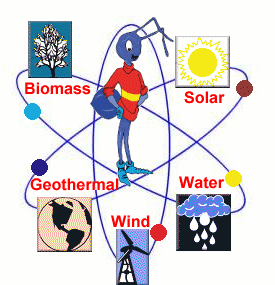 Army to build green-energy capabilities, Fierce Government August 12, 2011 — By Molly Bernhart Walker, The Army plans to launch large-scale renewable and alternative energy projects on Army installations, Army Secretary John McHugh said Aug. 10. The Army predicts it will invest up to $7.1 billion over the next 10 years to meet its energy goals; this will produce 2.1 million megawatt hours of power annually, the service estimated in a statement.
What Army envisions as “an economically viable, large-scale renewable energy infrastructure,” will begin with a task force, McHugh said, to address energy security, escalating fuel prices and compliance with green-government mandates. The Energy Initiatives Office Task Force, which will be part of the Office of the Assistant Secretary of the Army for Installations, Energy and Environment, will be fully operational by Sept. 15, he said……For more:- see the Army press release http://www.fiercegovernment.com/story/army-build-green-energy-capabilities/2011-08-12
The devious path of the nuclear lobby’s money trail

 Nuclear safety: A dangerous veil of secrecy, Aljazeera, Dorothy Parvaz 11 Aug 2011“….…A high-stakes game There’s no denying that there’s a lot of money – and power – riding on the nuclear industry.
The money trail can be tough to follow – Westinghouse, Duke Energy and the Nuclear Energy Institute (a “policy organisation” for the nuclear industry with 350 companies, including TEPCO, on its roster) did not respond to requests for information on funding research and chairs at universities.
But most of the funding for nuclear research does not come directly from the nuclear lobby, said M.V. Ramana, a researcher at Princeton University specialising in the nuclear industry and climate change. Most research is funded by governments, who get donations – from the lobby (via candidates, political parties or otherwise).
The Center for Responsive Politics – a non-partisan, non-profit elections watchdog group – noted that even as many lobbying groups slowed their spending the first quarter of the year, the Nuclear industry “appears to be ratcheting up its lobbying” increasing its multi-million dollar spending.
“In the United States, a lot of the money doesn’t come directly from the nuclear industry, but actually comes from the Department of Energy (DOE). And the DOE has a very close relationship with the industry, and they sort of try to advance the industry’s interest,” said Ramana. Indeed, nuclear engineering falls under the “Major Areas of Research” with the DOE, which also has nuclear weapons under its rubric. The DOE’s 2012 fiscal year budge request to the US Congress for nuclear energy programmes was $755m.
“So those people who get funding from that….it’s not like they (researchers) want to lie, but there’s a certain amount of, shall we say, ideological commitment to nuclear power, as well as a certain amount of self-censorship.” It comes down to worrying how their next application for funding might be viewed, he said…. http://english.aljazeera.net/indepth/features/2011/08/2011877118599802.html
Japan about to approve Renewable Energy Law
Japan Set to Pass Law on Renewable Energy, WSJ By MITSURU OBE 12 Aug 11, TOKYO—Japan’s parliament is set to approve a landmark bill on renewable energy that was championed by Prime Minister Naoto Kan as a way to reduce the nation’s dependence on nuclear power, and which would break the monopoly of the 10 major utilities. Continue reading
Still time to push America’s EPA to protect water from nuclear industry

 TELL THE EPA: PROTECT OUR WATER FROM NUKES AND COAL!, COMMENT PERIOD EXTENDED THROUGH AUGUST 18, 2011 Nuclear Information and Resource Service, Michael Mariotte, 12 Aug 11, Thanks to years of inaction, hundreds of outdated power plants–mostly nuclear and coal–across the country use antiquated cooling water systems that scoop up massive amounts of water from local waterways and trap and crush aquatic life to death in the process. Each year these power plants kill billions of fish from our lakes, streams, and coastal waters.
Decades ago, the Environmental Protection Agency was supposed to come up with new, national requirements to modernize power plant cooling systems and fix this problem. But instead the agency is now caving to industry pressure and has proposed a new cooling water rule that takes a weak stance and punts decision making to the states on a case-by-case basis. This approach hasn’t worked in the past and won’t work now.
Even worse, the Nuclear Energy Institute (NEI) has launched an all-out campaign through its Nuclear Advocacy Network to demand an even weaker approach from EPA. NEI claims that more than 7,000 people already have sent letters to the EPA from its side. We need to counter their efforts, and quickly.
Urge EPA to stand up for our waters and wildlife. You can submit a comment here urging EPA to adopt a strong standard for modernizing power plant cooling systems in its final rule.
Nuclear company ENTERGY must pay up for plant closedown
AUDIO
 http://www.publicbroadcasting.net/wamc/news.newsmain/article/0/0/1839200/WAMC.New.England.News/NRC.Requires.Decommissioning.Payment.by.Vermont.Yankee.Owner NRC Requires Decommissioning Payment by Vermont Yankee Owner, North East Public Radio, Pat Bradley 11 Aug 11, VERNON, VT (WAMC) – Entergy had filed a notice to the Nuclear Regulatory Commission that it planned to cancel a guarantee payment of 40-million dollars to the decommissioning fund for the Vermont Yankee Nuclear Power Plant. In it’s notice, Entergy stated that because the federal agency had extended its license for 20 years, there was no need for the guarantee funds, and sufficient money could be earned on current investments over the 20 year renewal period.
But on Wednesday, Entergy was informed that it must make the payment. The NRC says it would be premature to cancel the payment because the Vernon plant might not be able to operate after next March. In its letter to Entergy, the NRC the decision is “…based on the ongoing civil court case Entergy Nuclear Vermont vs. Schumlin…” New England Coalition Advisor Ray Shadis believes it is the first federal acknowledgement that the plant is on track to shutdown next March…..
http://www.publicbroadcasting.net/wamc/news.newsmain/article/0/0/1839200/WAMC.New.England.News/NRC.Requires.Decommissioning.Payment.by.Vermont.Yankee.Owner
Florida Power and light under scrutiny about planned nuclear costs
 FPL’s $18 Billion Nuclear-Reactor Plans Leak Unanswered Questions Before Florida PSC, FLAGLERLIVE, Jim Saunders, News Service of Florida, 12 Aug 11, The state Public Service Commission on Thursday quickly wrapped up a hearing about Florida Power & Light’s proposal to collect $196 million next year to pay for nuclear-power projects. The commission is scheduled to rule on the request Oct. 24. FPL is seeking to collect the money from customers to help upgrade nuclear plants in St. Lucie and Miami-Dade counties and to take initial steps toward adding two new reactors…..
FPL’s proposal faced a series of attacks from attorneys for consumers and business and environmental groups. In part, they questioned whether FPL will ever build two new nuclear reactors and whether the company increased costs by trying to do an upgrade project quickly.
Also, two of those attorneys told the Florida Public Service Commission that FPL used out-of-date information during a similar 2009 hearing about the upgrade project. Joe McGlothlin, an attorney for the Office of Public Counsel, accused the company of “willful withholding” of information that would have shown higher project costs….
The arguments came on the first of several days of hearings about more than $335 million in nuclear-project costs that FPL and Progress Energy Florida hope to collect from customers next year. The Progress case is expected to start next week, with the company seeking $141 million. All but about $5.6 million of that amount would go toward a plan to add two new reactors in Levy County.
Hoping to encourage more nuclear energy, Florida lawmakers in 2006 allowed utilities to incrementally collect costs from customers rather than waiting until after projects are finished. That has led to the possibility, however, that customers could spend hundreds of millions of dollars on initial costs for nuclear plants that never get built…..
James Whitlock, an attorney for the Southern Alliance for Clean Energy, said utility customers should not have to pay initial costs for the proposed Turkey Point reactors. He said FPL would use the money to try to get a license for the project but that new nuclear plants are not currently feasible.
“If the plant’s never built and never comes online, there won’t be any benefit (to customers),” Whitlock said….http://flaglerlive.com/26580/fpl-nukes-psc
Nuclear reactors’ impact on America’s fresh water supplies
Nuclear Information and Resource Service, Michael Mariotte, 12 Aug 11, America’s aging power plants are not only the nation’s largest air polluters, they also withdraw more water than any other source, causing staggering aquatic impacts. And nuclear reactors are the largest water users of them all.
Power plants’ toll on fisheries rivals, and in some cases exceeds, that of the fishing industry. Fortunately, none of this damage is necessary because modern closed-cycle cooling systems recirculate cooling water, reducing withdrawals and fish kills by about 95 percent. Since 1972, Section 316(b) of the federal Clean Water Act has required power plants to use the Best Technology Available (BTA) to minimize the adverse environmental impacts of cooling water intake structures.
In 2001, EPA issued national regulations identifying closed-cycle cooling as BTA for new power plants. But many older reactors, typically although not exclusively those built more than 30 years ago, still rely on antiquated and damaging once-through cooling systems, which withdraw water directly from its source but do not recycle it. Instead the water is thrown back into its source at far higher temperatures than it was when taken in.
For more information on the environmental devastation caused by once-through cooling at nuclear reactors, see Licensed to Kill, a report published by NIRS and other groups in 2001 and available here.
The rule EPA proposed on April 20, 2011 would be a step backward in our collective efforts to safeguard America’s waters. Basically, EPA has chosen the path of least resistance by caving into industry pressure and punting this issue to state agencies–agencies that too often lack the resources and the ability to stand up to industry on this issue. And if the Nuclear Energy Institute gets its way, things will get even worse. What is needed is a clear rule focused on modernizing power plants by stopping the use of once-through cooling.
Urge EPA to stand up for our waters and wildlife. You can submit a comment here urging EPA to adopt a strong standard for modernizing power plant cooling systems in its final rule.
1 This Month

of the week – Shut Down Drone Warfare!


Tell the Ukrainian Government to Drop Prosecution of Peace Activist Yurii Sheliazhenko

Petition to revoke the licensing of the Near Surface Nuclear Disposal Facility (NSDF) at Chalk River. https://www.ourcommons.ca/petitions/en/Petition/Details?Petition=e-7247
To see nuclear-related stories in greater depth and intensity – go to https://nuclearinformation.wordpress.com
-
Archives
- March 2026 (230)
- February 2026 (268)
- January 2026 (308)
- December 2025 (358)
- November 2025 (359)
- October 2025 (376)
- September 2025 (257)
- August 2025 (319)
- July 2025 (230)
- June 2025 (348)
- May 2025 (261)
- April 2025 (305)
-
Categories
- 1
- 1 NUCLEAR ISSUES
- business and costs
- climate change
- culture and arts
- ENERGY
- environment
- health
- history
- indigenous issues
- Legal
- marketing of nuclear
- media
- opposition to nuclear
- PERSONAL STORIES
- politics
- politics international
- Religion and ethics
- safety
- secrets,lies and civil liberties
- spinbuster
- technology
- Uranium
- wastes
- weapons and war
- Women
- 2 WORLD
- ACTION
- AFRICA
- Atrocities
- AUSTRALIA
- Christina's notes
- Christina's themes
- culture and arts
- Events
- Fuk 2022
- Fuk 2023
- Fukushima 2017
- Fukushima 2018
- fukushima 2019
- Fukushima 2020
- Fukushima 2021
- general
- global warming
- Humour (God we need it)
- Nuclear
- RARE EARTHS
- Reference
- resources – print
- Resources -audiovicual
- Weekly Newsletter
- World
- World Nuclear
- YouTube
-
RSS
Entries RSS
Comments RSS
 nuclear-news