UK and Japanese govts collude with nuclear industry to minimise Fukushima news
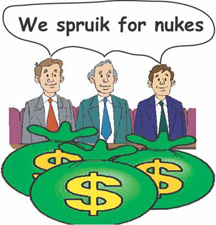 [the UK government] invited Westinghouse, Areva and EDF Energy, all pillars of nuclear power production, to contribute to government briefs and statements. “We need to all be working from the same material to get the message through to the media and the public,” ….Such spin and manipulation of information is likely to continue in the coming months as the industry struggles to recover.
(includes video)After Fukushima: the collusive nuclear industry fightback Independent Australia, 6 August 11, On the 66th anniversary of Hiroshima today, in a week whenrecord levels of radiation have been found at Fukushima, David McNeill looks at the way the nuclear industry has corruptly colluded with regulators in Japan and Britain to quieten valid public safety concerns about nuclear power.
With no end in sight to the world’s worst atomic power crisis in a quarter of a century, collusion between Japan’s nuclear industry and its supposedly neutral government watchdogs is, perhaps for the first time, under serious scrutiny. In May, inspectors from the International Atomic Energy Agency singled out the lack of independence between regulators and the industry during a trip to Japan, noting that the Ministry of Economy, Trade and Industry (METI) simultaneously promotes nuclear power and oversees it. Prime Minister Kan Naoto has since ordered a government committee to probe that relationship, though puzzlingly, committee head Hatamura Yotaro has said that it “will not aim to clarify” who is responsible for the accident.
Then came Fukushima.
the importance of a strategy for the pro-nuclear British government to spin the world’s worst nuclear accident in 25 years in a way that would minimize its impact on Britain’s citizenry.
No comments yet.
1 This Month

of the week – Shut Down Drone Warfare!


Tell the Ukrainian Government to Drop Prosecution of Peace Activist Yurii Sheliazhenko

Petition to revoke the licensing of the Near Surface Nuclear Disposal Facility (NSDF) at Chalk River. https://www.ourcommons.ca/petitions/en/Petition/Details?Petition=e-7247
To see nuclear-related stories in greater depth and intensity – go to https://nuclearinformation.wordpress.com
-
Archives
- April 2026 (68)
- March 2026 (251)
- February 2026 (268)
- January 2026 (308)
- December 2025 (358)
- November 2025 (359)
- October 2025 (376)
- September 2025 (257)
- August 2025 (319)
- July 2025 (230)
- June 2025 (348)
- May 2025 (261)
-
Categories
- 1
- 1 NUCLEAR ISSUES
- business and costs
- climate change
- culture and arts
- ENERGY
- environment
- health
- history
- indigenous issues
- Legal
- marketing of nuclear
- media
- opposition to nuclear
- PERSONAL STORIES
- politics
- politics international
- Religion and ethics
- safety
- secrets,lies and civil liberties
- spinbuster
- technology
- Uranium
- wastes
- weapons and war
- Women
- 2 WORLD
- ACTION
- AFRICA
- Atrocities
- AUSTRALIA
- Christina's notes
- Christina's themes
- culture and arts
- Events
- Fuk 2022
- Fuk 2023
- Fukushima 2017
- Fukushima 2018
- fukushima 2019
- Fukushima 2020
- Fukushima 2021
- general
- global warming
- Humour (God we need it)
- Nuclear
- RARE EARTHS
- Reference
- resources – print
- Resources -audiovicual
- Weekly Newsletter
- World
- World Nuclear
- YouTube
-
RSS
Entries RSS
Comments RSS
 nuclear-news
Leave a comment