15 years later -work still continuing on getting rid of nuclear reactor
Visitors allowed into the decontamination workshop at Lubmin must wear radioactivity detectors and change into special protective clothing.
Working from inside containers, equipped with portholes, employees use high-pressure water, abrasive dust jets and acid baths to decontaminate the rooms one at a time.
“Don’t think radioactivity just disappears. It stays there as ground dust which has to be disposed of,” says Uwe Kopp, in charge of one of the workshops…..
Contaminated material from the plant is held in dozen of containers and barrels, awaiting a final government decision on a site for long-term storage.
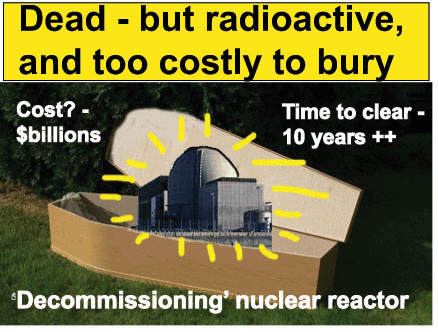
The Lubmin plant on the Baltic coast was home to five of East Germany’s six nuclear reactors and supplied 10 percent of the communist country’s electricity when it was taken off the grid in 1990 following German reunification.
“It was Russian technology, but it wasn’t the same model as Chernobyl,” the Ukrainian power plant responsible for the world’s worst nuclear disaster, in 1986, says Marlies Philipp, the former plant’s spokeswoman.
The site was mothballed for a few years before work began on dismantling it in 1995.
Decontamination work has been going on ever since at a cost to date of 4.1 billion euros ($5.8 billion), a sum which does not include the actual demolition of the buildings.
“We don’t have money for that,” says Philipp, who used to work as an engineer.
Of the 5,500 staff employed there at the time of the fall of the Berlin Wall in 1989, 830 have managed to stay on to work on decommissioning and decontamination.
“We want to preserve the jobs of workers still here because not all are of retirement age,” says Philipp.
Work at the plant is expected to continue until 2013 or 2014.
At first it was “learning by doing,” she says but experience now means “we can hope to win contracts for decommissioning plants in the west” when they too are taken off the power grid.
Chancellor Angela Merkel’s government decided in the wake of the disaster at the Fukushima plant in Japan in March to shutter all 17 of Germany’s nuclear reactors within 11 years.
Visitors allowed into the decontamination workshop at Lubmin must wear radioactivity detectors and change into special protective clothing.
Working from inside containers, equipped with portholes, employees use high-pressure water, abrasive dust jets and acid baths to decontaminate the rooms one at a time.
“Don’t think radioactivity just disappears. It stays there as ground dust which has to be disposed of,” says Uwe Kopp, in charge of one of the workshops…..
Contaminated material from the plant is held in dozen of containers and barrels, awaiting a final government decision on a site for long-term storage.
The end of the nuclear era in Lubmin forced the town to look in new directions, and it has tapped into the growing renewable energy sector, in particular wind power.
No comments yet.
1 This Month

of the week – Shut Down Drone Warfare!


Tell the Ukrainian Government to Drop Prosecution of Peace Activist Yurii Sheliazhenko

Petition to revoke the licensing of the Near Surface Nuclear Disposal Facility (NSDF) at Chalk River. https://www.ourcommons.ca/petitions/en/Petition/Details?Petition=e-7247
To see nuclear-related stories in greater depth and intensity – go to https://nuclearinformation.wordpress.com
-
Archives
- April 2026 (68)
- March 2026 (251)
- February 2026 (268)
- January 2026 (308)
- December 2025 (358)
- November 2025 (359)
- October 2025 (376)
- September 2025 (257)
- August 2025 (319)
- July 2025 (230)
- June 2025 (348)
- May 2025 (261)
-
Categories
- 1
- 1 NUCLEAR ISSUES
- business and costs
- climate change
- culture and arts
- ENERGY
- environment
- health
- history
- indigenous issues
- Legal
- marketing of nuclear
- media
- opposition to nuclear
- PERSONAL STORIES
- politics
- politics international
- Religion and ethics
- safety
- secrets,lies and civil liberties
- spinbuster
- technology
- Uranium
- wastes
- weapons and war
- Women
- 2 WORLD
- ACTION
- AFRICA
- Atrocities
- AUSTRALIA
- Christina's notes
- Christina's themes
- culture and arts
- Events
- Fuk 2022
- Fuk 2023
- Fukushima 2017
- Fukushima 2018
- fukushima 2019
- Fukushima 2020
- Fukushima 2021
- general
- global warming
- Humour (God we need it)
- Nuclear
- RARE EARTHS
- Reference
- resources – print
- Resources -audiovicual
- Weekly Newsletter
- World
- World Nuclear
- YouTube
-
RSS
Entries RSS
Comments RSS
 nuclear-news
Leave a comment