Western North Carolina at risk of becoming USA’s nuclear waste host
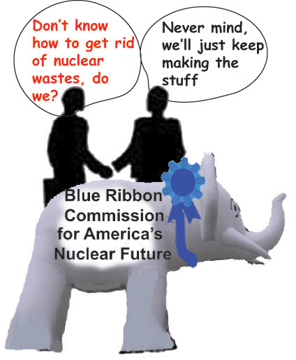
 Specter of nuclear waste dump returns to WNC, Macon County News, , 28 July 2011 by Christopher Carpenter “…– “We’re back to where we started; it’s the same story,” said Olson, a biologist and biochemist by training who has worked with NIRS since 1991. This week the first draft recommendations of a federal commission on nuclear energy are due out. Olson cautioned to be prepared for more flashbacks to come.
Unfortunately ‘fabulous’ It was only later that Yucca Mountain became the main focus of federal planners, even though there were many indicators that the site was geologically unsound. The site was crisscrossed with four major fault lines, the porous volcanic bedrock was far from ideal and in the first three years of studying the site, more than 200 earthquakes were recorded registering over 2.5 on the Richter Scale. Twenty years and $10 billion later, the Obama Administration finally conceded that a facility at the site would be destined to leak radiation and decided to walk away from it.
Thirty years ago, Western North Carolina, with its solid granite bedrock, was identified as a possible site for a national nuclear waste repository. The community of Sandy Mush in Leicester (just 23.5 miles from the Buncombe County Courthouse in downtown Asheville) was one of twelve sites in the country that were seriously being studied by the U.S. Department of Energy.
“Our sites are fabulous by comparison,” says Olson, speaking strictly in geological and technical terms.
In January 2010, U.S. Secretary of Energy Steven Chu announced the formation of a Blue Ribbon Commission on America’s Nuclear Future, part of the Obama Administration’s stated commitment to restarting the country’s nuclear industry. The commission was tasked with developing recommendations for “a safe, long-term solution to managing the nation’s used nuclear fuel and nuclear waste.” That includes figuring out what to do with all the waste from all the active and decommissioned reactors built in the country since the 1950s, as well as waste from the nuclear weapons program of the Cold War.
In its first weeks, the Commission, made up of 16 pro-nuclear advocates, was presented with a history of the nuclear waste issue in the country. However, instead of all 12 of the previously proposed sites, the presentation focused on only three: Sandy Mush among them.
The technical specifications of Sandy Mush and the surrounding region is not the only thing that makes it an ideal dump for 60 years of nuclear waste. Another charge of the Blue Ribbon Commission is to give recommendations concerning “fuel recycling” (the extraction of plutonium from the highly radioactive waste or “spent fuel” of a nuclear reactor). The most likely, indeed, the only currently proposed location for a “recycling center” in the country is at so-called Savannah River Site in Augusta, Ga., a former production site for weapons grade plutonium.
As Olson notes, the Southeast is the epicenter of the federal push to revive the nuclear energy sector. On Jan. 7, 2011, the Commission met in Augusta and heard from nuclear boosters in the area keen to develop what is being styled as an “energy park” on the DOE Savanah River Site. The facility, already being called the “U.S. Energy Freedom Center,” would support research, development and demonstration of renewable and alternative energy sources, but its primary focus would be reprocessing or recycling of highly radioactive fuel waste.
Asheville just happens to be situated at what the NIRS calls the “Nuclear Crossroads,” where I-40 and I-26 meet in Western North Carolina, and what would likely become one of the main corridors for transporting nuclear waste from sites around the country headed to the Savanah River Site.
“We’re talking not just hundreds of shipments, but thousands and possibly tens of thousand over at least two or three decades,” Olson explained. “And if they build new reactors, as they are planning to do for the first time in 30 years, it would be continuously.”
And once there, only one percent of the spent fuel can be reprocessed into plutonium to be used in theoretical “breeder reactors” that have never proven successful in other countries which have pursued the technology. The remaining 99 percent of the millions of tons of radioactive material would still need a permanent repository (with containment integrity for hundreds of thousands of years).
The closest acceptable site? Yep. Right here.
There is quality granite all through the Appalachian chain, but WNC is special. And as they say, “location, location, location.” ……
http://www.maconnews.com/news/state–region/1372-specter-of-nuclear-waste-dump-returns-to-wnc
No comments yet.
1 This Month

of the week – Shut Down Drone Warfare!


Tell the Ukrainian Government to Drop Prosecution of Peace Activist Yurii Sheliazhenko

Petition to revoke the licensing of the Near Surface Nuclear Disposal Facility (NSDF) at Chalk River. https://www.ourcommons.ca/petitions/en/Petition/Details?Petition=e-7247
To see nuclear-related stories in greater depth and intensity – go to https://nuclearinformation.wordpress.com
-
Archives
- March 2026 (244)
- February 2026 (268)
- January 2026 (308)
- December 2025 (358)
- November 2025 (359)
- October 2025 (376)
- September 2025 (257)
- August 2025 (319)
- July 2025 (230)
- June 2025 (348)
- May 2025 (261)
- April 2025 (305)
-
Categories
- 1
- 1 NUCLEAR ISSUES
- business and costs
- climate change
- culture and arts
- ENERGY
- environment
- health
- history
- indigenous issues
- Legal
- marketing of nuclear
- media
- opposition to nuclear
- PERSONAL STORIES
- politics
- politics international
- Religion and ethics
- safety
- secrets,lies and civil liberties
- spinbuster
- technology
- Uranium
- wastes
- weapons and war
- Women
- 2 WORLD
- ACTION
- AFRICA
- Atrocities
- AUSTRALIA
- Christina's notes
- Christina's themes
- culture and arts
- Events
- Fuk 2022
- Fuk 2023
- Fukushima 2017
- Fukushima 2018
- fukushima 2019
- Fukushima 2020
- Fukushima 2021
- general
- global warming
- Humour (God we need it)
- Nuclear
- RARE EARTHS
- Reference
- resources – print
- Resources -audiovicual
- Weekly Newsletter
- World
- World Nuclear
- YouTube
-
RSS
Entries RSS
Comments RSS
 nuclear-news
Leave a comment