Nuclear industry’s massive costs have been underestimated
Kenichi Oshima, a professor of environmental economics and policy at Ritsumeikan University, has done some calculations and has reached a completely different conclusion….
“If we were to funnel funds earmarked for reprocessing and the nuclear budget, it would be very feasible to get power generation with renewable sources of energy off the ground.”
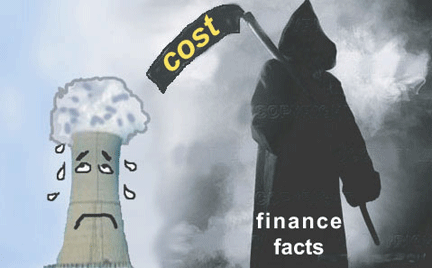
 Contrary to power company figures, cost of nuclear power generation highest: research Mainichi Daily News, 23 July 11 Utility companies across the country continue to tout the low cost of nuclear energy on their websites. Tohoku Electric Power Co. boasts nuclear power’s economic efficiency, while Hokkaido Electric Power Co (HEPCO) the stability of its cost. Each site comes with bar graphs indicating the cost of generating power through various power sources, and the figures are exactly the same regardless of the utility. For every kilowatt-hour of power generated, hydroelectricity is listed as costing 11. 9 yen, petroleum 10.7 yen, liquefied natural gas 6.2 yen, coal 5.7 yen, and nuclear 5.3 yen.
In a section of its website responding to questions sent in by elementary school children, Chubu Electric Power Co. informs us that nuclear power “is the cheapest.” The media, including the Mainichi, have often cited the information provided to us by power companies.
However, Kenichi Oshima, a professor of environmental economics and policy at Ritsumeikan University, has done some calculations and has reached a completely difference conclusion. Oshima says that the cost for a kilowatt-hour of electrical power between fiscal 1970 and fiscal 2007 was 10.68 yen for nuclear, 3.98 yen for hydroelectric, and 9.9 yen for thermal generation, with nuclear-generated power coming out as the most expensive. These calculations were even presented at a meeting of the government’s Atomic Energy Commission last September. So how does one explain these two different conclusions?
First of all, there is a huge gap between estimates given by power companies and figures derived from actual records.
The figure “5.3 yen per kilowatt-hour of power” as the cost of nuclear power generation is an estimate submitted in 2003 by the Federation of Electric Power Companies of Japan (FEPC) to a subcommittee of the Committee for Natural Resources and Energy, an advisory body to the Minister of Economy, Trade and Industry. The estimate presupposed a power plant that began operations in the 2002 fiscal year and would run 40 years with a utilization rate of 80 percent. Construction costs were calculated based on an actual power plant that had recently begun operations, and foreign exchange rates and fuel prices needed to calculate the cost of importing fuel were derived from economic indices at the time. It’s a government-endorsed figure that has continued to give nuclear-power generation the “low cost” seal of approval.It’s a government-endorsed figure that has continued to give nuclear-power generation the “low cost” seal of approval.
Oshima’s calculations, meanwhile, have been based on actual performance figures found in utilities’ corporate financial reports. These reports list various expenditures including labor and fuel costs, as well as depreciation expenses, by power source, which are plugged into a mathematical formula established by the Ministry of Economy, Trade and Industry (METI) and used by power companies to calculate electricity production costs. Dividing source-specific “expenditures” by “actual generated power,” we come up with 8.64 yen, 9.8 yen and 3.88 yen per kilowatt-hour for nuclear, thermal, and hydroelectric power, respectively. Already at this point, the figures differ from the estimates.
Furthermore, in the calculations, Oshima included funds from the national government — in the form of subsidies to local municipalities and other financial assistance — to expenses.
“The public foots the cost of fuel through power bills, but if you trace the financial assistance from the national government back to their source, they’re taxes,” Oshima says. “My calculations looked at how much of the burden of power generation is resting on the shoulders of the public.”
A major pillar of the government’s financial assistance comes in the form of subsidies as stipulated in Japan’s three power source-related laws. According to Oshima’s research, 70 percent of past subsidies given out based on the laws were funneled toward nuclear power projects.
Oshima says that such subsidies, in essence, are all “nuclear power subsidies.” This is how he reached the conclusion that every kilowatt-hour of power generated by nuclear power costs 10.68 yen…….
“If we were to funnel funds earmarked for reprocessing and the nuclear budget, it would be very feasible to get power generation with renewable sources of energy off the ground.”
No comments yet.
1 This Month


10 March A LIVE WEBINAR THE REAL EFFECTS OF NUCLEAR POWER
What the Industry Isn’t Telling Us
1:00 PM Mountain, 2 pm Central, 3 pm Eastern. Live on the Keepers of the Water Facebook page


18 March Webinar @ 1 PM EST: An Assessment of SMR Projects: The Case of Canada
register for the zoom:
https://us02web.zoom.us/webinar/register/WN_o8BIIOUvQ2ONJR1nta65DQ#/registration


of the week – STOP SMALL MODULAR REACTORS IN CANADA
To see nuclear-related stories in greater depth and intensity – go to https://nuclearinformation.wordpress.com
-
Archives
- March 2026 (76)
- February 2026 (268)
- January 2026 (308)
- December 2025 (358)
- November 2025 (359)
- October 2025 (376)
- September 2025 (258)
- August 2025 (319)
- July 2025 (230)
- June 2025 (348)
- May 2025 (261)
- April 2025 (305)
-
Categories
- 1
- 1 NUCLEAR ISSUES
- business and costs
- climate change
- culture and arts
- ENERGY
- environment
- health
- history
- indigenous issues
- Legal
- marketing of nuclear
- media
- opposition to nuclear
- PERSONAL STORIES
- politics
- politics international
- Religion and ethics
- safety
- secrets,lies and civil liberties
- spinbuster
- technology
- Uranium
- wastes
- weapons and war
- Women
- 2 WORLD
- ACTION
- AFRICA
- Atrocities
- AUSTRALIA
- Christina's notes
- Christina's themes
- culture and arts
- Events
- Fuk 2022
- Fuk 2023
- Fukushima 2017
- Fukushima 2018
- fukushima 2019
- Fukushima 2020
- Fukushima 2021
- general
- global warming
- Humour (God we need it)
- Nuclear
- RARE EARTHS
- Reference
- resources – print
- Resources -audiovicual
- Weekly Newsletter
- World
- World Nuclear
- YouTube
-
RSS
Entries RSS
Comments RSS
 nuclear-news
Leave a comment