A nuclear cost chain reaction – explosively expensive
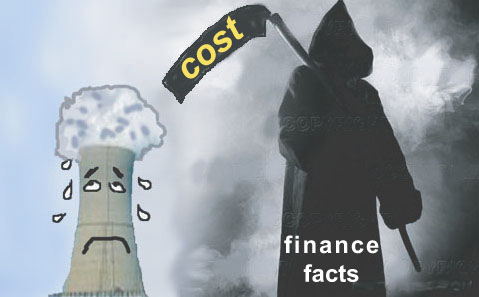 So, the construction of nuclear is stalling and the costs are rising. Contrast that with renewable energy, where installations are surging, and most of the technologies are coming down in price as they mature and reach scale....
Nuclear power’s real chain reaction: spiralling costs, The Guardian (UK) Damian Carrington, 22 July 11, Time is money, they say, and the new nuclear power plant being built byEDF at Flamanville in France is now at least four years behind time and €2.7bn over budget. EDF blamed the delay on two fatal construction accidents and dealing with safety analyses prompted by the Fukushima disaster.
The new delays and bumper cost overruns of EDF’s new reactor in France make it very hard to believe that nuclear power can fulfil the promises its supporters make.
So what does the news mean for the role for nuclear power in delivering the low-carbon electricity essential to tackling climate change? The three ‘Cs’ of energy policy are carbon, cost and continuity of supply, and Wednesday’s announcement by EDF is relevant to the latter two.
The Flamanville fiasco shows once again that new nuclear power plants are not being built on time or on budget, diminishing the arguments in favour of them.
The only other new nuclear plant being built in Europe is at Olkiluoto in Finland. Areva, like EDF a state-controlled French company, told me this will be connected to the grid no sooner than 2013 and costs are now estimated at €5.6bn. That is four years late and €2.6bn over budget.
I wanted to understand better the effect of the delay and ballooning costs at Flamanville 3 on the ultimate cost of the electricity produced, and Jim Watson, professor of energy policy at the university of Sussex, kindly agreed to help.
The UK’s committee on climate change estimates nuclear power as the cheapest low carbon source, but budget busting comparable to that at Flamanville would make it the same, or higher, than wind power.
The details of his working are at the end, but the summary is that the cost per kilowatt hour has jumped between about 33% and 45% in the last few years. Watson notes that the cost is particularly sensitive to delays, as this widens the gap between the heavy capital outlay and the point at which money starts to flow back in.
So, the construction of nuclear is stalling and the costs are rising. Contrast that with renewable energy, where installations are surging, and most of the technologies are coming down in price as they mature and reach scale….
1 Comment »
Leave a comment
1 This Month

of the week – Shut Down Drone Warfare!


Tell the Ukrainian Government to Drop Prosecution of Peace Activist Yurii Sheliazhenko

Petition to revoke the licensing of the Near Surface Nuclear Disposal Facility (NSDF) at Chalk River. https://www.ourcommons.ca/petitions/en/Petition/Details?Petition=e-7247
To see nuclear-related stories in greater depth and intensity – go to https://nuclearinformation.wordpress.com
-
Archives
- March 2026 (230)
- February 2026 (268)
- January 2026 (308)
- December 2025 (358)
- November 2025 (359)
- October 2025 (376)
- September 2025 (257)
- August 2025 (319)
- July 2025 (230)
- June 2025 (348)
- May 2025 (261)
- April 2025 (305)
-
Categories
- 1
- 1 NUCLEAR ISSUES
- business and costs
- climate change
- culture and arts
- ENERGY
- environment
- health
- history
- indigenous issues
- Legal
- marketing of nuclear
- media
- opposition to nuclear
- PERSONAL STORIES
- politics
- politics international
- Religion and ethics
- safety
- secrets,lies and civil liberties
- spinbuster
- technology
- Uranium
- wastes
- weapons and war
- Women
- 2 WORLD
- ACTION
- AFRICA
- Atrocities
- AUSTRALIA
- Christina's notes
- Christina's themes
- culture and arts
- Events
- Fuk 2022
- Fuk 2023
- Fukushima 2017
- Fukushima 2018
- fukushima 2019
- Fukushima 2020
- Fukushima 2021
- general
- global warming
- Humour (God we need it)
- Nuclear
- RARE EARTHS
- Reference
- resources – print
- Resources -audiovicual
- Weekly Newsletter
- World
- World Nuclear
- YouTube
-
RSS
Entries RSS
Comments RSS
 nuclear-news
[…] for four times that amount ‘ about 64%. So to replace fossil fuel generated electricity with Nuclear power would require a five-fold increase in the number of reactors, from 440 to about 2200. Cooling […]
Pingback by Nuclear Power Cost | Wind And Solar | July 29, 2011 |