Decentralised solar energy boom taking off in India
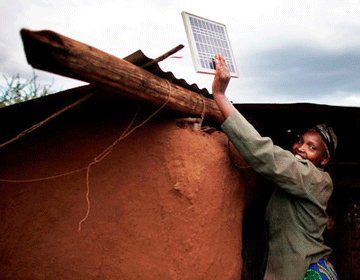 solar technology presents an elegant and immediate solution to powering everything from light bulbs and heaters to water purifiers and pumps…….most new grid capacity will be sucked up by industry, leaving little for the poor who live in off-grid desert outcrops, mountain hamlets and jungle villages like Nada. For them, the surest way to get electricity anytime soon may be to get a solar panel and make it themselves.
 Fuel for solar boom could come from rural India, where thousands give up on grid, buy panels, Washington Post, 2 July 11 “……….Across India, thousands of homes are receiving their first light through small companies and aid programs that are bypassing the central electricity grid to deliver solar panels to the rural poor. Those customers could provide the human energy that advocates of solar power have been looking for to fuel a boom in the next decade.
With 40 percent of India’s rural households lacking electricity and nearly a third of its 30 million agricultural water pumps running on subsidized diesel, “there is a huge market and a lot of potential,” said Santosh Kamath, executive director of consulting firm KPMG in India. “Decentralized solar installations are going to take off in a very big way and will probably be larger than the grid-connected segment.”……
Despite decades of robust economic growth, there are still at least 300 million Indians — a quarter of the 1.2 billion population — who have no access to electricity at home. Some use cow dung for fuel, but they more commonly rely on kerosene, which commands premium black-market prices when government supplies run out.
They scurry during daylight to finish housework and school lessons. They wait for grid connections that often never come.
Buying solar panels is more expensive than grid electricity, but for people off the grid it compares well with other options. One of Selco’s single-panel solar systems goes for about $360, the same or less than a year’s supply of black-market kerosene. And government subsidies mean customers actually pay less than $300.
When people who live day-by-day on wage labor and what they harvest from the land choose solar, they aren’t doing it to conserve fossil fuels, stop climate change or reduce their carbon footprints. To them, solar technology presents an elegant and immediate solution to powering everything from light bulbs and heaters to water purifiers and pumps…….
In two years, India’s government hopes the off-grid solar yield will quadruple to 200 megawatts — enough to power millions of rural Indian homes with modest energy needs…..
What’s predicted for India’s solar market is not unlike the recent explosion in cell phones, as villagers and slum-dwellers alike embraced mobile technology over lumbering landline connections. There is now at least one mobile phone link for every two people in the country.
The government has pushed for manufacturers and entrepreneurs to seize the opportunity. Its solar mission — an 11-year, $19 billion plan of credits, consumer subsidies and industry tax breaks to encourage investment — is fast becoming a centerpiece of its wider goal for renewable sources, including wind and small hydropower, to make up 20 percent of India’s supply by 2020. Solar alone would provide 6 percent — a huge leap, since it makes up less than 1 percent of the 17 gigawatts India gets from renewables alone. The federal government leads a massive campaign titled “Light a Billion Lives” to distribute 200 million solar-powered lanterns to rural homes, while also supporting the creation of so-called “solar cities” with self-contained micro-grids in areas where supply is short……
Another Hindu temple in the southern state of Andhra Pradesh boasts one of the world’s largest solar-powered kitchens, preparing 30,000 meals a day, while western Gujarat state has experimented with a solar crematorium. Even in the Himalayan frontier state of Arunachal Pradesh, where the sunshine is not India’s brightest, Buddhist monks have installed solar panels to heat water at the 330-year Tawang Monastery……..
No comments yet.
1 This Month


10 March A LIVE WEBINAR THE REAL EFFECTS OF NUCLEAR POWER
What the Industry Isn’t Telling Us
1:00 PM Mountain, 2 pm Central, 3 pm Eastern. Live on the Keepers of the Water Facebook page


18 March Webinar @ 1 PM EST: An Assessment of SMR Projects: The Case of Canada
register for the zoom:
https://us02web.zoom.us/webinar/register/WN_o8BIIOUvQ2ONJR1nta65DQ#/registration


of the week – STOP SMALL MODULAR REACTORS IN CANADA
To see nuclear-related stories in greater depth and intensity – go to https://nuclearinformation.wordpress.com
-
Archives
- March 2026 (76)
- February 2026 (268)
- January 2026 (308)
- December 2025 (358)
- November 2025 (359)
- October 2025 (376)
- September 2025 (258)
- August 2025 (319)
- July 2025 (230)
- June 2025 (348)
- May 2025 (261)
- April 2025 (305)
-
Categories
- 1
- 1 NUCLEAR ISSUES
- business and costs
- climate change
- culture and arts
- ENERGY
- environment
- health
- history
- indigenous issues
- Legal
- marketing of nuclear
- media
- opposition to nuclear
- PERSONAL STORIES
- politics
- politics international
- Religion and ethics
- safety
- secrets,lies and civil liberties
- spinbuster
- technology
- Uranium
- wastes
- weapons and war
- Women
- 2 WORLD
- ACTION
- AFRICA
- Atrocities
- AUSTRALIA
- Christina's notes
- Christina's themes
- culture and arts
- Events
- Fuk 2022
- Fuk 2023
- Fukushima 2017
- Fukushima 2018
- fukushima 2019
- Fukushima 2020
- Fukushima 2021
- general
- global warming
- Humour (God we need it)
- Nuclear
- RARE EARTHS
- Reference
- resources – print
- Resources -audiovicual
- Weekly Newsletter
- World
- World Nuclear
- YouTube
-
RSS
Entries RSS
Comments RSS
 nuclear-news
Leave a comment